

& rg way,
awrun LI, I YI
I RE
DETROIT JEWISH NEWS
Purely Commentary
The Fascination of the Passover Story and the
Festival of Freedom's Educational Aspect
Symbolizing the Continuity of Jewish Experience
Passover invites constant referral to freedoms, to libertarian movements, to com-
munal experiences in gaining accord for just rights for the oppressed of all faiths and in
all world spheres.
The Festival of Freedom has an especially major aspect. It is educational, it teaches
conduct. It advises those seated at the Seder table to stand-firm in support of justice, in
opposition to tyranny, and it emphasizes how vital it is to understand the merits of
communication.
The entire Haggada is a communicative routine. Rabbis are introduced in a proce-
dure of discussing many problems and their analyses are directed toward an appreciation
of the goals that lead to freedom.
The entire procedure is impersonal. The Lawgiver Moses is the hero of the festival.
He had led the enslaved Jews out of Egypt and without him there would not have been
an Haggada. The entire Passover theme would have been non-existent. Yet, his name is
not mentioned in the Passover story as it is chanted on the nights of the Sedorim. The
reason? Because Jewish traditions do not create deities and do not glorify individuals -
above the high principles they had advocated. The ideal, the principle, is above its maker.
All mankind is linked with the idealism and no one is above the law or specially privileged
to benefit from it.
Passover's Three Major Symbols:
Pesah, Matza and Marror
The three major factors that symbolize. Passover — Pesah, Matza and Marror — are
depicted on the first page of this issue.
The following are the translations of the Hebrew texts on Page One:
Rabban Gamliel used to say: Whoever does not make mention of three things on
Passover has not fulfilled his duty. They are: the Passover lamb; the unleavened bread;
the bitter herb.
,
The Passover lamb that our fathers used to eat when the Temple was still standing
.what was its reason? Because the Holy One, blessed be He, passed over the houses of our
fathers in Egypt, as it is said: that ye shall say: 'It is the sacrifice of the Lo•d's passover,
for that He passed-over the houses of the children of Israel in Egypt, when He smote, the
Egyptians, and delivered our houses. And the people bowed the head and worshipped.
Lifting the Matza plate the celebrant says: This unleavenedbread that we eat —
what is its reason? BecauSe the dough of our ancestors had not time to become leavened
before the King of Kings, the Holy One, Blessed be He, revealed Himself to them and
redeemed them as it is said: And they baked unleavened cakes of the dough which they
brought- forth out of Egypt, for it was not leavened; because they were -
thrust out of
Egypt, and could not tarry, neither had they prepared for themselves any victual.
-
Lifting the plate of bitter herbs the celebrant says: This bitter herb that we eat —
what is its reason? It is because the Egyptians embittered the - life of our ancestors in
Egypt as it is said: And they made their lives bitter with hard service, in mortar and in
brick, and in all manner of service in the field; in all their service, wherein they made
them serve with rigor.
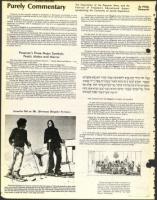
Israelis Ski at Mt. Hermon Despite Syrians
By Philip
Slomovitz
The lessons for mankind in the Haggada and at the Seder are so voluminous that it is
no wonder that traditionally the rabbis sat with the theme until long past midnight.
There was, and there is, so much to debate over in finding solutions for a just world! And
Passover is such an ideal time for it!
Taking into account these fascinations, it is necessary to emphasize the importance of
the festival for youth — what a joy for them to be introduced and reintroduced each year
to the story of redemption, liberty, attainment of self-respect in which their ancestors
were the actors in an historic drama!
For the adult, for the parent, there is even greater glory. Intertwined with it is the
opportunity to teach and to keep the child instructed in the continuity of Jewish existence
and experience. Perhaps the major lesson for Jews in the Passover story is the selection
which admonishes that there is an obligation upon every generation to teach the lesson
of Passover as if each Seder participant were an actor in the original drama: because of
the repetition of historic experience that keeps reminding the Jew of the 20th century that
what happened 3,500 years ago could also happen if the libertarian ideal had not been
attained by the ancestral Israelite libertarians.
The great value of making study, learning, disputes over basic aspects of freedt_-_,
confrontations by the rabbis who play their roles in the Passover story, relate to the great
tradition of a Seder as a family fUnction.
The family is the symbol of Jewish strength, and knowledgeability of the Jewish
historical background is an obligatory factor that links past with the present. That which
is learned from the Haggada is applicable to the present. It has an augury for the future.
It teaches anew what libertarians have been emphasizing endlessly — that no one is free
unless his neighbor enjoys the liberties guaranteed in a free society.
Therefore the Seder, through the Haggada, in its recounting by generation after
generation, has a powerful emphasis on the basic rules for mankind, regardless of race
or faith.
•n"-irvo
• -: • • NY.' win l7, xn in= nxrixn'7 MIX n't1 liii lil 'nn
'rsT:4
nnn ,4
- •• "7 • " nt17 771- 11.7117:2 Iri.n.7 N17177 0"1" ' , 1 .1"I t 2 riT11
,-r.
riX Ii IPX .t.zri irm tt)17;77T L il.z 7:2'7:2 lrr,t.IN rs z.: 77:7i ..t",--)27n
T T
T -
-
T
.
T •••
T
T
- ' . •
-.'
T :
•
T :
•
•
nr1L7 n. rii wnri 11777L7 Clt x9 1'', 12P **1 '17.'.`Nrj inr7 7'7Nr :.rli,i , .
T
•12"11t
V n V1 "17M rin-r171217.
T
• T
T
.
''' - r
This selection from the Haggada is simple, yet powerful:
In each and every generation it is et man's duty to regard himself as
though he went forth out of Egypt, as it is said: And thou shalt telb thy
son in that day, saying: It is because of that which the Lord did for me
when I came forth out of Egypt. Not our fathers only did the Holy One,
Blessed be He, redeem them, but us too He redeemed with them, as it is
said. And He .brought us out from thence, that He might bring us in, to
give us the land which He swore unto our fathers.
Lifting the wine glass the celebrant says:
Therefore, it is our duty to thank, to praise, to glorify, to exalt, to
extol, to bless, and to acclaim Him Who polormed for our fathers and
for us, all these miraculous deeds. He has brought us forth. from bon-
dage to freedom, from sorrow to joy, front mourning to festival, from
darkness to great light and from slavery to redemption. Let us sing
before Him a new song, Hallelujah!
It is irrefutable and it repeats perennially in its admonition for all generations not
to forget the past, to dignify the present as an assurance of a respectful and respected
future.
The glamor of a great festival is interlinked with its lessons, its communicative dis-
courses, the continuity of fascination that stems from historic experiences. That's what
makes it a truly people's celebration with legacies handed down from generation to gener-
ation linking them indestructibly into a peoplehood of proud lineage.
These Israeli skiers have more to watch for than the Aspen or Vail-type hazards as they make
their way down Mt. Hermon. The danger is in the form of Syrian artillery units on careful watch.
Israelis have been skiing on Mt. Hermon since the 1967-1968 season. Despite initial lack of ameni-
ties, the Mt. Hermon facility has erected a ski-lift and a resort village called Neve Ativ. Plans are
being made to 'make the resort a year long attraction.
Perpetuating the Seder tradition of
passing on the Passover story from gener-
ation to genera tion: Scene of Seder in
Trieste in 1864, reproduced from the Jew-
ish Pit blication, Society's fascinating
work, "Haggada and History" by Yosef
Hayim Yerushalmi.
•
1 •,11•