
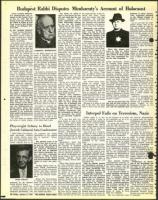

Budapest Rabbi Disputes Mindszenty's Account of Holocaust
Jozsef Cardinal Mindszen-
ty's autobrography was re-
viewed in The Jewish News
of Nov. 29, 19'74. The fol-
lowing review was written by
Dr. Albert B. Belton of New
York, formerly Bela Berend,
rabbi of the Budapest Ghet-
to in 1974.
By DR. ALBERT BELTON
"Jozsef Cardinal Mindszen-
ty: Memoirs" published by
Macmillan reveals a giant of
a man, a giant of a church
leader: firm, zealous, tough-
minded, unyielding.
His ordeal in the hands of
the political police may have
broken his body and spirit
temporarily for the four day
trial in February 1949, but
even in prison, he soon over-
came that, he revived his
spirit and fast became his
old tough self again. Neither
- the seven years imprison-
ment, nor the additional 16
years isolation in political
asylum at the American Em-
bassy in Budapest could
change that.
Memoirs of any public fig-
ure usually present the writ-
er's own personal reminis-
cences of significant events
in his own private life and
more so those that took place
in the world at large. We find
the 341 page Memoirs want-
ing, unbalanced, dispropor-
tionate and incomplete due
to deliberate omissions.
For instance, he described
his ministry for 27 years to
the parish in Zalaegerszeg
(1917-1944) in various capac-
ities and also enumerates the
wrong doings of the short
lived Communist regime of
Bela Kun, but he fails to
make mention of the intern-
ment camp right there in his
own city (Zalaegerszegi In-
ternalo Tabor) where, after
the collapse of the first dic-
tatorship of the proletariat,
leftist political prisoners were
held, beaten and tortured for
many years.
He also failed to mention
the series of violent crimes,
CARDINAL MINDSZENTY
of the White Terror in the
years of 1919-1925, the po-
groms of Siofok and Orgo-
vany, the murder of leftist
journalists Somogyi and Bac-
so, the tortures, mutilations
and murders by the Special
Military Units, commanded
by Ivan Hejjas and George
Pronay.
He failed to enumerate the
many restrictive and oppres-
sive measures that had been
put into effect against the
Jews in the 1920s, largely at
the demand and initiative of
his own Kereszteny Part, the
Christian Party, such as the
Numerus Clausus (restricting
the number of Jews who
may attend Secondary Schools
and Universities), the Num-
erus Nullus (no Jew could
get a job in any branch of
the Government, no Jew may
own Tobacco Shop, or Liquor
Shop, no Jew may ever
reach the rank of officer in
the Army) and so on and on.
He failed to mention the
atrocities of the Rongyos
Garda (Hejjas Unit) and the
beatings, the Ebredo Magya-
rok and the Turul Federation
administered to Jews at the
Universities, as well as any
place if a Jew just happened
to be within their reach.
Playwright Schary to Head
Jewish Cultural Arts Conference
NEW YORK—Dore Schary,
noted playwright, producer
and motion picture execu-
tive, has been named chair-
man of a Conference on the
Jewish Cultural Arts to be
DORE SCHARY
sponsored by the National
Jewish Welfare Board.
According to Daniel Rose,
the conference will be a ma-
jor Jewish celebration of the
American Bicentennial. "We
will celebrate the Jewish
contribution to the cultural
life of America," Schary
said.
The national event, to be
held in New York in the lat-
ter part of 1975, will spark
local Jewish celebrations of
the American Bicentennial
and will seek to stimulate
local Jewish community cen-
ters and other community
agencies to build on their
.achievements in the cultural
arts and to strengthen Jewish
culture in every way possi-
ble.
Leading figures from na-
tional Jewish organizations
and local Jewish community
centers and other agencies
are on the planning commit-
tee for the Cultural Confer-
ence.
Schary was - Commissioner
of Cultural Affairs of New
York City in Mayor John
Lindsay's administration. He
is the author of 40 screen-
plays, including the Academy
Award-winning "Boys Town"
and "Edison the Man."
48 Friday, January 3, 1975 THE DETROIT JEWISH NEWS
—
And finally he failed to
make a clean breast for him-
self, and admit that his own
sermons, lectures, state-
ments, publications were of
rather anti-Semitic coloring,
as was his 1919 booklet
"Watch Out for the Press."
Having come into contact
with democracies, I do not
say that he is an anti-Semite
today, but he was no friend,
let alone protector of the
Jews in those days.
Everyone knows that 1944
was a fateful and disastrous
year for Hungary. Invaded
by the Nazis, it was made a
combat zone for the giant
armies of Europe, and it
brought deprivation, forced
labor, imprisonment, torture,
deportation and whole-sale
slaughter for its citizens of
the Jewish faith.
Of course, we understand
that the major part of his
Memoirs should deal with his
case. After all, the world is
anxious to hear his side of
the story. But to reduce to a
two-line mention in passing
the destruction of his fellow
countrymen of the Jewish
faith is not only gravely out-
of-proportion, but it also
shows his rather impassive
attitude towards this catas-
trophy.
On top of it, his brief ac-
count is full of errors. The
Pastoral Letter was never
read in the Churches, be-
cause the Sztojay govern-
ment begged it off, and Car-
dinal Seredi relented.
Instead, brief announce-
ments were read both from
the pulpits as well as on the
radio on July 8 and 9, 1944
(after all Jews outside the
capital city of Budapest had
already been deported) stat-
ing that the Conference of
Bishops and the Cardinal
continued negotiations with
the government on behalf of
the persecuted, but mainly
for the converted (baptized)
Jews.
It is true that both Car-
dinal Seredi as well as the
Papal Nuncio, Angelo Rotta
and the Conference of Bish-
ops submitted petitions to the
Government more than once,
but to no avail: the round-up,
tortures, deportations con-
tinued. This frustration an-
gered Cardinal Seredi to such
extent that after Oct. 16, 1944
he flatly refused even to try
again.
Mindszenty's claim that
Catholic intervention saved
the majority of Budapest
Jews from the gas-chambers
is simply untrue, especially in
view of the forced marches,
and the wholesale murder on
the streets of Budapest dur-
ing the reign of terror by the
devoutly Catholic Arrow-
Cross Fuehrer, Ferenc Szal-
asi.
Many other factors played
far more important roles in
the survival of the remnant
of Hungarian Jews, such as
the Baky-Putsch, the force-
ful protest of the neutral
cvountries, the presence of
the representative of the
Swedish King, the dire re-
taliatory threats of the Al-
lied Powers, Radio Kossuth
from the USSR, Admiral Hor-
thy's own personal reluctance
to remain an accomplice in
the continued genocide, Ro-
mania's abrupt desertion of
the Axis and its joining the
Allies in combat against the
Nazis, and last but not least
the rapid advance of the vic-
torious Red Army. These
were the factors that kept
postponing, and eventually
cancelled out the well plan-
ned, prepared and scheduled
total evacuation and deporta-
tion of Jews from Budapest.
Mindszenty's sole contribu-
tion towards "Saving the
Jews" was that he did not
withhold his signature from
the collective protests of the
Bishops when Cardinal Sere-
di asked him to sign them.
Mindszenty claims credit
to the Catholics for the sur-
vival of the Jewish remnant
in Hungary, but he fails to
mention Father Andras Kun,
the faithful follower of the
"devoutly Catholic" chief of
state, Szalasi, who personally
tortured and murdered hun-
dreds of Jews in the winter
of 1944 in the besieged city
of Budapest. After the War,
,Kun was arrested, tried, con-
victed, sentenced and exe-
cuted for his terrible crimes.
Mindszenty says: "In June
.1944, ignoring the Bishops'
Protest, the Arrow - Cross
men, on Hitler's orders car-
ried off from Veszprem both
the baptized and unbaptized
Jews."
The Arrow - Cross Party,
headed by Szalasi, were
placed in power by the Na-
zis four months later, Oct.
16, 1944, therefore pinning
the June '44 deportation on
them is incorrect, and also
contradicts Mindszenty's own,
earlier statement that it was
the Sztojay government
which ordered and carried
out the deportations.
Blaming it on Hitler is just
half of the truth. The whole
truth is that it was the Hun-
hundreds of edicts, decrees,
rules, regulations published
in the Official Gazette of
Hungary, ordering these ac-
tions.
Let us just take the confi-
dential decree, sent to the
Province chiefs on April 7,
1944, which begins with the
following words: "The Royal
Hungarian government decid-
ed to rid the country of the
Jews . . . " Mindzenty, as a
Hungarian noble man, and as
Prince-primate of Hun - v
may wish to absolve his
trymen of the horrible cr. e
of genocide, and therefore he
attempts to place the blame
elsewhere.
In all the 341 pages of the
Memoirs, Mindszenty never
claims of having personally
aided, helped, saved, or res-
cued a single Jewish family
ever.
Having read through the
book, studied the documents
and the photos, we can't help
but express our sympathy
and sorrow, as well as admir-
ation for the fortitude of this
Man of God. Courage, hero-
ism, bravery, suffering,
martyrdom a n d unyielding
firmness all the way.
But was it necessary? Was
anyone helped by it? With all
his suffering Mindszenty could
not stop the process of so-
cialization that came upon
Hungary as the direct conse-
quences of Yalta and Pots-
dam. No single person, not
even a whole country can
change that.
Instead of salvaging what-
e v e r was salvageable, he
chose to fight — alone! The
outcome was a foregone con-
clusion. Luckily, of t h e
Hungarian Bishops, no one
else followed him.
10
When this picture was
taken in 1944, Dr. Belton
was chief rabbi of the Bud-
apest ghetto in which 75,000
Jews were imprisoned dur-
ing the Nazi occupation.
garian government, headed
by Premier Dome Sztojay
who condemned the Jews to
deportation and destruction
and placed the Ministry of
Interior headed by Andor
Jaross in charge of it. The
round-up, beatings, torture,
ghettoization and deportation,
the whole bloody mess was
purely and solely a Hungar-
ian operation. Hungarian po-
lice, Hungarian gendarmerie
Csendorok, Hungarian units,
Hungarian agents, Hungarian
government officials at all
levels of the administration,
the majority of whom be-
longed to Mindzenty's Roman
Catholic Church, carried out
the task with unprecedented,
barbaric cruelty.
And we can prove this. Not
just with the trial records of
Hungarian war criminals, but
also with the hundreds upon
Interpol Fails on Terrorism, Nazis
British author S. A. Bar-
ram is writing a book on
international Arab terrorists.
Portions of a chapter dealing
with Interpol, the interna-
tional police agency, and its
lack of effort in combating
terrorism, appear here:
The arrest of a murderer,
swindler or even a pimp as
the result of information re-
layed by Interpol is usually
trumpeted broadly by the or-
ganization to the world's
press.
But when it comes to inter-
national terrorism, Interpol—
with the air of a first year
college student—restricts its
activity to the study of coun-
ter methods, although the or-
ganization's financial, techni-
cal and manpower resources
could well enable them to
play an active, decisive and
successful role.
Such an attitude towards
the international terrorist is
contrary to the Interpol Char.
ter, which specifically calls
for the widest possible mu-
tual assistance between all
criminal police authorities.
Indeed, the spate of armed
hijacks led to an embarass-
ing moment for Interpol in
1970, when the organization
was pressed for action to
counter the escalation of this
20th Century form of piracy.
Interpol's General Assem-
bly passed a resolution on hi-
jacking which was basically
no more than lip service be-
ing paid following discussion
by 29 members of an Inter-
pol committee set up to in-
vestigate the problem.
So secret and confidential
were the talks that not even
Interpol's own magazine, the
International Criminal Police
Review published what hap-
pened—and the Review has a
circulation that is both re-
stricted and confidential!
As can be seen from the
above, Interpol obviously had
no firm intention of taking
an active role in combatting
international terrorism. It
hides behind an escape clause
in its constitution: Article 3
states, "It is strictly forbid
den for the organization to
undertake any intervention or
activities of a political, mili-
tary, religious or racial char-
acter."
Thus, Interpol classifies
internationalist terrorism as
politically motivated, and, as
the record shows, has not
been too concerned with the
combatting of hijacking.
If the Interpol attitude to-
wards hijacking and interna-
tional terrorism is vague,
there is ambiguity when it
comes to tracing, arresting
and investigating Nazi and
Fascist criminals—perpetra-
tors of crimes against peace
and humanity. For here, In-
terpol simply refuses coop-
eration with other police
forces in trying to track
down war criminals.
This was illustrated when
the German Administration
of Justice—after the capture
of Eichmann—temporarily in-
tensified its efforts to track
down Nazi criminals. When
they turned to Interpol, they
were refused co-operation on
grounds of Article 3.
In 1961, the Executive of
the World Jewish Congress
engaged in a world wide cam-
paign to change Interpol's
policy, and the Executive
submitted a protest to the
Interpol General Assembly
meeting in Copenhagen. In-
terpol refused to budge.
This interpretation of Arti-
cle 3 is a violation of the Or-
ganization's own Constitution,
which incorporates tl. '-
versal Declaration of H
Rights, adopted by tho
eral Assembly of the
Nations.
Furthermore, its 'Resolu-
tion of the Extradition and
Punishment of War Crimin-
al's, Feb. 13, 1946, was rec-
ommended by the general as-
sembly to members and non-
members; the resolution cov-
ered extradition of war crim-
inals back to countries where
they had committee crimes,
for the purpose of 'trial and
punishment' according to the
laws of these countries.
Today Interpol is an expen-
sive, failing anachronism that
while away precious time
and resources—while the in-
ternational terrorist groups
become more and more high-
ly organized.