

71 7 w.
4.
▪
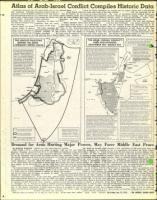
Atlas of Arab-Israel Conflict Compiles Historic Data
Graphically portrayed, not-
ably_ annotated, containing
impressive records of Middle
East developments during the
past 50 years, "Atlas of Arab-
Israel Conflict" (Macmillan)
provides data covering the
vast field of emerging strug-
gles in that area.
Martin Gilbert, the British
historian, Fellow of Merton
College, Oxford, compiled the
material and the hundreds of
quotations that appear on the
101. maps which serve as an
impressive record of the ex-
periences of the half-century
of controversies and battles
that marked the Zionist and
Israeli endeavors.
Exerhplary. are these- two
quotations from the many
that appear on the maps:
"We Arabs, especially the
educated among us, look with
deepest sympathy on the
Zionist movement . . . We
will wish the Jews a hearty
welcome home . . ."
—Emir Feisal (1919)
"For the Syrians, the oc-
cupied territories means not
only the Golan Heights, but
Jerusalem, and even Tel
Aviv."
—Henry Kissinger (1974)
The eighth volume in Mac-
millan's History Atlas Series,
"Atlas of the Arab-Israel"
Conflict" touches, in the de-
scriptive maps and annota-
tions, upon all aspects' of the
Middle East situation. It
traces the Zionist ideologies,
the issues that arose in the
course of Jewish settlements
in Palestine, the immigration,
refugee and other problems.
Effective in so many ways,
this atlas nevertheless misses
many points of value.
It is noteworthy, as indi-
cated, that the Emir Feisal's
statement to Dr. Chaim Weiz-
mann in 1919, received prop-
er recognition in this valu-
able work. Other similar de-
clarations are included. Some
are missing and are regret-
tably omitted.
The vows of Presidents
Woodrow Wilson, Warren G.
Harding, Harry S. Truman
and the more recent heads of
the U.S. government should
not have been overlooked.
But the material utilized
does serve a purpose in pro-
viding an understanding of
the grave after effects of the
Arab opposition to Zionism.
The periods covered in this
volume include: The earliest
Sidon
0
I
THE JEWS OF PALESTINE
BEFORE THE ARAB
CONQUEST 1000 BC-636 AD
For more than one thousand six
hundred yearS the Jews formed
the main settled population of
Palestine. Although often conqu
ered - by Assyrians, Babyloni-
ans, Persians, Greeks, Egyptians
and Romans - they remained
until the Roman conquest the
predominant people of the land,
with long periods of complete
independence. During the six
centuries that followed the
Roman conquest, some Jews
still remained in Palestine, mostly
near Safed, Tiberias, Hebron and
Jerusalem, the four 'Holy Cities'•
of Judaism
10
20
Miles
Acre
Haifa
The war is not over yet We must admit that
our territory has not yet been liberated and
we have another fight before us for which
we must prepare. GENERAL GAMASSY, EGYPT
THE AR,6413- ISRAELI CONFLICT:
AIMS AND OPINIONS
NOVEMBER 1973- MARCH 1974
On 2 February 1974 the Egyptians announced that they had
begun work to open the Suez Canal. But simultaneously
with the disengagement of the Egyptian and Israeli forces
in Sinai, the Syrians began to bombard Israeli military
positions and civilian settlements on the Golan heights.
On 3 February 1974 the Syrian Foreign Minister, A .H.
Khaddam, announced that Syria was carrying out
' continued and real war of attrition... keeping Israel's
reserves on active duty and paralysing its economy'.
Throughout March 1974 the Syrians insisted that there
could be no negotiations with Israel until Israel withdrew
completely from the Golan Heights. On 31 March it was
stated in Washington that a 'foreign legion' ser ving inside
Syria included units from Kuwait, Morocco and Saudi
Arabia, as well as North Korean pilots and a Cuban
armoured brigade with over 100 tanks
Jaffa
CHIEF OF STAFF, 4 MAP,
Beirut
°
MINISTER GROMYKO AND SYRIAN'
PRESIDENT ASSAD, JOINT STATEMENT
7 MARCH 1974
•
• Damascus
".• Kuneitra
SYRIA
•
The Golan
Heights
e
ct-
JORDAN
• Amman
Jerusa lem
Port
Said
The Soviet Union and Syria re-'
affirm that the establishment of a
durable and just peace cannot be
achieved in the Middle East
unless Israel withdraws from all
occupied territories, and the legi-
timate rights of the Palestinians
are restored SOVIET FOREIGN
Ozi
Netanya
Tel Aviv
Mediterranean Sea
history back to 1000 BCE-683
CE, the aspirations for the
Jewish National Home com-
mencing with the Balfour
Declaration, Israel's state-
hood and the wars.
The first map introduces
the subject historically, and
the concluding one is de-
scriptive of the events dated
until March of 1974. They
portray effectively the his-
tory and developments of the
conflict in these two repro-
duced maps.
SAUDI
ARABIA
Dead
Sea
•
- Beersheba
Suez Canal •
Ashkelon
•
Cairc
v
•
•
a cur:wed by Israel: forcesm
June 1967 _
N
Suez
late''
El Arish
•— The 1949 cease- fire lines
(israe •s borders 1949 - 1967)
Negey 1
.
; The front lines at the ceaseti:e
of October 1973
1
I
Akaba
The zone of disengagement in
Sinai, March 1974
EGYPT
Palestine is not only part of the Arab homeland but
also a basic part of South Syria We consider it our
right and duty to insist that Palestine should remain a
free part of our Arab homeland and of our Arab Syrian
country PRESIDENT ASSAD OF SYRIA. 9 MARCH 1974
• .
Sharm el-
Sheikh
Sina
—
J
El
We stick to our stand that Israel should withdraw from
all Arab territories she occupied since June 1967• and
say that there can be no peace in this area without
complete withdrawal We also steed not say that Arab
Jerusalem, that precious jewel on the forehead of this
homeland, will never and under no circumstances
come under any sovereignty other than absolute
Arab sovereignty KING HUSSEIN OF JORDAN. 2 DEC 1973
i
Principal centres of the Jewish
Revolt against Roman rule, 66 -
73 AD (In 70 AD the Romans
captured Jerusalem. destroyed
theTemple and the city. and took
many Jews as captives to Rome)
Area of earliest Jewish settle-
ment ( the 12 tribes of Israel)
The Jewish kingdom at the
time of Solomon ( 1000 BC)
73 The boundaries of the Hasmonean
- Jewish kingdom, 165-63 BC
•
Present day towns (for reference)
I am not for staying 20 kilometres from the Canal
I do not see in Abu Rude's. and in oil, the hnal security
line for Israel - although there is oilthe.re - because it
means also control of the Suez Canal I can see
the reasons for wanting control en the Gulf of E lat.
but I cannot think we will have peace with Egypt while
we control not only the entrance to EllaPbut also
the entrance to Suez
M DAYAN. ISRAELI DEFENCE MINISTER, 10 MARCH 1974
For the Syrians. the occupied ti.witories means not only
the Golan Heights. but Jerusaten;. and even Tei Aviv
we will not descend from the Golan. we will not-
partition Jerusalem, we will not return Sharm el -
Sheikh, and we will not agree that the distance
between Netanya and the border shall be 18 A ilo. -
metres But if we want a Jewish State we have to
be prepared to compromise on territory -
U S SECRETARY OF STATE. HENRY KISSINGER. 11 MARCH 1974
the tali, in Israel about a o'emilitalized Sinai should
stop If they want a d•rnilitanzed Sinai. I shall be.
asiking fora CA.V7IrtitarrZed Isr ael PRESIDENT SADAT OF
EGYPT. - TIME MAGAZINE. 25 MARCH 19 74
GOLDA MEIR. ISRAELI PRIME MINISTER. 29 DEC 1973
•
© Marlin Gilbert
© Martin Gitbert
Demand for Arnis Hurting Major Powers, May Force Middle East Peace
By MURRAY ZUCKOFF -
NEW YORK ( J T A) —
Egyptian President s Anwar
Sadat may have let the cat
out of the diplomatic bag,
and, thereby, placed into pub-
lic domain the policy of
"quiet diplomacy" pursued
by the United States and, to
some degree, by the Soviet
Union.
The voluble Egyptian lead-
er warned that the Mideast
is a bomb ready to explode
and that this bomb must be
defused by continuing the
momentum of the progress of
peace either through step-by-
siep negotiations as proposed
by Secretary of State Henry
A. Kissinger, or, if that
doesn't work, by the resump-
tion of the Geneva peace
talks as favored by .the Soviet
Union.
With this either or strategy
Egypt was very likely float-
ing a trial balloon on behalf
of both the U. S. and USSR
for a joint superpower effect
to settle the Mideast conflict
and get the Israeli-Arab im-
passe off dead center.
There have been strong in-
dications in recent weeks by
the U.S. and the USSR that
neither power can continue to
go it alone in the Mideast and
that neither country is in a
position to continue for much
longer as patrons of client
states.
At the same time, neither
the U.S. nor the USSR can
afford, at this time, to write
off their respective clients
nor to permit a situation to
develop whereby one or the
other is totally frozen out of
the Mideast scene. But
neither sup2rpower con say
so, or does not want to say
so, publicly.
Both the U.S. and USSR
are beginning to cringe under
the continuing pressure of
their respective clients' de-
mands for ongoing supply of
arms, and spare parts. Efforts
to limit the production of
strategic arms also is putting
a dent into what the Soviet
Union and the United States
can supply their Mideast
clients in the way of sophisti-
cated weapons.
The merry-go-round of sup-
plying arms to the Arabs and
Israelis continues because
neither superpower wants to
offend its respective clients
at a time when both are seek-
ing to establish firm footholds
in the Mideast and neither
are in a position to limit or
halt each other's supply of
arms.
At the same time, neither
the Arabs . nor Israelis relish
the prospects of eventually
being reduced to "vassal
states" by their respective
patrons by sheer necessity of
depending on them to supply
the arms or assure peace.
Such a development would
destroy the viability of tall
the Mideast nations as sover-
eign and independent states.
At the moment, however,
progress in negotiations de-
pends in large measure on
what the U.S. and the 'USSR
can do either together or
separately to cool tempers on
both sides. Of all thet Arab
states, Egypt is most anxious
to achieve a settlement, if
only to retrieve some land
from Israel, including the
Abu Rodeis oil field and to
embark on some kind of in-
ternal economic stabilization.
Egypt would, therefore.
welcome a joint undertaking
by the two superpowers in
helping to get the next stage
of negotiations going. In this
respect, Egypt may be the
catalytic agent in bringing
the t w o superpowers to-
gether, or at least provide
them with the necessary pub-
lic rationalization for an
agreement to be co-equals in
the next stage of peace talks.
The coin of step-by-step
negotiations and Geneva talks
has been flipped diplomatci-
ally in recent weeks during
talks between President Ford
and Soviet Communist Party
Secretary Leonid I. Brezh-
nev, French President Valery
Giscard d'Estaing and Brezh-
nev, and, President Ford and
Giscard d'Estaing.
Even Israelis are beginning
to talk more openly about un-
freezing the Soviet Union's
role in future Mideast talks,
now frozen by Kissinger's ap-
proach. On Dec. 3, Israeli
Foreign Minister Yigal Allan
reiterated that Israel
is
pared - to resume di4
id
relations with the USS
noted that Soviet officials are
aware of this.
What was significant about
Sadat's statement,
an interview with
with Iranian
publisher, Farhad Massoudi,
was that the step-by-step ap-
proach was given priority
with Geneva talks to follow
if the first approach failed.
Also of significance was its
timing: Brezhnev is due in
Cairo early next month and
Allon is due to return to
Washington at the same time,
48—Friday, Dec. 27, 1974
THE DETROIT JEWISH NEWS