
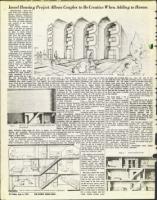

Israel Housing Project Allows Couples to Be Creative When Adding to Homes
JERUSALEM — When Yit-
zhak Rabin first offered the
finance ministry portfolio to
Housing Minister Yehoshua
Rabinowitz the latter refused
the offer, claiming that he
was fired up about housing
and wanted to get things
moving there.
The housing ministry is
about to go into an experi-
mental project, the first of
its kind, to which former
minister of housing, Ra•ino-
witz gave the green light.
Now it is up to the new min-
ister of housing, Avraham
Offer, to continue in the same
spirit and accelerate the im-
plementation of the project,
which came into being back
in the days of Housing Min-
ister Sharef.
The project consists of the
construction of a residential
neighborhood for 48 couples
in Or-Yehuda, outside Tel
Aviv, in original dwellings
reminiscent of the "Raby-
Grown" model: a dwelling
built in stages, in height, ac-
cording to the dwellers'
needs and with their active
participation.
The homes in this neigh-
borhood are built around a
court, rhomboid shaped,
which serves also as a gar-
din and playground. The
buildings are Y-shaped and
combined they form vacant
space. Each house resembles
a frame, three stories high
with only the first floor com-
Stage 1 -
fr.
c
Overall appearance of some of the houses being built in Or-Yehuda.
the first stage 40 square
meters (.8361 sq. m.-1 sq.
yd.) will suffice; two years
later, with the-birth of their
first child,- the need for ex-
pansion will arise, and it will
One level, with living room, bedrocitii; kitchen, and
conveniences.
plete: bedroom, living room,
kitchen and amenities; The
rest of the construction, in
height, is done later.
The guiding principle here
is that a newlywed young
couple does not require a
large two-bedroom home. In
be done, in height, by the
occupant himself and accord-
ing to his choice, from a var-
iety of possibilities made
available to him by the hous-
ing ministry.
- The inclination to draw the
occupant into the building
plan is derived from the
awareness of psychological
demands whch have hereto-
fore been ignored; the hous-
ing ministry clients have
been complaining about the
lack of variety in the lic;mes
it builds. In fact, a survey
conducted by the ministry
shows that 70 per cent of the
800,000 homes which it had
built, underwent interior al-
terations after their transfer
to their occupants. -
Architect Yisrael Gudowitz,
who is in charge of rural
planning in the housing min-
istry, initiated and is • now
executing the experimental
project in Or-Yehuda.
The conventional homes
which the couples have been
receiving from the housing
ministry do not provide the
occtipants with an opportun-
ity to express themselves in
home- building. At the con-
gress of architects and en-
gineers held in Israel last
year, the professionals
stressed the need for tenant
involvement.
Gudowitz also had a word
of criticism to say about the
homes built by the ministry
for young couples, primarily
because the dwelling given
-
One of a variety of possibilities for internal division of apartment.
52—Friday, Sept. 6, 1974
THE DETROIT JEWISH NEWS
them is "too large for their
present needs, and, in all
likelihood, too small for the
future." This bothered him,
and he began looking for
solutions. While visiting the
famous Dutch architect, Aldo
van Eyck, he saw that the
latter had - built his home at
a width of 2.70 meters but
high. He had divided the in-
terior of the house into five
levels. "My first reaction
was — why not in Israel?"
Gudowitz admits, "And I felt
that here was the solution - to
the housing •inistry's burn-
ing problem."
On his return, Gudowitz
prepared plans and a model,
and tried to interest people
in his scheme, but for the
most part, the reaction was
that the plan was not fea-
sible. But anyone acquainted
with the dynamism ,and per-
severance of the young ar-
chitect, _who brought the
ministry an international
award for rural planning, for
his work in Hazba and Ker-
em Shalom, knows that he
does not give up very read-
ily. His chance tame in the
exhibition -held on the occas-
ion of Israel's 25th anniver-
sary. 4n the ministry's pav-
ilion he set up a model of
the "envelope home" for the
young couple, in order to ob-
tain the opinion of the public
about the ministry's plan.
The opinion was favorable.
Of the 1,000,000 visitors to the
pavilion, 300,000 received
questionnaires, and all the
replies were positive. "The
ministry could not oppose
this vox populi," says Gudo-
witz. And thus will brick and
concrete make his plan come
true in Or-Yehuda.
The home which the young
couple receives is planned
in three wages, to conform
with its age and need's. The
first stage is the first level
on the 40 sq.m. space, and it
contains a living room, bed-
room', amenities and kitchen.
The second stage is intended
for a young couple and one
child; should another room
be needed, the occupant him-
self adds the room, since the
preparations for all three
stages were made when the
exterior "envelope" was built
— pipes and sanitary installa-
tions and electrical outlets,
so tha ► all the occupant has
to do is buy items available
on the market.
The third stage — for a
couple with children — af-
fords a• variety of possibili-
ties never before available
in any housing project. It is
possible to expand everyday
living areas, that is, to en-
large the living room on the
first floor,.to build a dining
room and add others. To top
the three stages, there' is a
fourth, for a couple with ad-
olescent children, an attic-
type accommodation which
can be used as a. workroom,
a hobby den, a guest room,
or as another children's bed-
roo m.
This plan has many advan-
tages, for the occupant and
the housing ministry. The oc-
cupant does not require a
building permit from the ur-
ban building commissions or
approval by some condomin-
ium apartment committee,
should he wish to add on to
his house, since all additions
take place inside the dwell-
Stage 4 —
ing. Also, the cost of the
dwelling will be much lower
—about IL 50,000 , (about $12,-
000) compared with the
IL 74,000 (about $18,000) a
70 sq.m. home now costs the
couple. The savings is affect-
ed by the less expensive
mode of construction (by the
use of uniform elements) and
even more by the savings in
building time.
The experiment, due to run
its course, in nine months,
will take in 48 families select.
ed from among young couples
registered for housing. They
have been briefed as to what
they may expect, and the
housing ministry will be
working with them for the
next six years, offering them
advice and.gaidance in com-
pleting the dwellings.
The housing •ministry will
provide the new neighbor-
hood with a variety of ser-
vices, such as a joint laundry
r o o in with coin-operated
laundromats and a trash
room with a central- shredd-
ing machine. The occupants
will receive facilities for soc-
ial activities, such as a room
for the area committee and
a court for garden and play-
ground.
(Translated from Yediot
Ahronot.)
Three completed levels.