
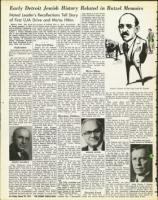

Early Detroit Jewish History Related in Butzel Memoirs
Noted Leader's Recollections Tell Story
of First UJA Drive and Mo'os Hitim
Editor's Note: The Fred
M. Butzel memoirs, as dict-
ated to William I. Boxerman,
prominent social service ex-
ecutive, a former Detroiter
who is now associated with
the Jewish Welfare Fund in
Los Angeles, continues here
with accounts of important
Jewish community projects
that were introduced in the
early 1920s and thereafter.
the purpose of holding title
to the various pieces of prop-
erty owned in the commu-
nity. These organizations, to-
gether with the United He-
brew Schools, the Fresh Air
Society and the Hebrew Free
Loan Association, constituted
the Jewish Welfare Federa-
tion.
Federation
Under Waldman's direc-
tion, the relief work was or-
ganized into a se'parate
society known as the Jewish
Social Service Bureau; the
recreational work was turn-
ed over to the Jewish Centers
Association; the clinic was
moved out to Holbrook Ave.
and became the North End
Clinic. It was run for a time
by the Fresh Air Society but
finally split off into an inde-
pendent organization.
The original UJC was kept
alive, and its ex-presidents
constituted its board only for
Support for the Hebrew
Schools and for our various
overseas and national or-
ganizations was undertaken
in an annual drive called the
United Jewish Appeal. The
organizations which had been
in the Community Fund re-
mained there.
In our first UJA drive, we
had invited the Palestine Ap.
peal to join, but it found so
much resistance on the part
of the community, that, upon
request, the Palestine Appeal
graciously withdrew but
easily raised its objective.
Within several years it was
taken into the drive without
any opposition.
From the beginning, Wald-
man was very anxious to
have a 100 per cent federa-
tion and was ready to make
almost any compromise.
In this respect, his succes-
sors, Dr. John Slawson and
Kurt Peiser, agreed with
him. I assented to the various
inclusions very reluctantly,
and I have always thought
that we paid too high a price
for what might possibly be
illusory unity.
The Detroit Hebrew Or-
phan Home had some money
which it had gotten in the
course of several lucky real
estate trades. They were
very eager to erect a large
building on their property at
Davison and Lawton, where
they owned a lot next to the
Jewish Old Folks Home.
Waldman kept begging
them to put off their building
until more information and
data were available. Either
he or Slawson induced the
two children's homes to en-
ter a Jewish Child Care
Council, of which the Feder-
ation and the Jewish Social
Service Bureau formed the
other two members.
At the meetings of the
council, various problems of
policy were discussed, and
at least an attempt was
made to evolve a community
program for children.
The two children's homes
consolidated when the worn-
en's board resigned and con-
veyed to the other group its
property and its obligations.
In the meantime, the Jew-
ish Social Service Bureau
had been having a great deal
of internal difficulty in its
management. In order to re-
lieve the burdens on its di-
rector, the children living
away from their homes were
put under care of a new or-
ganization known as the Jew-
ish Child Placement Bureau,
of which Mrs. Edith Berco-
vich was the director.
The two children's homes
were induced, even before
they merged, to accept her
56—Friday, March 29, 1974
THE DETROIT JEWISH NEWS
When Blanche Hart had fin-
ished 20 years of service, we
gave her a celebration and a
purse.
She had felt for a long
time that she was not equal
to all the tasks involved in
the conduct of the United
Jewish Charities. She had
urged that a survey be made
and that we should bring to
Detroit someone comparable
to the heads of the various
federations in the country.
Leopold Wineman had pro-
vided a bequest in his will to
the UJC. With the consent
of the family and at the sug-
gestion of Jacob Billikopf,
who had come to Detroit for
the Hart anniversary cele-
bration, we ordered a survey
of the entire situation in 1924
from Samuel Goldsmith, who
was then head of the Bureau
of Jewish Social Research.
The medical, relief, recre-
ational and educational
phases of Detroit were quite
thoroughly covered. Some of
the work was very well done
and some of it I thought
wretched. However, it was
determined to break up the
UJC, to federate the consti-
tutent parts and to take in
some of othe other organiza-
tions. Morris Waldman was
brought to Detroit for the
purpose of doing this, and
Miss Hart retired and went
into business.
MORRIS WALDMAN
* *
First UJA Drive
as their investigator. She
readily returned many of the
children to their own homes
and prevented the dumping
of children into institutions,
which had been taking place.
Mrs. Bercovich impressed
the home so well that she
was invited to become direc-
tor of the joint institution,
and her help was enlisted in
drawing plans for a new
structure.
It was felt that the big lot
on Davison Ave. was too ex-
posed for a children's home
and not well situated. So a
new lot was bought, with the
entire block frontage on
Burlingame, from Petoskey
to Otsego. The late Sam B.
Kahn was president, and a
very grandiose building was
contemplated with a capacity
for 100 children. A great deal
of argument took place be-
fore the beautiful and com-
modious building, with a
normal capacity of 50, was
built.
In the plans, office space
was provided for the Jewish
Child Placement Bureau, but,
no sooner was the building
ready for occupancy, when
the board of the Jewish Chil-
dren's Home told Mrs. Ber-
covich they would be glad to
have her as a director if she
would give up her relation-
ships with the Jewish Care
Council and the Jewish Child
Placement Bureau. She, of
course, refused to do this,
and Dr. Otto Hirsch, who
was associated with Bnai
Brith in Chic a g o, was
brought here as the first
superintendent of the new
Jewish .Children's Home.
* * *
A llocating Children
When Kurt Peiser arrived.
it was necessary to replace
the old Jewish Care Council
by a joint intake committee
to allocate children.
All applications for admis-
sions were investigated by
the Jewish Social Service
Bureau and thereupon passed
upon by a joint committee,
consisting of two representa-
tives each from the JSSB,
the Jewish Child Placement
Bureau, Jewish Children's
Home and Jewish Welfare
Federation.
In the early days of the
committee, especially after
children who had been from
5 to 13 years in the home
had been removed, there was
a great deal of worry lest
there be not enough children
for the home.
As the price for its coop-
eration, it had been ad-
mitted to the Community
Fund and had its support
fairly well assured. I was
chairman of this joint com-
mittee and, inasmuch as I
was a director of all three
agencies, I was consequently
charged on all sides with
treachery and lack of prin-
ciple.
This latter accusation was
based on the fact that when
the Children's Home was
quite empty, I tried to have
borderline cases sent to the
home instead of the Jewish
Child Placement Bureau.
Under our rules, it was
assumed that a permanent
case should go to the Jewish
Child Placement Bureau and
a temporary case to the Jew-
ish Children's Home and that
all infants should go to the
Jewish Children's Home. It
was not always easy to say
whether a family with an
immoral mother or a desert-
ed father or a feeble-minded
or insane parent would ulti-
mately be reconstituted.
And I must confess that
when the Children's Home
was empty, I usually pre-
sumed that the family would
be reconstituted, and when
the home was very full I
usually presumed that there
was no hope for the family.
In recent years, when all
the societies frequently felt
the pinch of poverty, they
were only too willing to let
the other society take the
children rather than insist on
their rights.
Take my word for it, the
meetings of the committee
were always exciting and
educational.
* * *
Mo'os Hitim
One of the organizations in
Detroit with which I have
had little contact, but in
which I have always been
strongly interested, is Mo'os
Hitim. Its dictator and czar
for many years was the late
Louis Smith, an enormous
bulk of a man with a heart
as big as himself. He in turn
has been succeeded by his
son, Charles A. Smith, who
is just as large and just as
sentimental.
It was very hard to get a
list of the families helped
with Passover relief and, in
spite of their claims to
charity, the various appli-
cants were not treated with
too much tenderness. The
committee of men always
got a big kick out of the
annual distribution of Pass-
over supplies and cash.
HAROLD SILVER
The executive of the Jew-
ish Social Service Bureau,
Harold Silver, has created a
fairly good relationship and
has helped to bring some
order into the proceedings,
so that there is not too much
overlap between the clients
of the Passover relief.
In order to help along in
this good relationship it has
been necessary frequently to
give a subvention from the
JSSB. Sometimes this is ex-
cessive and frequently it has
brought a great deal of pro-
test from a minority of the
directors of the JSSB, who
did not see much sense in
this special form of relief.
* * *
Hospital Fund
After the World War, a
society was formed through
-Artist's Sketch of the Late Fred M. Butzel
one of the numerous self-
starters which every com-
munity has. It was known as
the Hebrew Hospital Associa-
tion.
With much effort and
many affairs, $4,000 was
collected, which was invested
in a lot on the corner of
Brush and Piquette Sts. In
due time this was sold for
$40,000. So the Jewish com-
munity was said to have
collected $40,000 for a Jewish
hospital.
This amount, in turn, was
borrowed by one of the di-
rectors of the Hospital As-
sociation, who used it to good
advantage in his own busi-
ness. With the help of the
Federation, he was induced
to repay the money and it
was turned over as a special
trust fund to the Jewish Wel-
fare Federation for invest-
ment.
The interest each year re-
verts back to the Hebrew
Hospital Association, which
uses it for hospitalizing poor
Jews on the recommendation
of the North End Clinic.
At one time, a very ade-
quate amount was set aside
to buy kosher meals for Jew-
ish patients at our various
hospitals; but, to everyone's
surprise, no patients could
be found who cared for this
special consideration.
The funds of the Hebrew
Hospital Association proved
Very helpful on several oc-
casions. Once, when the Chil-
dren's Home was built, it
was placed on a Burlingame
Ave. lot which had been
bought on time.
Very unwisely, the home
was built so expensively that
not only were their funds
used up, but there was
danger of liens and unpaid
bills for the furnishings.
When the payments on the
lot came due, no money was
to be had, and although the
buildings and lot were worth
many times the amount of
all the indebtedness, no bank
would make any loan, as the
coming crisis was already
visible over the horizon.
The McQuade f a mil y,
which owned the property,
was land poor and insisted
on its money because the
heirs were financially press-
ed. Legal proceedings were
started, and there was im-
minent danger of the entire
investment being lost for the
lack of less than $15,000.
At that point, at the re-
quest of the Jewish Welfare
Federation, which undertook
to indemnify the Hospital As-
sociation, permission was
granted to sell some of the
bonds and lend the money
to the Jewish Children's
Home. The loan and interest
are now fully paid up.
(Conclusion next week:
Jewish Farmers in Michigan)
Judge Charles C. Simons,
referred to in last week's in-
stallment of the Butzel mem-
oirs, is pictured above. The
photograph bearing his name
last week was in fact, Morris
Waldman, whose picture ap-
pears today at left.