

%If
THE JEWISH NEWS
Incorporating The Detroit Jewish Chronicle commencing with issue of July 20, 1951
Member American Association of English-Jewish Newspapers, Michigan Press Association, National Editorial Associa-
tion. Published every Friday by The Jewish News Publishing Co., 17515 W. Nine Mile, Suite 865, Southfield, Mich. 48075.
Seoond-Class Postage Paid at Southfield, Michigan and Additional Mailing Offices. Subscription $10 a year.
PHILIP SLOMOVITZ
Editor and Publisher
CARMI M. SLOMOVITZ
CHARLOTTE DUBIN
City Editor
Business Manager
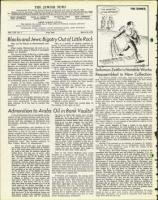
M R. SECRETARY,
iSTHIS DETENTE?
DREW LIEBERWITZ
Advertising Manager
Sabbath Scriptural Selections
This Sabbath, the seventh day of Nisan, 5734, the following scriptural selections
will be read in our synagogues:
portion, Leviticus 1:1-5:26. Prophetical portion, Isaiah 43:21-44:23.
Pentateuchal
•
Candle lighting, Friday, March 29, 6:36 p.m.
VOL. LXV. No. 3
Page Four
March 29, 1974
Blacks and Jews: Bigotry Out of Little Rock
Why are the Blacks so detrimentally anti-
Israel?
What makes Muhammad Ali such an an-
tagonist, to have gone to Beirut to propagate
enmity for Zionism?
The current issue of Encore, a news maga-
zine published by Blacks for Blacks contains
comments repeating many of the charges
against Israel. Accusations of brutality, claims
that Oriental Jews are discriminated against
in Israel, allegations that Arabs suffer in-
equality are included in the bill of numerous
claims that injustice is Israel's policy toward
500,000 Arabs in Israel.
The failure to ascertain the facts, the re-
sort to prejudice toward a state struggling for
existence and, exerting its energies to estab-
lish friendships with non-Jews in a process
of ascertaining peace is most deplorable.
Leaders of the black communities who
have gone to Israel to witness the aims of
that government have invariably reported op-
timistically on the status of minorities. But a
policy of non-cooperation and a lack of friend-
ship is being pursued by Blacks in public
asseverations of enmity.
A traditional friendship between the two
communities, Jews and Blacks, should never
have been abandoned. It has nevertheless
been harmed. Is it too late to correct the
blunders?
. .
This is a matter of serious concern to
Jewry. It should arouse equal anxiety among
the Blacks to correct misrepresentations and
to avoid misunderstandings. And upon Jew-
ish leadership rests a responsibility to exert
every possible effort to end a situation that
is bad for us, unpleasant for the American
relationships, an unhappy one for the Blacks
themselves.
At the conference of Blacks in Little Rock,
Ark., all of white United States was attacked
and condemned and assistance to Israel was
a major target for attack.
It is little comfort to know that the re-
sponsible black leadership was absent from
the destructive Little Rock sessions. The
need to enlighten the 'deluded becomes even
more compelling.
Have the Blacks forgotten that Jews made
supreme efforts for justice for their people
in Little Rock only a decade ago?
People battling for justice thus under-
took to deny the right to live to an ern--
battled people.
Is it possible that the rank and file of
the Blacks do.- not see through machinations
that lack not only decency but common un-
derstanding of the need for people to live
in harmony and to assist each other in es-
tablishing a good society?
Woe unto the blind who would deu to
the seeing of the light of day!
Admonition to Arabs: Oil in Bank Vaults?
A ton -of literature has accumulated on the
subject of oil. Americans have read about the
menacing Middle East situations, about Arab
threats and the outrages of blackmail and
threatening attitudes toward the nations of
the world.
Most commentators and students of the
emerging threats to the security of many na-
tions from a lack of oil and a reduction in
energy supplies have overlooked a basic fact:
that even oil could lose its value, as it already
has lost its Trumanaspect. An editorial in New
Yorker touched upon that element in the in-
ternational crisis. The leading editorial in
New Yorker, March 18, admonished:
We've just learned that Arab financiers
are helping to put up a Hilton hotel in Atlanta.
We've also heard rumors that the Arab nations
are going to lift their oil embargo against the
United States. Not long •ago, of course, when
the world was just waking up to some of the
dire consequences that an oil shortage could
have for the industrialized nations ( among
others), Arab leaders were touring the world
threatening economic destruction of any nation
that did not fall in with their uolitical demands.
Somewhere along the line, their mood seems
to have softened, and the softening may have
had something to do with that hotel in Atlanta.
As the oil flows out of the Middle East at its
new, exorbitant prices, astronomical sums of
money are flowing in. Over the next several
years, the amounts will rise into the hundreds
of billions of dollars. The Arab nations will
need places where they can spend the money
and invest it. And money, like oil, it seems,
must flow West in large amounts if it is to be
worth much to the Arabs. According to one
real estate report, Arab investors will hay some-
thing like a billion dollars' worth of real estate
in the United States alone in the course of the
next two years. If the oil-producing nations use
their power to destroy the economies of the in-
dustrialized nations, they will be destroying
the base on which their power rests. If they
should go as far as to expropriate American
businesses, the United States can always ex-
propriate the Atlanta Hilton. What all this sug-
gests . to us is a new economic law: the Inter-
dependence Theory of Value. According to
classical economics, the value of a thing varies
with its scarcity. According to Marx, the value
of a thing varies with the amount of labor that
goes into making it. According to the Interde-
pendence Theoiy of Value, the value of a thing
varies with the manners of the nation that
produces it. The goods of nations that black-
mail other nations lose value. The goods -of
nations that get along well with other nations
rise in value. Value, according to this law, is
generated by steady,.reliable associations with
others. When such relationships are missing,
even money loses its value, as the Arab govern.
ments may now be learning'. They might as
well fill up their bank vaults with oil.
Just as the entire Mideast issue could
backfire as a menace to the Arabs—if Israel
is to continue to suffer, so may also all her
neighbors--the oil wealth could impoverish,
just as it has reduced the human values in
the controversies that have divided the friend-
ly nations. Will the just-quoted editorial con-
tribute toward common sense in international
relations? Surely, the Arab potentates are not
that stupid, to .overlook the seriousness of the
issue they have aggravated.
Farcically, yet tragically, the energy prob-
lems continue to be linked to Israel's position
in the Middle East. The threats that Israel
must give up—that's really the intended new
holocaust—give up!—or the world's democra-
cies, especially the U.S., Holland and Den-
mark, will continue -Co suffer, is still sounded.
But the aim is clear: what the magnates are
striving for is highest prices. When will the
afflicted learn the reasons and how to coun-
teract blackmailing pressures?
t'v'044"4
-mum
Solomon Zeitlin's Notable Works
Reassembled in New Collection
Prof. Soloinon Zeitlin's scholarship, marked by notable continuity,
finds renewed expression in an encyclopedic work, the first volume
of which has just been issued by Ktav Publishing Co.
"Studies in the Early History of Judaism" contains 22 of the
eminent scholar's essays which have appeared in various publications
during the past 50 years.. The studies incorporated in this work are
so extensive, they contain such a variety of material on Jewish historic,
religious and other subjects, that the entire collection, when finally
reissued in the new series will supplement the most valuable ency-
clopedic literary works on the Jewish bookshelf.
Synagogue, liturgy and prayers, observance of festivals, reasons
for the second day of holidays in the Diaspora and for a second day
of Rosh Hashana in Israel, Jewish historiography and Josephus, the
Sicarii and many other elements izl Jewish experiences are defined
in this work.
Recognized as the outstanding authority on the Second Common-
wealth, the subjects related to that era have special significance in
these collected works. Dr. Zeitlin's studies on the early stages of
Christianity, his historic essay on the "Christ Passage in Josephus"
and other related subjects on the religious aspects of the Second
Commonwealth thus, have equal importance for Christian as well as
Jewish readers.
A 38-page supplementary 'introductory essay summarizing his
literary contributions in this volume add value to the importance of
this volume. There is, as an example of the definitive aspects of this
essay, this reference to Josephus:
"Some accuse Josephus of being a traitor to his people, the
Judaeans. This accusation is not well founded. It is true that when
the news of the fall of Jotapata reached Jerusalem and the extremists
learned that Josephus had surrendered to the Romans, lie certainly
was a traitor to them. However, in the eyes of the Judaean refugees
like Rabban Jochanan ben Zakkai he could not- have been _considered
a traitor ' because they also preached for peace with the Romans.
Josephus thought that in surrendering to the Romans he could be
useful to his country, that he surrendered to the Romans as a "min-
ister of God.' ".
Because of his eminence as an authority on Josephus, Dr. Zeitlin's
prof that the Christ passage was an interpolation retains historic
significance. In his introductory essay to the new volume of his
collected works Prof. Zeitlin states:
"In the essay, 'The Christ Passage in Josephus,' I arrived at the
conclusion that this passage was not written by Josephus. It is too
favorable to the Christian point of view, and Josephus would not ca"
Jesus 'the Christ' and write that he arose on the third day as
prophets had foretold. I endeavor to show that this passage was inte,-
polatgd by Eusebius. My conclusion- that Eusebius is the author of
this passage is based on the phrase 'The Tribe of Christians' used
in this passage as was said before that the scholars who maintained
the authenticity of this passage argued that this phrase could not have
been written by a Christian and thus they conclude that it must have
been written by a Jew and hence by Josephus. In my opinion the
phrase 'The Tribe of Christians' reveals the true author of this
passage. Throughout the entire literature of the ante-Nicene Fathers
there is not a- case where the word phulon, tribe, is used in reference
to the Christians, either by the Fathers on their own behalf, or quoting
non-Christian writers. The first and the only Father who used the
phrase was Eusebius in quoting the letter of Pliny the Younger and
the reply by the Emperor Trajan. Pliny and Trajan in speaking of
Christians did not prefix the word 'tribe.' My conclusion was that the
phrase 'tribe Of Christians' which is found in the Christ passage in
Josephus came from the same author who used it in quoting pagan
writers. Eusebius interpolated this passage in Josephus."
Dr. Zeitlin's works merit a place in higher education. His works
should be used in adult study courses. His contributions to Jewish
scholarship, fortunately, are marked by continuity from their begin-
nings more than 50 years ago.