

THE JEWISH NEWS
Incorporating The Detroit Jewish Chronicle commencing with issue of July 20, 1951
Member American Association of English-Jewish Newspapers, Michigan Press Association, National Editorial Associa-
tion. Published every Friday by The Jewish News Publishing Co., 17515 W. Nine Mile, Suite 865, Southfield, Mich. 48075.
Second-Class Postage Paid at Southfield, Michigan and Additional Mailing Offices. Subscription $10 a year.
PHILIP SLOMOVITZ
Editor and Publisher
CARMI M. SLOMOVITZ
CHARLOTTE DUBIN
City Editor
Business Manager
DREW LIEBERWITZ
Advertising Manager
Sabbath Scriptural Selections
This Sabbath, the 29th day of Adar, 5734, Shabat Hahodesh, the following
scriptural s lections will be read in our synagogues:
Pentateuchal portions, Exodus 38:21-40:38, 12:1-20. Prophetical portion, Ezekiel
45:16-46:18.
Rosh Hodesh Nisan Torah reading, Sunday, Num. 28:1-15.
e
Candle lighting, Friday, March 22, 7:28 p.m.
VOL. LXV. No. 2
Page Four
March 22, 1974
Kissinger, Jewry, Philanthropy, Politics
Secretary of State Henry A. Kissinger's
role in matters that seriously affect Israel's
position and security as well as the tensions
involving Russian Jewish demands - for recog-
nition of their right to emigrate without
monetary penalties or continuing persecu-
tions has emerged as a major item on the
political agenda.
Some of the judgments of the secretary
of state have often been shocking; and occa-
sional Jewish reactions to the issues involving
the political aspects of situations that demand
realistic evaluations have been equally dis-
tressing.
Challenging inquiries about Dr. Kissin-
ger's readiness to take Jewish spokesmen into
his confidence undoubtedly accounted for the
important meeting he held last week with
representatives of national Jewish organiza-
tions. The sense of satisfaction that expressly
resulted from that conference offered en-
couragement that our government will not be
lax in its dealings with the Arab states, and
in tackling the moot Russian problems.
What the emerging controversies, if they
truly were disputable approaches, teach our
community is that the political aspects of
issues affecting our kinsmen cannot be ig-
nored. As frequently happens in such situa-
tions, prejudiced views on occasion arouse
the accusations that Jews in government are
exerting too much influence in the direction
of the American foreign policies. But the
bigoted will not hesitate to resort to anti-
Semitic sentiments when the domesic eco-
nomic issues are involved, and such attitudes
must therefore be viewed without panic.
Conditions being as they are, and the
emerging situations inevitably involving vital
American policies, the cause of justice is not
helped by entertaining suspicions or resort-
ing to accusations that are not always- sus-
tained by developing facts. There is the obli-_
gatory factor of withholding judgment on the
man in charge of foreign affairs in our gov-
ernment. If the sense of confidence in Dr.
Kissinger is justified, as the Jewish spokes-
men keep asserting when they conclude meet-
ings with the secretary of state, then pessi-
mism must be avoided and discouraged.
At the same time, there must be an ad-
herence to a policy of involvement politically
by those representing Jewish interests when-
ever issues relating to the security of our
fellow Jews is involved, whether they are in
Israel whose existence is continually threat-
ened in neighboring animosities; in Russia,
where anti-Semitism keeps assuming Czarist
proportions; in Moslem states whence nearly
all Jews have already escaped in their search
for havens of refuge.
The lesson not to be forgotten in all Jew-
ish communal deliberations is that fund
raising alone is not enough. If political con-
cern were to be abandoned, all that the funds
attain could result in a lost cause because of
the protection that is needed in retention of
basic Jewish rights to the traditional identi-
fications.
An experience of note was a recent sensa-
tional story that involved the secretary of
state. Boston Magazine published a lengthy
article reporting an off-the-record meeting
Dr. Kissinger held with a number of noted
Jewish personalities, including Nobel Prize
winners and eminent philanthropists. It was
about a meeting at the home of Eli Goldston
in Cambridge, Mass. Kissinger reportedly
discussed the serious situations that had
arisen after the October war and he was
quoted as having been upset by talk about
"Israel being sold down the river." Because it
was "making the Jewish community nervous,"
the situation was being reviewed with addi-
tional seriousness after that conference and
the Boston Magazine article asserted:
What that meant, according to the report to the
Cambridge coffee klatsch, was that Kissinger felt
the Israelis had to be prepared to make major
concessions in Geneva. Major territorial conces-
sions. "It's going to be rough, boys, but I'll do
the best I can,:' was more or less the impression
of what Kissinger had said in Washington. And,
they thought he had _ said, the American Jewish
community had better be prepared to accept those
concessions: It wasn't a sell-out. It was the only
course possible.
It was all pretty grim. No one said anything
for some moments. They just stared into Eli Gold-
ston's coffee cups. •
Then Irving Rabb was on his feet. What this
means, he was saying, is that it's more important
than ever to support Israel. And that means finan-
cial support. We've got to convince people to give
not only what it's easy for them to give, but what
it's hard for them to give too. Convince them to
dig down even into their capital.
That was the first reaction. The biggest names
in the Jewish community, the men selected to
hear, behind closed doors, what Henry Kissinger
had told a confidential few, were planning not
political action, not a grass roots lobbying cam-
paign for Israel. They began to plan how to raise
more money.
But that's always been the first reaction of the
American Jewish community where Israel is con-
cerned, and Boston Jews have not been an excep-
tion.
The alluded-to Jewish response is com-
mendable. The help, so vital, must be sup-
plied. But the concern in the political involve-S.
ment must not be abandoned.
These are critical times. The secretary of
state is in a difficult position. He must follow
American policy, and we prefer to ..believe
that the Israeli needs coincide with the
American; and that he can't—as he affirms—
forget his background.
The hope is that Kissinger can be likened
to a Benjamin Disraeli in England and a
Henry Morgenthau Jr. in this country, both
of whom exercised responsibilities stemming
from the Jewish heritage.
Until the facts are established, the duty
is to provide for Israel's needs and to battle
for justice on the American scene. It calls
for establishment of truth in a muddied situa-
tion and to be as involved politically as Jewry
is dedicated philanthropically. Time is of the
essence, just as time is often a healer. While
fulfilling our obligations there is the added
duty not to abandon hope that the solutions
that will come with time will not spell "sell-
out."
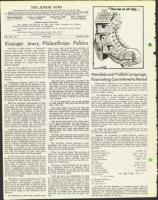
Mendele and Yiddish Language,
Fascinating Commitments Noted
Yiddish and the literature of the language that was the medium
of communication and expression for millions of Jews for many
decades—indeed, for centuries—are gaining renewed interest. Many
volumes are appearing -to define the spoken tongue and the wealth of
creative writings in Yiddish.
The significance of very notable works is defined in a most
informative work, "A Traveler Disguised" by Prof. Dan Miron of
Tel Aviv University, currently a visiting professor at Columbia Uni-
versity and a researcher at YIVO Institute in New York. The sub-
title of this Schocken-published work, "The Rise of Modern Yiddish
Fiction in the 19th Century," adds an explanatory note to the author's
aims that emerge most interestingly for students of languages.
While this work is devoted primarily to a study of the life and
works of Sh. Y. Abramovitsh who wrote under the pseudonym Mendele
Mokher Seforim—Mendele the Bookseller—it is such an interesting
study of the Yiddish language and literature that it emerges as one
of the most fascinating analyses of the expressive medium. In indi-
cates that Maskilim, who used and glorified Hebrew, turned to it,
defended their use of Yiddish, almost every one of them had to make
again and again the naive discovery that the majority of the Jewish
population in Russia and Galicia were, after all, approachable only
through Yiddish."
Dr. Miron also points out that "Sholem Aleichem was the first
Yiddish writer who felt a strong need to regard his literary activity
as a part of a historical identity."
"Mendele," the grandfather of Yiddish literature, emerges in
this volume in many roles, and his portrayal by Dr. Miron mirrors
the beginnings of Yiddish literary 'achievements and the inspiration
it provided for a rich chapter in Jewish history, the works of many
notables are mentioned in this work and Dr. Miron, in his informa-
tive work, points to the commitments to Yiddish even in the Hebrew
by quoting this charming doggerel by one of the great Yiddish writers
and poets:
My fellow writers
don't hold it against me
that I find pleasure
in the language
of Berl and Shmerl
and that I
don't deride it
of a language
of "stammerers,"
for it is my people
that I hear speaking
through them.
— Y. L. Peretz
,07..1i071
r12'N '5 .1W 1D
5 , 1a ra- ty
eK
_
k5
m1;
!coron
,
0(xl/p
T:
,;.-
ni) , un ,r-e
:
in "Menginot Haman —
The Melodies of
Our Age, Vol. 21.
Dr. Miron describes Mendele as "a disguised traveler" who "set
Yiddish literature on its way to maturity." His "Traveler Disguised,"
which will rank among the best works on Mendele, with its very many
annotations, the extensive bibliography, is an enrichment of literary
criticism. It is a superb study and it invites greater interest in Yiddish
than has been shown in a long time.