

Katsh Manuscript Collection of Rare Hebraica
Opens Treasury for Jewish Scholars at Dropsie
The material which corn- he became the third presi- the destruction of Jewish li-
PHILADELPHIA—The ex-
citement among scholars of prises the Katsh collections dent of Dropsie, the only non- braries and archives through-
the Bible when the Dead Sea is written in Hebrew, Ara- theological, non - sectarian out Europe during World War
Scrolls were first discovered maic, Arabic, Italian, Ger- graduate institution of its II, the USSR holdings have
in 1947 is now matched by man, Polish, Tartar, Persian, kind in the United States ded- taken on an even • greater
the Abraham I. Katsh Micro- Russian, Hungarian and Yid- icated exclusively to the stu- value.
The Katsh collection is ac-
film Collections of rare I-1e- dish. Much of the material' dy of Hebrew, biblical and
braica. Manuscripts from the covers the period when the Middle East languages and tually made up of a number
USSR, Poland and Hungary center of Jewish culture shift- cultures. He is the only per- of major collections. The
have been permanently hous- ed from the East to Western son ever given offical permis- most important and of partic-
ed in the new Manuscript civilization. There are Bibles, sion in writing by the USSR ular value to scholars now
Center in Philadelphia. the Talmud, prayer books, government's ministry of ed- engaged in restoring the Tal-
mud as it was originally ed-
Since the acquisition of liturgies, commentaries by ucation to microfilm this ited, is the Antonin Geniza
illustrious
scholars,
responsa
priceless
Hebraica
collection,
these microfilm collections, in
Collection. Known as the
addition to other Hebraica by leading authorities, docu- making five different visits "Oral Law," the Talmud is
ments
relating
to
talmudic
since
1956
to
the
Soviet
Un-
rare manuscripts acquired
the authoritative source of
from the Vatican Library in science and religious laws— ion to collect the material Judaism, second only to the
material
dating
back
to
the
under
a
grant
by
the
Ameri-
Rome, it's a veritable "field
"Written Law" of the Bible
day" for scholars and re- llth, 10th and 9th centuries; can Council of Learned So- itself.
manuscripts on gran mar, cieties and the Rockefeller
searchers who come to Drop-
The Antonin Geniza is
sie to find a wealth of manu- lexicography, philosophy, the- Foundation.
Dr. Katsh estimates that named for Archmandrite An-
ology,
poetry,
astronomy,
scripts that have never been
mathematics, medicine and Russia's holdings of rare He- tonin Kapustin, a Russian
published, or otherwise ever
historical items—translations braica manuscripts, books, monk residing in Jerusalem,
accessible to them. Since the
who went through the Geni-
1917 Russian Revolution, of Plato, Aristotle and Euclid letters, fragments and docu- zah, or storage place, of He-
made in the 10th and 11th ments which were preserved
scholars outside the non-
centuries which illustrate over the centuries total about brew documents that had
Communist countries have
how Jews helped to keep 50,000. They are now stored been preserved through the
had little access to these col-
centuries by the Jewish com-
lections. or little knowledge alive the light of learning in museums and libraries, munity of Fostat (old Cairo)
during the Dark Ages and mostly in Leningrad and
of their extent.
in Egypt. Jewish custom dic-
The scope of these trea- provided the real spiritual Moscow, and even Russian tates that documents bearing
link
between
East
and
West.
scholars
must
get
special
sures on film—coiled around
permission to see them. With the name of God cannot be
With the microfilm now
1,000 and more film
spools—defies any catalogued providing Hebraica scholars
description. There's the fam- a new tool for research, a
ous Bible Codex which was new drama in learning is tak-
copied in old Cairo by Sam- ing place at Dropsie. In this
uel b. Jacob in 1008 — the new microfilm library, where
only complete illuminated mechanical readers — film
Bible Codex in the world. viewing machines — are the
There is another Hebrew Bi- major pieces of equipment,
ble that was sold in Egypt in one will find Dr. Katsh him-
the year 847, although it was self, instructing a chosen
probably written much earl- few in the art of reading He-
ier; and a Hebrew letter writ- brew manuscripts. They will
ten by a certain Isaac Beza- compare microfilmed manu-
lel b. Hayyim to David Ha- scripts with printed texts, dis-
Nagid, the 13th Century rab- covering that the author in
binical leader from Egypt the published text has deleted
who was a grandson of Mai- or incorrectly translated a
phrase, of ten completely
monides.
Much of this Hebraica had changing the meaning of the
been lost over the centuries, sentence. Many of these sig-
like an unknown poem by nificant variants in the print-
Yehuda Halevi found in the ed text were noted by Dr.
microfilm of a 13th Century Katsh in his recently pub-
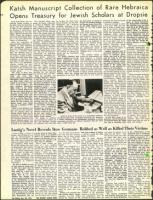
Seated in front of the screen of a mechanical reader in
manuscript. And many more lished "Ginze Mishna."
the Manuscript Center at Dronsie University, Dr. Abraham
Dr.
Katsh,
a
world-re-
lost liturgical poems for the
Jewish holidays—poetry that nowned Hebraica scholar, au- I. Katsh, president of the Philadelphia institution, is shown
dates back to the Golden Age thor and educator, brought examining microfilm of biblical fragments that are more
of Spain in the 13th Century. his collection with him when than a 1,000 years old.
destroyed, but must be buried of the manuscripts in the li-
brary of David Kaufmann,
or placed in storage.
Kapustin traveled to Cairo the distinguished Orientalist.
in the early 1860s and was His collection casts new light
able to make a choice selec- upon life in the Middle Ages,
tion of the Geniza material, and contains the 1,300-page
taking off with 1,189 manu- Mishna Torah of Maiinon-
scripts now preserved in the ides, a digest of material for
Leningrad public library. Jewish theologians and jur-
Among other early visitors to ists. Dr. Katsh also acquired
the Cairo Geniza — and col- microfilms of important ma-
lectors of its treasures—was terial dealing with the Hole-
Dr. Cyrus Adler, later to be- caust from the Jewish Hit - -
come the first president of torical Museum in Warsaw
Dropsie University, where Poland.
The Dropsie microfilms,
some 450 fragments of the
Cairo Geniza are stored in producing manuscripts and
documents from library and
the Manuscript Center.
Another important part of museum collections that
the Katsh collection is the li- stretch from Moscow to the
brary of Abraham Firko- Vatican, contain enough ma-
witsch, who lived in Crimea terial for at least 1,000 PhD
until his death in 1874. He dissertations, and enough ma-
brought together the largest terial to keep a generation or
collection of Hebrew, Samar- more of scholars busy deci-
itan and early Karaitic manu- phering, translating, identify-
scripts in the world, now ing, authenticating and col- –
housed in the Imperial Li- lating. There is hardly a sub-
brary at St. Petersburg. ject not included in the col-
The Friedland collection in lection. The whole gammat of
the Oriental Institute in Len- Jewish learning is represent-
ingrad, named for the Jewish ed.
"These microfilm treasures
philanthropist, Aryeh Lieb
Friedland, is rich in Bible show there were no 'dark'
commentaries, Kabala and ages in Jewish literary crea-
other valuable documents tivity," says Dr. Katsh, who
dealing with the history of sums up their value as a new
Russian and Oriental Jewish research tool for Hebraica
communities. The collection scholars by quoting from an
includes over 10,000 printed ethical will composed by the
books and some 300 volumes famed Jewish physician and
in manuscript form, most of translator, Judah ben Tibbon,
them on parchment. Though written to his son in
There is also the famous the 12th Century, it illus-
collection of Baron David trates the significance of
Guensberg, patron of Jewish Dropsie's microfilm treas-
art and learning, whose li- ures:
"My son! Make thy books
brary in Moscow consists of
about 6,000 rare manuscripts thy companions, let thy cases
and fragments dealing with a and shelves be thy pleasure
variety of subjects including grounds and gardens. Bask
lexicography, Judeo - Arabic in their paradise, gather their
and Aramaic commentaries fruit, pluck their roses, take
on the Bible, on the false their spices and their myrrh.
messiah Sabbatai Zvi, medi- If thy should be satiate and
eval Hebrew literature, Kab- weary, change from garden
ala and mysticism. to garden. from furrow to
It took three years of ne- furrow, from prospect to
gotiations with the Hungarian prospect. Then will desire
government before Dr. Katsh renew itself and thy soul be
was able to microfilm some filled with delight."
as Killed Their Victims
Lustig's Novel Reveals How Germans Robbed as Well
was asked to undress, to be in his condemnation of the
Arnost Lustig, a native of
Prague, was 16 when he was
sent to Theresienstadt in
1942 with his parents. Then
they were sent to Auschwitz
where his father died in the
gas chambers. From there
he and his mother were sent
to Buchenwald. They return-
ed to Prague after war, he
became a radio reporter and
screen writer. In 1968, after
the Soviet occupation, he
left Czechoslovakia. He now
lives near Washington with
his wife and two children and
is teaching at American
University.
He tells of finding his wife
in tears when he came home
in 1963. He reports that his
wife explained: "Having
been asked by a West Ger-
man court, 18 years after
World War H, to write
whether her parents had
turned in their wedding rings
to the Reichsbank, as had
been ordered for all Jews in
Germany's territory, she re-
plied that yes, her parents
had turned those rings in at
Prague to a branch of the
Reichsbank in 1941. To that,
today's German court replied
'hat unfortunately it has not
been documented that her
40 Friday, Dec. 28, 1973
—
It is the story of 20 Ameri-
cans who fell into German
hands. One of them sought
also to rescue a lady, the
charming dancer Katerina
Horovitzova whose parents
were already in Nazi
clutches.
They were relegated to a
hostages' camp whose com-
mander was the softspoken
German commander Fried-
rich Brenske. Ascertaining
that the Americans were
wealthy, that they could be
milked for large funds before
being sent to their death, as
the terrorist Brenske and his
associates had planned at the
outset, they were treated
with trickery. Brenske kept
assuring them they would be
sent to Switzerland and
would be released, but it
would cost a lot of money.
He began by asking them to
write vouchers on their
banks for large sums that
ran into the many millions.
Every step taken with the
treacherous assurances of an
impending release was ac-
companied by an added de-
mand for more and more
money.
Hoping to be released, they
kept writing letters, checks,
vouchers, giving orders
THE DETROIT JEWISH NEWS abroad for release of mil-
parents turned in those rings
because there is no mention
about it in existing German
papers and therefore her re-
quest for her parents' wed-
ding rings is rejected."
That's when Lustig sat
down, at 7 p.m., working
through the night and all of
the next day and wrote "A
Prayer for Katerina Horo-
vitzova," which was first
published in Czechoslovakia
in 1964 and won the Clement
Gottwald State Prize in 1967;
was translated into Croatian,
German, Bulgarian, Esto-
nian, Hebrew and Japanese;
and has just been published
by Harper and Row in an
English translation from the
Czech by Jeanne Nemcova.
It is much more than a
story of American Jews who
fell into the hands of the
German army criminals dur-
ing American troop disem-
barkment in Sicily in 1943.
It is another, and most ef-
fective, indictment of Ger-
man bestialities, and it once
again reminds mankind of
the manner in which all
Jews, regardless of the lands
they come from, became the
victims of the sick minds
that developed under Nazism.
lions upon millions of dollars
— all as a price for false
pledges of release.
One of them, Herman
Cohen, succeeded in having
the beautiful Katerina in-
cluded in the group to be
rescued. For her, too, more
and more funds were re-
leased. There was even a
bartering for a marriage, for
which a large fund was to he
paid, so that Cohen could
claim her release as his wife.
That's how it continued —
and in the process Rabbi
Dajem of Lodz was used to
perform the marriage cere-
mony, a German tailor was
tricked into making new
suits for Cohen and the
others. The rabbi and the
tailor symbolized the collab-
oration of Jews in the mur-
derous plot that was to be
committed after the millions
were to be secured.
They were on the doorstep
of the Nazi gas chamber.
Only one of the group saw
through the Nazi extortion
scheme and was killed wher
he protested. The smoking
chimneys already provided
evidence of the impending
scheme to murder the Amer-
ican millionaires and the
beautiful Katerina. When she
ready for her bath — they
had all been given soap bars
as ruses that they were
merely to be clean for en-
trance into the delusion of
going to a Swiss haven—the
heroic act occurred. As Lus-
tig describes it:
"She had to lean slightly
backward to unfasten her
brassiere. She bent her arm
sharply at the elbow and
suddenly ripped off the deli-
cately embroidered piece of
white lingerie, striking Horst
Schillinger (Brenske's as-
sistant) right between the
eyes with the hooks at the
end of it, just as he was
laughing hardest. He was
momentarily blinded by sur-
prise as well as pain. Hun-
dreds of thousands of people
had already passed through
this dressing room, as docile
as sheep, and nothing like
this had ever happened be-
fore . . ."
Katerina then yanked Lt.
Schillinger's pistol out of his
tipen holster. She shot and
killed. She was soon herself
murdered. But she exacted
vengeance.
The eminent psychiatrist
and survivor from the Nazi
terror, Dr. Bruno Bettelheim,
purported lack of' resistance
by Jews, gave as an example
a similar occurrence of a
dancer who before going to
her death in the gas cham-
ber, was ordered as she un-
dressed to perform a dance.
She grabbed a gun from a
Nazi officer and shot him.
Bettelheim's argument was
that if Jews had to die they
at least should have taken
the tormenters with thc
There is more to the g
story: his description o :he
submission of Jewish prison-
ers to Nazi orders to clean
up the mess after Katerina
had shot down Nazi murder-
ers, the meekness of the
rabbi and the tailor. Yet
there was a final prayer by
Rabbi Dajem of Lodz who
caressed Katerina's hair be-
fore it was shorn from her
dead body, before she was
burned, calling her cour-
ageous, beautiful.
Lustig's expose is power-
ful. It is a rebuke to the sub-
missive, a tribute to the
courageous, a revealing
story of how the Germans
not only killed but also
robbed. "A Prayer for Ka-
terina Horovitzova" emerges
as a major indictment of the
Nazi criminals.