

Purely Commentary
David Ben-Gurion as a Labor Organizer, Mobilizer
of Volunteers for Jewish Legion, Lover of the Bible
and a Man With Many Enemies as Well as Friends
By Phili
Slomovit:
Ben-Gurion the Giant in Many Areas of Jewish Activities : From Labor Leadership to Diplomacy
David Ben-Gurion lived a full life. He could be judged as having been a very
successful man. He succeeded in his initial objective: to show the way of pioneering
by settling in Israel as a youth, by adopting a Hebrew name—changing Green to Ben-
Gurion, Son of a Young Lion," and by setting an example for those who advocated
redemption by becoming a laborer in Eretz Israel. He was successful in his first
"professional" job: as a union leader he proved his ability as an organizer, and
he was as much an architect of the Israel Federation of Labor—Histadrut—as he
was, later, of the state of Israel. Also: he was successful as an advocate of Zionism
and as an organizer of forces for Poale Zion, the Labor Zionist founding nucleus;
and then, as architect of the Jewish state, emerging into statesmanship and as a
brilliant minister of defense.
B-G, the abbreviation for his name that was ascribed to him with great
affection, was a simple man. He was approachable. From his earliest years as an
advocate of the Socialist Zionist idea he had made friends among the masses. Except
that he had to be fully protected in recent years and that security became a matter
of necessity in public life, he remained the haver, the comrade of his fellow
Zionists.
He can be recalled only in that fashion. When we first met him in the 1920s,
he had come to speak at a Labor Zionist "rally" at the old Philadelphia-Byron
Hebrew School building. The quotes around the "rally" are necessitated by the fact
that at that time it was lucky to get a few minyanim to a Zionist meeting—to any
such gathering unless it was a demonstration in protest against pogroms. So, very
few then came to hear the man who rose to greatest heights in Jewish history.
But even before the struggles to build up a Zionist follow-
ing, Ben-Gurion had already made himself known here. He had
come to assist in the mobilization of volunteers for the Jewish
Legion, and he succeeded in securing a very large following here.
An interesting study of that period and a compilation of the list of
Detroit and Windsor volunteers in the Jewish Legion was made
by Allen A. Warsen, Detroit educator who is devoting his time
entirely now to gathering historical Jewish data. In his special
articles, Mr. Warsen has listed the volunteers, he has traced
their family backgrounds and their Zionist interests. The volume
included some prominent personalities, notably Gershon Avrunin,
Nathan Linden and others.
Among the surviving members of the legion, who worked
closely with Ben-Gurion, are Norman Cottler, Alfred H. Bounin,
Samuel Gach, now a resident of Los Angeles, Joseph Sandweiss
and H. Bookstein.
Ben-Gurion's close associate in the legion and in a life-
time of Zionist efforts was Yitzhak Ben-Zvi, the second president
of Israel. The chief organizer of the legion, however, was a B-G
antagonist—Vladimir Jabotinsky.
when the Yom Kippur War was infamously developed upon a praying people.
Ben-Gurion's assertion to this commentator, in his letter of March 1971 was
a kind of advanced philosophy akin to Albert Einstein's. He was not a synagogue
attendee, he did not put on tefilin and talit, but he had a great measure of faith.
Humanists loved him, traditionalists could not deny him comradeship. Like all his
associates in the labor movement, he loved a hasidic song and enjoyed a rebbe's
story. Perhaps that feeling grew with time as he mellowed into historicity.
Especially notable was his love of the Bible. He propagated scriptural studies,
conducted Bible classes, inaugurated the famous series of Bible Quizes which drew
worldwide interest and participation.
One of the last of his great speeches was the one he delivered at the last
World Zionist Congress in Jerusalem, in January 1972. This commentator believed
that among the best speeches at that congress were: Dr. Abraham Heschel's, which
was made available in an advance text—we reprinted most of it; Moshe Dayan's-
we could not secure the text, and it will no doubt appear in the printed recd
of the WZC; Jacob Arie Chazan's, which was an outstanding declaration by CV
of Israel's most noted Marxists—it was in Yiddish and mostly a polemic from
platform to delegates' section with Menahem Begin; and David Ben-Gurion's.
That speech, in Hebrew, was a magnificent assertion of faith in his ideals.
It was marked by the drawing of spiritual treasures from the Bible. This commen-
tator made a serious effort to secure the B-G text of that magnificent address.
On Feb. 24, 1972, in reply to the request for it, he wrote:
"I am not well now, and I have not my notes here. Within
a week I may be able to send you the notes of my speech."
Then, on the following March 11, he wrote: "I am sending
you my speech at the last Zionist Congress . . . " It was his
original, in Hebrew, and portions appeared in this commentator's
column, April 14, 1972.
In the letter that accompanied the text of that speech, he
commented on the interview this commentator had with Henry
Ford II in which the automobile magnate made kindly references
to Ben-Gurion. "I enjoyed the conversation with Henry Ford,"
he wrote, and his letter contained this additional paragraph:
"I am still not well, but I hope in a week I will be able to
return home to Sde Boker."
That historic speech was studded with biblical quota-
tions. He turned to Isaiah and to Amos, and he glorified in the
prophecy he helped fulfill with the re-establishment of Israel's
statehood.
*
*
Ben-Gurion had many quarrels. He was blamed for having
Ben-Gurion, during his visit here as an enlistment officer
relegated
Chaim Weizmann, who might not have become Israel's
for the Jewish Legion, also spent some time in Windsor. He
first president, to a position of impotence—something for which
addressed meetings in the Yiddish People's Theater on 12th
Chaim never forgave David.
Street to create enthusiasm for the fighters for the liberation of
There was a deep-rooted hatred between him and Vladimir
Palestine from the Turks, and he made lasting friendships in
Jabotinsky, the rightist in Zionist ranks.
Detroit.
Most regrettable was the Ben-Gurion animosity toward one
Paula Ben-Gurion was soon to travel with him. She had
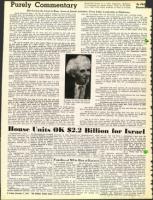
A photo of David Ben-Gurion
of the kindest and most gentle men in the ranks—Moshe Sharrett.
been his nurse when he became ill in New York during his initial
30 years ago, when he enjoyed
visits in this country, and their love affair was never marred
Ben-Gurion also quarreled with one of his closest associates
in Poale Zion . and Histadrut, Golda Meir. They patched up their
a little cigar.
by any of the crudities with which her frankness was treated.
differences two or three years ago.
The Ben-Gurion story is unique in many respects. Charles de Gaulle became
an enemy of Israel. His successors are Israel's antagonists. Yet, de Gualle had
But Moshe Dayan and Teddy Kollek stuck by him and with him, and joined
him in forming the ill-fated Rafi political party.
great respect for him, and his successor, President Pompidou, is among those
who have sent messages of condolence to President Ephraim Katzir of Israel.
Ben-Gurion was a scholar. His Bible studies were only part of his special
Even the enemy honors the mastermind of Israel's statehood.
interests. He became a Greek scholar, and his library was stocked with books on
He was fearless. When the Jews of Palestine were fighting for their right
Greeks, the Greek language and literature, the modern and the ancient.
to national independence in 1948, he directed the military affairs with a determined
will not to submit to destruction. There were times when he was willing to make
And so, he was a builder and an organizer, and a very human being whose
concessions. He made one such submission in 1957 to President Eisenhower after
personal feelings were never secreted. His friends knew it, and his enemies felt
the succcessful Sinai War. He advocated some concessions in 1967. He could not
his stings. But his love for Israel was uppermost with him. That is why the biblical
have done other than join in a rally to action in defense of his nation's very life
tribute—A prince and a mighty man has fallen in Israel—is
applicable to him.
House Units OK $2.2 Billion for Israel
WASHINGTON (JTA) —
Two House committees over-
whelmingly approved Tues-
day President Nixon's re-
quest for $2,200,000,000 in
emergency military aid for
Israel.
The full House is expected
to vote on the measure be-
fore Monday and send it to
the Senate.
The Appropriations Corn-
mittee, without a record
vote, wrote in its bill $1,000 -
000,000 to be given to Israel
as -a grant and the balance
of $1,200,000,000 in credit.
The Foreign Affairs Com-
mittee in authorizing the full
amount did not specify grant
and credit segments.
A committee aide told the
Jewish Telegraphic Agency
the breakdown was left to
the Appropriations Commit-
tee.
Proposals in both commit-
tees to reduce by $500,000,000
the full appropriation to re-
supply weapons for Israel
lost in the October war were
set aside.
Administration spokesmen
Monday outlined the need for
2—Friday, December 7, 1973
the full amount the President
asked by detailing in secret
session the kind of equipment
that the United States must
send to Israel to counter.
balance the Soviet Union's
weapons shipments to Egypt,
Syria and Iraq.
In the Appropriations Corn-
mitte, Rep. Otto E. Passman
(D.La.), chairman of the
Foreign Operations Commit-
tee, called for a $500,000,000
cut last week. But Tuesday
he recommended restoration
to the full amount after re-
ferring to the administra-
tion's explanation of the
need.
The Appropriations Com-
mittee, of which Rep. George
Mahon (D. Texas) is chair-
man, incorporated the $2,-
200,000,000 as part of the
over-all foreign aid bill total-
ing $5,800,000,000.
The latter amount includes
a military credit of $300,000,-
000 and a grant of $50,000,000
for Israel, but they are not
parts of the $2,200,000,000
emergency money.
The Foreign Affairs Com-
mittee was told by Deputy
THE DETROIT JEWISH NEWS
Secretary of State Kenneth
Rush that "we attach great
importance" to securing the
full amount because "we
must make it clear to our
friends in Israel and to those
who have opposed her in the
past that we will see to it
that Israel has the weapons
to defend herself effectively."
Israel has purchased near-
ly $1,000,000,000 in equipment
from the United States since
the Egyptian-Syrian attack
on Oct. 6, Rush said. "She
will need substantial amounts
in addition to this $1,000,000,.
000," he added, "in order not
only to replace her losses but
to counterbalance the heavy
flow of sophisticated Soviet
weapons to the Arab armies."
McGovern, Hatfield Drop
War Powers Amendment
WASHINGTON (JTA) —
Senators George S. McGov-
Families of MIAs Riot at Knesset
By DAVID LANDAU
The Knesset was to have
JTA Jerusalem Bureau Chief held—at opposition instiga-
JERUSALEM (JTA)—Sev- tion—a debate on the POWs
eral scores of relatives of and the MIAs, but it was de-
missing soldiers caused an ferred at the last moment
uproar and broke windows when the opposition Knesset-
in the Knesset precincts in ers were persuaded that it
a heart-rending demonstra- would not be useful at this
tion over the plight of their time. One demonstrator was
injured by broken glass.
loved ones.
A delegation of the demon-
They demanded to see
Premier Golda Meir or De- strators met with six Knesset
fense Minister Moshe Dayan, members of various factions
and since neither were avail-
and complained of harsh and
able. turned half crazed with
grief and anxiety and started heartless treatment at the
heaving rocks and surging hands of army bureaucrats
through the Knesset gates charged wth dealing with
and up to the building itself. them.
ern (D., SD) and Mark 0.
Hatfield (R., Ore.) have
abandoned their proposed
legislation that would forbid
the President from using
American combat forces on
land, sea or in the air in the
Near East without first ob-
taining the consent of Con-
gress.
Sen. McGovern disclosed
their decision in a personal
letter to the Jewish Tele-
graphic Agency's Washington
Bureau chief, Joseph Pola-
koff, in which he said: "Due
to the recent enactment of
the war powers bill which
imposes similar restriction
in the face of foreign hostili-
ties anywhere, Sen. Hatfield
and I have decided to with-
draw our amendment.
In his letter, Sen. McGovern
also observed that "There
has been a great deal of mis-
interpretation of the McGov-
ern-Hatfield amendment and
my position on the U. S. com-
mitment to Israel."
The 1972 Democratic party
presidential candidate reaf-
firmed his support for Israel.
Actually, the McGovern-
Hatfield proposal, which they
introduced a week after the
second cease fire went into
effect in the Arab-Israeli
fighting, went far beyond the
war-making restrictions im-
posed by the War Powers
Law. Their proposal was
seen as weakening the Amer-
ican hand in the Middle Ea"`
at a crucial time in
crisis.
While their amendment
would have forced the Presi-
dent to obtain congressional
authorization before he could
expend any funds whatever
for U.S. combat in the Near
East, the War Powers Law
authorizes the President to
order troops into combat any-
where for up to 90 days with-
out congressional authoriza-
tion. Israel has never in its
history asked for support by
U.S. military forces.
Once the war powers bill
was enacted into law on Nov.
7 when both houses of Con-
g r e s s overrode President
Nixon's veto, Sen. McGovern
informed Sen. Hatfield that
he would not pursue their
amendment since he thought
it was no longer needed be-
cause; of The, new law.
3