

THE DETROIT JEWISH NEWS
Friday, Nov. 30, 1973-11
Mormons Seen
Backing Israel
JERUSALEM—In a letter
to the editor of the Jerusalem
Post, a member of the
Church of Jesus Christ of
Latter-Day Saints (Mormon)
defended the "trustworthi-
ness" of his coreligionists
against criticism.
Describing the history of
Mormonism, John A. Tvedt-
nes, said the religion was
born of a "Zionist spirit,"
*lereby the immigration of
__.ws to Israel was not only
regarded as a right but as a
duty.
He said that a Mormon
prophet, Joseph Smith, in
1841 delegated one of the
Apostles, Orson Hyde, to
Jerusalem to "dedicate the
land for the return of the
Jews. This he did, calling
upon God to restore the land
to its 'rightful heirs' and to
inspire the powers of the
earth to aid in the establish-
ment of a Jewish 'nation.' "
Tvedtnes said that during
the Yom. Kippur crisis, Mor-
mons from all over the world
were meeting in Salt Lake
City, and that many publicly
announced their concern for
Israel. Many already living
in Israel volunteered their
services. Following one Sha-
bat service, a congregation
went en masse to Magen
David Adom to donate blood.
He said he put off writing
the letter because "it might
be viewed as bragging or as
an attempt to 'prove' some
false loyalty to the Zionist
cause."
However, he said, "I have
deemed it necessary to state
the reasons for which our
Jewish brethren may rest as-
sured that we are their good
friends, in both good and bad
weather."
Judges Moonlight
as Taxi Drivers
TEL AVIV — Hall of jus-
tice judges have organized a
volunteer taxi service for
members of border agricul-
tural settlements.
A number of judges go out
every day with their cars to
taxi volunteers sent by the
agricultural center here to
the settlements needing
them. mainly on the Golan
Heights and in the Galilee.
Another service tendered
by the judges is special rides
in emergency situations, in
answer to calls from the
city's emergency staff. The
rides are given from the hall
of justice where judges are
•TI duty day and night for
h cases.
- Chief Justice of the Peace,
Ya'akov Segal, said that a
questionnaire has been cir-
culated among Tel Aviv
judges and in all courts in
the country regarding mobil-
ization for night patrol at
border settlements. Judges
also are part of the special
teams sent to bring words of
deaths to war victims' fami-
lies.
,
;
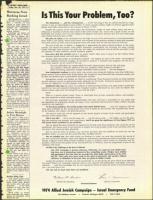
Is This Your Problem, Too?
The dimensions . . . and the consequences . . . of the Yom Kippur War are almost beyond our imag-
ination. It was an indescribably brutal conflict, in which a greater military might was thrown against Israel's
people than Hitler committed to the invasion of Russia in 1941.
Despite the surprise of the initial attack, the tremendous weight of Arab military force, and the in-
difference or hostility of almost every nation in the world except ours, Israel won a great victory on the
battlefield. Her civilian army not only stopped the Egyptian and Syrian advances but now sits inside Egypt
and is farther into Syria than in 1967.
The price of victory in this unwanted war was high: its cost, in life and resources, is incomprehensible.
Since Israel is one family, almost every home was touched by the grievous number of dead and wounded.
The entire nation sat shiva, and mourning her dead with Israel, Jews all over the world sat with her.
The cost of the war, in dollars, is staggering. It approaches the gross national product of the entire
country. For almost two months, since Israel's manpower mobilization, the economy has been virtually
halted. Although some factories ran shifts day and night, the production went to aid the war effort. It did
not advance, or even maintain, normal economic growth.
Even now, after the ceasefire, there is no peace. Israel's labor force is dug in on the military fronts.
Her economy grinds slowly and with great difficulty.
Already under the burden of tremendous taxation — the highest tax rate in the world — the people of
Israel face additional financial struggles. An increase in taxation, a voluntary loan program, the loss of in-
come from exports: all are results of the war.
Her new difficulties are compounded by Israel's determination that her life and prog-
ress continue. With the advent of the war, problems which existed on October 5 .. .
those of housing, education, refugee absorption needs, poverty ... did not disappear.
New immigrants continue to arrive daily. Last month, even during the fighting, more than 5000 immi-
grants arrived, most of them from Soviet Russia. The number of newly liberated Jews increases weekly, and
so does the demand upon overburdened absorption facilities.
Immigration centers and hostels are filled to overflowing. Three thousand families are today doubled
up with previous arrivals in apartments barely adequate for one family. Temporary quarters to house new
arrivals are imperative. A crash program must be undertaken.
Additional help must be given to hundreds of deprived large families and aged persons particularly
hard hit by war and economic dislocations. Irrigation systems, destroyed by war, must be rebuilt. Kib-
butzim whose crops were lost during the war must be aided.
How?
There is a Jewish balance sheet. Those in Israel gave lives of sons, husbands, fathers, and brothers:
we, whO cannot be in Israel, must give money.
We must give expression to our determination that Jews will have a homeland; to our desire that
the absorption of immigrants should not cease; to our conviction that education, health, welfare, housing
should not be neglected.
To lick these problems, the Jewish people must stand behind Israel . . . must join together with the
same spirit exhibited by the young heroes who went to battle, by the families who accepted their losses,
by the orphans, the widows, the grieving parents.
The kind of Israel that will be depends on the Jewish people of Israel, of the world, and particularly
the Jews of the United States.
This is not 1967 . . . this is not the same war . . . not the same world . . . but neither are we the same.
We have maturity and strength and commitment. And if we grasp the significance of Yom Kippur 1973, we
will accept Israel's problems as our problems.
We are asking the Jews of Detroit to respond and to help solve those problems. We cannot be on the
battlefronts. We cannot work in the factories to replace the young Israelis on the fronts and those who will
not return. We cannot be there physically.
But we must be there in another way: we must proclaim that the problems of Israel are not her
problems alone: we must tell the world that they are our problems.
We are mindful, too, that while aiding our brethren in Israel, we must also maintain the source of
our own communal strength: those local agencies and domestic beneficiaries which consolidate our com-
munity. Programs which enable Detroit children to grow in Judaism, which shelter our homeless and de-
pendent, which enrich the quality of our own Jewish lives in America, must be safeguarded as part of our
solidarity with Israel.
All this is the challenge to the Jews of Detroit.
Our 1974 Campaign is already underway. Obviously, we could not wait. Initial meet-
ings have seen a tremendous response to the compelling needs. Pledges have trebled
and quadrupled. We have thus far exceeded the total dollar achievement of the 1973
AJC-IEF. These gifts have been made in the spirit of generosity and sacrifice without
reference to donations of the past. They are given for today's needs.
Accept the problems of Israel, not only emotionally as we did during the great shock wave following
the attack. When your Campaign volunteer calls on you, respond with deliberation, with depth, with corn-
mitment . . . with the knowledge that we are buying the future of Israel, the future of the Jewish people,
yes — our own future, too.
We can and we must make these our problems.
Arabs Help Out
"Any attack against Israel
is an attack against every
single Israeli Arab. Bombs
and rockets don't make any
distinction . . . If we don't
volunteer to help, who will
replace our soldiers at the
front?"
Sharif e-Tibi, an Israeli
Arab electrician was volun-
teering for emergency work
during the war.
.."-)
William M. Davidson
General Chairmen
• tie
Lewis S. Grossman
1974 Allied Jewish Campaign — Israel Emergency Fund
163 Madison Avenue • Detroit, Michigan 48226 • WO 5-3939