

'
Aintw
87 PETS
CANNANS
The Israeli Dogs of Distinction
Six puppies, seven weeks old,
Michigan's Pioneer Cannon
Breeder Beth ha Emunah Ken-
nels.
12568 Lakefield
St. Charles, Michigan 48655
642-8776
Famous Trees
of Abraham
Fre Rabbi L. I. Rabinowitz's
"T
and Flora" column in
Je
em Post
Two of the trees of Abra-
ham are famous in legend
and tradition. The first is
the tree in Hebron under
which is angelic guests-
lisguised as foot-weary trav-
elers, ate while their host
waited on them: "And he
stood over them under the
tree, and they ate" (Genesis,
'18:8). And what purports to
be that very tree is still
pointed out as one of the
1 .and.marks and tourist attrac-
tions of Hebron.
The second tree, or grove
of trees, is that planted by
Abraham in Beersheba (Gen-
21:33). Its history can
be traced in imaginative
commentary and in beauti-
ful legend. The commentary
Is that of Nahmanides, who
points out the surprising
fact that Abraham found it
necessary to carry the sac-
rificial wood for the Akeda
(sacrifice) all the way from
Beersheba t o Jerusalem
(Genesis, 22:3), and sug-
gests that it came from that
grove because Abraham
wished to make sure that
healthy and not wormy wood
would be used for the sacri-
ficial fire. And the legend:
otat it was from this grove
that Abraham's grandson
Jacob, on his way to Egypt,
took the saplings that would
- Ine day provide the planks
which his descendants would
need to erect the sanctuary
in the wilderness after they
-merged from the bondage
of Egypt.
Jews' connection with
Hebron dates to Abraham.
3ut there is a third mention
of trees in relation to Abra-
ham which occurs in a por-
tion (of the Pentateuch) and
`,_.) which. as far as I am
aware, no further mention is
made in Jewish tradition.
When Sarah died in Hebron,
Abraham was apparently
still in Beersheba and he
came to seek a suitable
burial place for his beloved
- ,rife. All that he asked from
ilphron the Hittite was "the
of Machpelah which is
the edge of this field." It
would appear from this that
his request was only for the
sepulchre, without any de-
mand for rights or title to
....V land attaching to it. It
was Ephron who volunteered
the larger area. "Nay, my
lord, hear me. The field I
jive thee, and the cave that
is therein." And then begins
the Oriental bargaining for
both land and cave. And
-- Then the transaction is com-
pleted, "The field of Ephron
. . the field, and all the
trees that were in the field,
that were in all the borders
round about it, were made
sure unto Abraham for a pos-
session."
Thus it was that Abraham,
whose status in Hebron here-
4 ofore had been that of a
stranger, living with his ally,
.there.
-
THE DETROIT nwsN Neva
Friday, Sept. 28, 1973-77
Irony and Tragedy, Jews and Germany
McKay Book Recapitulates Massacre in Munich
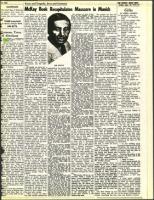
Jim McKay is the profes-
sional name used by James
K. McManus in his role as
sportscaster for ABC's Wide
World of Sports. He is the
master as sports writer as
well as television and radio
narrator. He proves his skill
in a fascinating and reveal-
ing book, "My Wide World,"
just issued by Macmillan.
Lovers of all sports will be
intrigued by the reminis-
cences of McKay in this ex-
ceptionally well outlined ac-
count of experiences in many
athletic events.
Golf fans will be enlight-
ened by the reports on many
contests in which the major
experts in the sport appear
in a rich cast of characters.
Track and field events,
basketball and swimming,
every conceivable sport is
described in the delineation
of a keen observer's views.
Then there is the Munich
experience, the Olympics,
the tryouts and the after-
math.
All details are given by a
well informed man. McKay
deals with the Munich events
as an historian, and as a
humanist. He views the past.
recalling what had happened
at the earlier Olympics under
Hitler, acknowledging the
irony of repeated occur-
rences when Germans were
about to be the saviors of
Jews whose lives were threat-
ened by Arab terrorists.
He was there to broadcast
the developing horror, and it
is appropriate that McKay
should have begun by quot-
ing:
"In his book 'The Nazi
Olympics,' Richard D. Man-
dell wrote: . . . 'entranced by
the Nazi Olympics (of 1936)
was the world's "Man of the
hour." Adolf Hitler, who was
entirely unathletic and was
no classical scholar, became
convinced that his athletes'
triumphs were omens, por-
tents whose significance was
clear. The athletes, like
other exceptional Germans,
were to inspire the whole
German Volk. The new mas-
ter race would lead a cultur-
al movement toward accom-
plishments whose glorious,
though dimly divined, out-
lines suggested that the Ger-
mans of the future might sur-
pass the greatest cultural
creators of all time. Inspired,
hardworking, unerringly led
Germans would rival the
classical Greeks as inventors
of new beauty and joy-intox-
icated styles of life."
Then came the tragedy in
the Israelis' Building 31 in
the Munich Olympic Village.
It is a well-known story of
exactly a year ago. and Mc-
Kay's narration adds to its
historic perpetuation as an
indictment of terrorism.
When he entered on the
scene to cover the horrors
for the American audience,
on that terrible day of Sept.
6, 1972, he went to the offices
of the Israeli television where
stood the trucks of the Bun-
desgreuzschritz, the West
German Border Police. He
relates:
"I remember going to the
offices of Israeli television
after our first transmission,
looking for their producer-
reporter, who had been in-
side the village and was now
semi-official spokesman for
the team. It was not a pleas-
ant walk to the office. I ex-
pected to find women weep-
ing and men cursing.
"What I found was differ-
ent. The Israelis seemed less
The dilemma of Tuvia Sokol-
sky was the dilemma of the
world, but particularly of Willy
Brandt and Golda Meir. The
hostages themselves would have
no say in the decision.
McKay has something to
say about the terrorists, and
he expresses a view about
continuation of the games,
questioning the serenity, ask-
ing if it was a farce or a
dream:
JIM McKAY
'surprised by the tragedy than
anyone else I had seen. As
they moved quietly and com-
petently about the offices,
there was great sadness and
bitterness in their eyes, but I
also sensed a determination
and a preparedness; not res-
ignation, but an acceptance
of reality.
"One man explained it to
me as I waited.
" 'We live with this every
day of our lives,' he said.
`Every citizen of Israel
knows that an implied condi-
tion of his citizenship is the
possibility of ambush and
death. We do not accept its
inevitability. We do not plan
to let it continue. But we ac-
cept the fact that it exists as
of this moment.' "
Then, McKay records an
interview with a survivor:
West German Chancellor Willy
Brandt was in Munich now. Se-
cret negotiations were under
way.
I interviewed a survivor, a
man I am sure I will never for-
get. His name was Tuvia Sokol-
sky, coach of the Israeli weight-
lifting team. He spoke no Eng-
lish, but what he said and meant
was crystal-clear, through the
words of his interpreter and the
expressions on his face.
Mr. Sokolsky is a small, mus-
cular man, apparently in his late
forties. He is balding and wears
a small mustache. You could
imagine him as a neighborhood
tailor in New York, or a delica-
tessen owner in Los Angeles.
As he sat, slumped in his chair
in the studio, his hands folded
in front of him, perspiration
beading his forehead under the
hot lights, his face showed the
weariness of centuries-old perse-
cution. the sorrow of a brother
at a graveside, the potential
wrath of an Old Testament Je-
hova.
Patiently, in Hebrew, speaking
softly, wearily, he went through
the description of the morning
that now was like a dirge being
sung in different voices.
Then I asked him the question
that I thought I must, the ques-
tion that was in the front of the
minds of hundreds of millions
of people watching around the
world.
"Mr. Sokolsky," I said, "If you
were standing right now at the
side of the German directing the
rescue forces, what would be
your suggestion, what would you
tell him to do?"
After the translation of the
question, the small man sat and
thought for a moment. lie moved
in his chair. He spoke, and as
he did, I saw his eyes mist up,
heard his speech falter. As he
finished, his mouth turned far
down at both corners and he
lowered his head.
The translator spoke.
"What Mr. Sokolsky said is dif-
ficult to translate and it is more
moving to me in Hebrew than I
can make it in English. I will
try. He says that he has always
vowed to himself that he would
never give in to cowardly ter-
ror, to these men who will not
fight us hand to hand and face
to face, but only when they are
armed and we are not. He says
this is a principle most impor-
tant to him, one that he has told
himself he will never betray. And
yet, he says, he must be honest
and tell you what is in his mind
now, that the only thing he cares
about is to see his friends alive
and free, at whatever the cost."
The wonderful games of the
Twentieth Olympiad lie in ruins
after the events of yesterday
and early this morning. The peo-
ple of the nations gathered here
have retired to their beds in
deep despair. The city is silent.
The cheering has stopped.
In the past decade, politicians
and statesmen have learned to
live with the possibility of their
own sudden and violent death.
Assassinations have shaken the
structure of the world's greatest
stronghold of representative gov-
ernment. Still, what happened at
the Furstenfeldbruck air base
near Munich a couple of hours
ago was different, and even more
of an outrage against humanity
than the other killings. The mur-
dered Israelis were not repre-
sentatives of their government.
They were sportsmen, some of
them wrestlers and weight-lifters,
men who had dedicated them-
selves to the cultivation of their
bodies so that they could best
another man in an equal con-
test, under the rules.
The fanatics of the Black Sep-
tember Movement violated the
sanctuary of the Olympic Village,
tied the hands and blindfolded
the eyes of these men whose
physical capabilities were their
reason for being here. In time,
under the pressure of ambush
from German police snipers at
the airport, they fulfilled the ter-
rible threat they had made many
hours before. Having not had
their way, they destroyed their
captives.
At this moment, it appears that
the games are over, that the
preparations of many years were
in vain, that the fragile concept
of the "serene Olympics" was a
farce or a foolish dream.
No Jew needs to be told that
a pounding on the door in the
middle of the night means ter-
rible danger is at hand. For too
many centuries in too many
lands, it has meant that persecu-
tion. terror, and brutality have
come again to visit the once-
Chosen People. It was almost re-
flex action. then. for wrestling
coach Moshe Weinberg to lean
from his bed at the first alarm
at 4:30 yesterday morning, to
fling his strong body against the
door as a human barricade, and
to shout to his colleagues to
flee, quickly by whatever means
they could find.
They ran, in their night clothes,
to windows and balconies. Some
Jumped from the second floor,
like weight-lifting coach Tuvia
Sokolsky.
While they were still frantic-
ally trying to escape, Moshe
Weinberg was dead. first victim
of the assassins' bullets. His body
was flung outside the door, la-
ter recovered by the German DO.
lice and taken to a hospital
morgue, where it was identified
by his mother. Ironically, she is
one of the few Jews still a resi-
dent of Munich.
Then, in memorializing all
of the victims of the mass
murder, listing the names of
all of the Israelis who lost
their lives in that night of
terror, McKay states:
"Daybreak brought no rays
of hope with it. Seventeen
men are dead — the eleven
hostages, five of the killers,
and a Munich policeman.
Three Arabs are in prison.
"Most of the teams are
dressed in their parade uni-
forms and seated in blocks,
chunks of color; some red,
others blue or green. The
Americans came informally.
on their own initiative, and
are scattered among the
other countries. There is a
report that the Soviets stayed
away, but looking through
my binoculars. I can't be
certain of that. They may be
scattered through the crowd,
too.
"The games will go on, ap-
narently within a matter of
hours. Avery Brundage said
so, in his embarrassingly in-
appropriate remarks a few
minutes ago. He talked not
about the slain men for whom
the memorial was being con-
ducted, but about the Olym-
pics. He seemed more angry
at the interruption of the
games than grieved at the
death of the men.
"He pointed out that the
bigger the Olympics became,
the more they seemed sub-
ject to commercialism, poli-
tics, and now to criminals.
And then he linked the politi-
cal maneuvering that had ex-
cluded Rhodesia from the
games with the murders. In
the Rhodesian case, he said,
"we gave in to naked politi-
cal blackmail," and now we
have murders.
"It seemed so insensitive
to equate a political contro-
versy with wanton murder,
particularly here, as the piti-
ful survivors of the team of
Israel sat in the front row,
wearing their yarmulkes and
grieving for their brothers.
"When Brundage an-
nounced, in ringing tones,
that the games would go on,
the applause that greeted his
words also seemed terribly
out of place like cheering in
a church."
The night of terror called
for evaluation of the memor-
ial the German attitude—and
the reactions and inappropri-
ateness of the view of the
man who in 1936 was be-
lieved to have kowtowed to
Adolf Hitler—Avery Brund-
age.
There is the description of
the memorial service, and
this McKay comment is ad-
ditionally worth referring to,
including its allusion to the
German sensitiveness:
"It occurs to me that in the
days of the ancient games, al-
though it is not true that wars
were stopped for the Olym-
pics, it is a fact that soldiers
were given safe conduct
through enemy lines to par-
ticipate in them. Last night,
that tradition was broken, for
the first time in all the long
centuries since the first
games in Greece. Even with-
in the confines of the Olympic
Village, safe conduct is no
longer guaranteed.
"Dr. Heinemann spoke to
the occasion today, saying
that here there is 'no divi-
sion of North, South, East, or
West, just the division be-
tween decent people who
want peace and those who
would destroy the world by
violence.'
"There were remarks by
the Israeli ambassador and
their chef de mission. The
lesson was as obvious as a
medieval morality play. Two
men in yarmulkes spoke
without bitterness, thanking
their hosts for trying to save
the hostages, even though, in
the end, it could not have
turned out worse.
"When last the Olympics
were held in this country,
men in yarmulkes were be-
ing beaten and thrown into
concentration camps. Now,
they stood like mankind's
conscience, reminders of the
past as they were symbols of
the terrible present.
"Never before, never In
man's history, have so many
people of so many nations
stood together for one griev-
ing hour, to contemplate the
sickness of their race—the
race of man—and, hopefully,
to think more seriously than
ever before how they might
be a friend to their neighbor,
to the man standing next to
them today in the Munich
stadium, to all the 80,000 here
from around the world, to the
one billion solemnly watching
television sets In every na-
tion."
"My Wide World" by Jim
McKay closes with the fol-
lowing, describing the fare-
Gifts
By EMMA LAZARUS
"0 World-God, give me
Wealth!" the Egyptian
cried.
His prayer was granted. High
as heaven behold
Palace and pyramid; the
brimming tide
Of lavish Nile washed all his
land with gold.
"0 World-God give me
Beauty!" cried the
Greek.
His prayer was granted. All
the earth became
Plastic and vocal to his
sense; each peak,
Each grove, each stream
quick with Promethean
flame,
Peopled the world with
imaged grace and light,
The lyre was his, and his the
breathing might _
Of the immortal marble,
his the play
Of diamond-pointed thought
and golden tongue.
"0 World-God, give me
Power!" the Roman
cried.
His prayer was granted. The
vast world was chained
A captive to the chariot of
his pride.
"0 Godhead, give me Truth,"
the Hebrew cried.
His prayer was granted; he
became the slave
Of the idea, a pilgrim far
and wide.
Cursed, hated, spurned, and
scourged with none to
save
The Pharaohs knew him, and
when Greece beheld.,
His wisdom wore the hoary
crown of old.
Beauty he hath forsworn,
and wealth and power.
Seek him today, and find in
every land,
No fire consumes him,
neither floods devour;
Immortal through the lamp
within his hand.
well to Olympic Village in
Munich.
"We stand now in front of
Building 31. Looking through
the window on the first floor,
we see two empty rooms. On
the floor lie two plastic shop-
ping bags. That's all.
"To the side of the front
door, where the man in the
white hat stood, smoking a
cigarette as he bargained
with the mediator, is a mar-
ble tablet, five feet wide,
standing on steel legs about
five feet high. Carved on it,
in German on the left side,
Hebrew on the right, are the
stark facts:
" 'In this building lived,
during the games of the XXth
Olympiad, the team of the
nation of Israel, from the 21st
of August until the fifth of
September, 1972 . .
"It bears the names of the
Israelis who died, and at the
bottom says,
" 'Think of them.'
"A single green wreath sits
atop the tablet. On the blue
and white ribbon adorning it
is the name -of the lady who
placed it there.
" 'From Frau Emmy Pin-
ter of Wurzburg to the dead
of the fifth of September'.
"Tomorrow, a new year
begins."
A noted sports authority
thus summarizes a good book
in which he relates athletic
history while memorializing
the effects of sports drama-
tized. Tragically, it is also
the story of sports terror-
ized. As an historian, McKay
has added a valuable chapter
in the record of German iro-
nies and Munich's terrors.