

THE JEWISH NEWS
Incorporating The Detroit Jewish Chronicle commencing with issue of July 20, 1951
Member American Association of English-Jewish Newspapers, Michigan Press Association, National Editorial Associa-
tion. Published every Friday by The Jewish News Publishing Co., 17515 W. Nine Mile, Suite 865, Southfield, Mich. 48075.
Second-Class Postage Paid at Southfield, Michigan and Additional Mailing Offices. Subscription $8 a year. Foreign $9
PHILIP SLOMOVITZ
Editor and Publisher
CARMI M. SLOMOVITZ
Business Manager
CHARLOTTE DUBIN
City Editor
DREW LIEBERWITZ
Advertising Manager
Sabbath Nahamu Scriptural Selections
This Sabbath, the 13th day of Av, 5733, the following scriptural. selections will
be read in our synagogues:
Pentateuchal portion, Deut. 3:23-7:11. Prophetical portion, Isaiah 40:1-26.
Candle lighting, Friday, Aug. 10, 8:22 p.m.
VOL. LXIII. No.
22
Page Four
August 10, 1973
Theologians and Mixed Marriage Issue
A sharp division exists in Jewish ranks on the issue of mixed marriages. Neverthe-
less, there has emerged a new element, in the ranks of the Reform rabbinate that is as
earnestly opposed to performing such marriages as are those in Orthodox and Conservative
ranks.
While it is true that among the Conservatives there is a handful that will make
certain concessions, the fact is that Orthodox and Conservative rabbis will not officiate at
such weddings unless there is a conversion by the non-Jewish partner to the marriage.
Now the Reform ranks have added strength to this view.
Will a firmer stand against yielding to concessions which must lead to losses in our
ranks'encourage stricter identification by our youth? We do not have an organized prose-
lytizing force to encourage conversions to Judaism, but in the instance of the threatening
increases in intermarriages acquisition of such gains is vital for our existence. As a religious
entity we do not encourage abandonment of faith that must lead to losses in our ranks.
The debates over the intermarriage questions have brought some comments on the
issue from non-Jews. A typical example is the letter to the New York Times from a man
who had dealt with the Catholic question for many years— Paul Blanshard. His views and
the refutation by an official of the Reform rabbinate, Rabbi Joseph H. Glaser, follow:
Of Marriage, Religion and the Freedom to Mix
Of Mixed Marriages, Religion and Clergy
• To the Editor:
I was profoundly shocked to read that an ap-
parent majority of the members of the progressive
Central Conference of American Rabbis would deny
their brethren the right to perform mixed marriages.
The right of free men and women to cross denomi-
national lines in marriage without discrimination
seems to me one of the most basic rights in a
tolerant society.
For 25 years I have campaigned against that
Catholic form of. discrimination in mixed marriage
which requires the non-Catholic to sign away the
religion of his children, and I have been particu-
larly caustic in denouncing the anti-Semitic feature
of that policy which rates a Catholic's marriage to
a Jew (disparity of cult) below marriage to a
Protestant (mixed religion). Now I feel like saying
et tu, Brute.
Although I am the son and grandson of Protest-
ant clergymen, I am happily married to a lady of
Jewish extraction, and recently I witnessed the
marriage. of my granddaughter in duplicate cere-
monies, one Quaker and one Reform Jewish. That
marriage might. well serve as a symbol of the kind
of America civilized men should want, a free so-
ciety of free choice where. clerical arrogance is not
permitted to impose any form of sectarian dis-
crimination.
PAUL BLANSHARD
New Haven, June 21, 1973
The writer is author of "American Freedom and
Catholic Power."
To the Editor:
Paul Blanshard's confusing statement (letter
July 7) on the recent reaction of the Central Con-
ference of American Rabbis needs correction.
First, we did not deny our members the right
to perform mixed-marriage ceremonies. The major-
ity simply declared its opposition to such partici-
pation. There were no sanctions provided and we
reaffirmed our policy of recognizing divergent in-
terpretations of Jewish tradition held by our mem-
bers.
More important, we are not infringing on the
Blanshard-given right to "cross denominational (sic)
lines in. marriage." Any couple can do this with a
justice of the peace, a ship's captain or any clergy-
man who sees fit to officiate. It is not bigotry,
reverse anti-Semitism or "clerical arrogance" for
rabbis to refuse to perform a Jewish religious cere-
mony symbolic of the beginning of a Jewish home
when they know that one of the parties is not in
tune with the sancta and sentiment of the- ritual.
Mr. Blanshard carelessly uses the word "denom-
inational." He is operating out of his own Protestant
context and should realize that the line between
Christian and Jew is far more—it is a difference
of religions, and we can't slip and slide across it
the way some of our non-Jewish brethren do by
heading the car in a different direction each Sunday
morning. When a Jew marries a non-Jew, there is
most likely a diminution in the offing in the num-
ber of Jews left in the world. When a Catholic and
a Protestant marry, or a Methodist and a Baptist,
Christendom is not diminished.
Finally, although I appreciate his concern, I
do not at all consider the Catholic Church's rating
of a Catholic's marriage to a Jew below marriage
to a Protestant as discriminatory or anti-Semitic.
For the reason just given it is totally logical, theo-
logically sound •and completely inoffensive to Jews.
Mr. Blanshard's "civilized" hope for America
betrays a contemptuous view of the clergy as "Mar-
rying Sams" and of religious institutions as service
stations. (Rabbi) JOSEPH B. GLASER
Executive Vice President
Central Conference of American Rabbis
New York, July 9, 1973
The Blanshard view is not new. Non-Jews have rebuked us in the past for strict ad-
herence to separation—as they term it—from the general community, in our insistence
that our children marry within our fold. But unless we yield to the greatest danger to our
existence by panicking over such views, the opposition to mixed marriages must be firm.
While, as far as has been acknowledged, only two Detroit area Reform rabbis refuses
to officiate at any type of mixed marriage, the majority voice of Reform rabbis on a na-
tional scale gives courage to the hope that there will be no relenting in the basic principle
of opposition to intermarriage. On a national scale the established view has gained ground.
Reform ideologists have become traditionalists in this respect. They lend strength to sur-
vivalism for American Jewry.
Meanwhile, not only the increase in intermarriages aggravates the issue, but the divi-
sion of opinion in rabbinic ranks adds to the tensions. Formation by a minority group of
Reform rabbis of a group called "Concerned Members of the Central Conference of American
,Rabbis" adds fuel to a smoldering situation. The decision of this minority group, which was
organized as a protest against the recent CCAR convention resolution that opposes mem-
bers' participation in mixed marriages, "to resist every attempt to restrict the spiritual
freedom of American liberal Jews," introduces a sentiment that may add rather than detract
bitterness in our ranks.
If a claim to "spiritual freedom" is to be conflict with spiritual traditions aimed at
preserving Jewish identity, then the debate may progress to a rancorous stage. Under any
circumstance, the rabbis who defy majority opinion are faced with the burden to prove that
their "spiritual freedom" does not contribute towards a disintegrating loss in our ranks
through abandonment of affiliation and multiplication of indifference in a need for greater
Jewish identification.
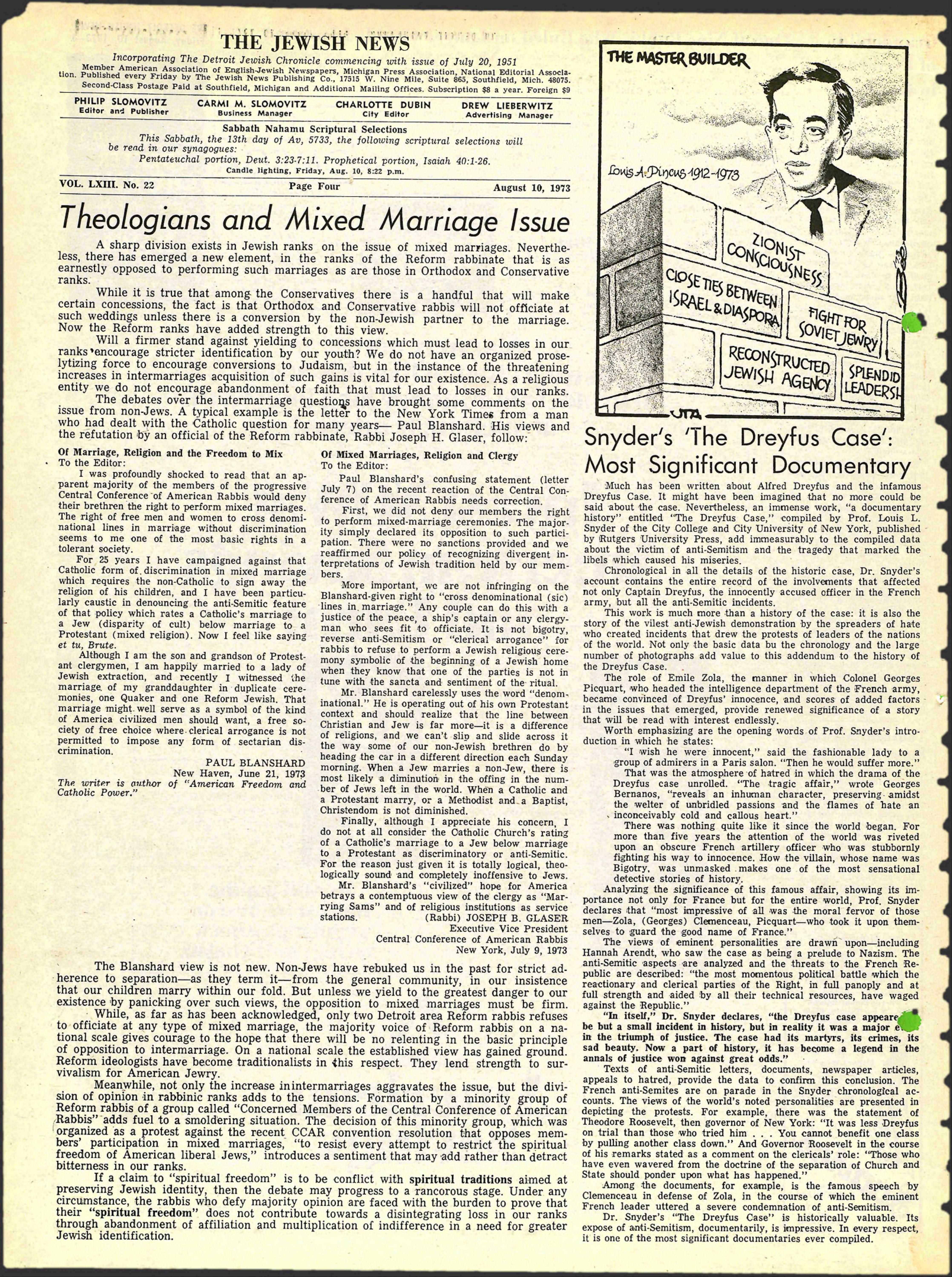
covirAy
REc°NSTRu
JEWISL4 AG
I )1)1E-NDID
LEADER51.
Snyder's 'The Dreyfus Case
Most Significant Documentary
Much has been written about Alfred Dreyfus and the infamous
Dreyfus Case. It might have been imagined that no more could be
said •about the case. Nevertheless, an immense work, "a documentary
history" entitled "The Dreyfus Case," compiled by Prof. Louis L.
Snyder of the City College and City University of New York, published
by Rutgers University Press, add immeasurably to the compiled data
about the victim of anti-Semitism and the tragedy that marked the
libels which caused his miseries.
Chronological in •all the details of the historic case, Dr. Snyder's
account contains the entire record of the involvements that affected
not only Captain Dreyfus, the innocently accused officer in the French
army, but all the anti-Semitic incidents.
This work is much more than a history of the case: it is also the
story of the vilest anti-Jewish demonstration by the spreaders of hate
who created incidents that drew the protests of leaders of the nations
of the world. Not only the basic data bu the chronology and the large
number of photographs add value to this addendum to the history of
the Dreyfus Case.
The role of Emile Zola, the manner in which Colonel Georges
Picquart, who headed the intelligence department of the French army,
became convinced of Dreyfus' innocence, and scores of added factors
in the issues that emerged, provide renewed significance of a story
that will 'be read with interest endlessly.
Worth emphasizing are the opening words of Prof. Snyder's intro-
duction in which he states:
"I wish he were innocent," said the fashionable lady to a
group of admirers in a Paris salon. "Then he would suffer more."
That was the atmosphere of hatred in which the drama of the
Dreyfus case unrolled. "The tragic affair," wrote Georges
Bernanos, "reveals an inhuman character, preserving- amidst
the welter of unbridled passions and the flames of bate an
• inconceivably cold and callous heart."
There was nothing quite like it since the world began. For
more than five years the attention of the world was riveted
upon an obscure French artillery officer who was stubbornly
fighting his way to innocence. How the villain, whose name was
Bigotry, was unmasked makes one of the most sensational
detective stories of history.
Analyzing the significance of this famous affair, showing its im-
portance not only for France but for the entire world, Prof. Snyder
declares that "most impressive of all was the moral fervor of those
men—Zola, (Georges) Clemenceau, Picquart—who took it upon them-
selves to guard the good name of France."
The views of eminent personalities are drawn upon—including
Hannah Arendt, who saw the case as being a prelude to Nazism. The
anti-Semitic 'aspects are analyzed and the threats to the French Re-
public are described: "the most momentous political battle which the
reactionary and clerical parties of the Right, in full panoply and at
full strength and aided by all their technical resources, have waged
against the Republic."
"In itself," Dr. Snyder declares, "the Dreyfus case appeare
be but a small incident in history, but in reality it was a major e'. _
in the triumph of justice. The case had its martyrs, its crimes, its
sad beauty. Now a part of history, it has become a legend in the
annals of justice won against great odds."
Texts of anti-Semitic letters, documents, newspaper articles,
appeals to hatred, provide the data to confirm this conclusion. The
French anti-Semites are on parade in the Snyder chronological ac-
counts. The views of the world's noted personalities are presented in
depicting the protests. For example, there was the statement of
Theodore Roosevelt, then governor of New York: "It was less Dreyfus
on trial than those who tried him . . . You cannot benefit one class
by pulling another class down." And Governor Roosevelt in the course
of his remarks stated as a comment on the clericals' role: "Those who
have even wavered from the doctrine of the separation of Church and
State should ponder upon what has happened."
Among the documents, for example, is the famous speech by
Clemenceau in defense of Zola, in the course of which the eminent
French leader uttered a severe condemnation of anti-Semitism.
Dr. Snyder's "The Dreyfus Case" is historically valuable. Its
expose of anti-Semitism, documentarily, is impressive. In every respect,
it is one of the most significant documentaries ever compiled.