

Hashomer Hatzair Veteran Sees Merger ]
of Old Dreams and New Realities
BY CHARLOTTE DUBIN
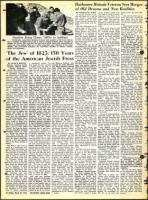
Hasidim Bring Cheer, Tefilin to Soldiers
„,71,111111W
Periodically, Lubavitcher Hasidim in Israel visit members of the Israel defense
forces stationed throughout Israel and at military outposts bringing cheer and gifts at
Hanuka and Purim. They also help the men put on tefilin. Here some Lubavitcher fol-
lowers are seen putting tefilin on a soldier somewhere near Kuneitra in the Golan
Heights. The government transports the Lubavitcher Hasidim in military vehicles,
planes and helicopters.
`The Jew' of 1823: 150 Years
of the American Jewish Press
a missionary society, but
they could not have secured
a charter from the state of
New York if they had come
-caa4-- March, 1973, marks exactly right out and said that they
150 years since the first Jew- were set on saving Jewish
ish periodical appeared in souls.
One of the spearheads of
the United States. An English
language paper called The the new society was a very
Jew, it was edited in New able man named Joseph Si-
York City by Solomon Henry mon Christian Frederick
Jackson, lasted for just about Frey (pronounced F r e e).
two years, and then ceased Born in Germany where his
to appear. Why was it pub- original name had been Jo-
lished? It was issued by Jack- seph Samuel Levi, he was
son, a passionate, fervent a Hebrew teacher, a hazan,
Jew, to counter the mission- and a shohet, but became a
ary propaganda then very convert to Christianity. A
active in the country. The number of years after his
Christian missionaries were arrival in the United States,
determined to "save” tie he was appointed an agent
of the society. The organiza-
Children of Israel.
-'11Pit It is one of the curious as- tion, which was very success-
By JACOB R. MARCUS
Director, American Jewish
Archives, Hebrew Union
College, Cincinnati
pects of American Jewish
history that the Jews here
always displayed an almost
pathological fear of Chris-
tian conversionists. There is
no easy way to explain• this
horror, this dread of the
soulsavers, because for the
most part the missionaries
have been egregiously unsuc-
cessful. Jews, however, re-
main afraid of these evan-
gelists as is documented to-
day by the outpouring of pro-
tests against the "Jesus
Freaks," the Jews for Jesus,
and the impending Christian
...campaign known as "Key
73." Maybe this Jewish dis-
may stems from the sad
realization that Christians de-
stroy the family when they
convert a Jew and separate
him or her from parents or
spouse.
The Jew of 1823 owed its
origin to a missionary cam-
paign which had gotten un-
der way about the year 1819.
Some converts to Christianity
and their friends wanted to
start a colony in New York
state; the colony would shel-
ter European Jewish con-
verts who were to be ship-
.. pad here in the hope that this
land would not expose them
to the contempt of either
Jews or Christians. In Eur-
ope these unfortunates were
damned by Jews for becom-
ing Christians and were
damned by Christians be-
cause they had been born
Jews. In 1820, the same
group of Christians interest-
ed in the projected Jewish-
Christian haven founded an
organization called the Amer-
ican Society for Meliorating
the Condition of the Jews.
They of course constituted
52--Friday, March 23, 1973
old Rebecca Jackson, who
married the great American
Jew, Major Mordecai Manuel
Noah. Noah was then 43,
some 26 years older. How-
ever, as an uncle of Rebecca
wrote her from England:
Better an old man's darling
than a young man's drudge.)
Solomon Jackson had settlei
originally in the Pocono
Mountains near the Dela-
ware River and had married
the daughter of a Presbyter-
ian minister; she bore him
five children. When she died
Jackson moved to New York
and reared all five children
as observant Jews. One of
them, Eliza, married a man
named Donovan who later
became a convert and joined
a synagogue of very Ortho-
ful and at one time had 200 dox Jews.
branches, was led by some of
Jackson was well-versed in
America's most notable per- Hebrew and Jewish lore and
sonalities. Among them were soon turned to Hebrew print-
two men who are still today ing and publishing. Was The
household names: John Ad- Jew his apology for having
ams and John Quincy Adams, strayed by marrying out of
both of whom served as the faith? Please note that,
President of the United unlike his Jewish journalistic
States. One of the men clos- successors, he did not call
est to the society was Elias his paper The Hebrew or
Boudinot, formerly president The Israelite. He called it
of the Continental Congress. The Jew as did quite forth-
For all its organizational suc- rightly Gabriel Riesser fight-
cess, however, the society ing for Jewish liberties in a
converted few if any Jews. reactionary Germany. (Ries-
The society sponsored a ser called his paper Der
conversionist magazine call- Jude, "The Jew.")
ed Israel's Advocate; it was
In 1926, publisher Jackson
resolved to restore the Jews
to their homeland, to save
them spiritually, and to make
sure that despite the society's
"very awful apprehensions,"
the Jews would not go to Hell.
Israel's Advocate began ap-
pearing early in 1823, and the
zealous Solomon Henry Jack-
son came out in March of
that year with The Jew dedi-
cated to the sole purpose of
defending Judaism "against
the insidious attacks of Is-
rael's Advocate." The mast-
head of Jackson's paper car-
ried the verse from Psalms
119: " 'Tis time to work for
the Lord; they have destroy-
ed thy Torah." The Jew was
not really a newspaper; it
was a tract issued periodi-
cally to refute the mission-
aries. It lasted till 1825.
And who was Solomon
Henry Jackson? As his name
would indicate, he had been
born in England, but had
come to this country four or
five years after the British
had been driven out. (Jack-
son may have been remotely
related to the 16- or 17-year-
THE DETROIT JEWISH NEWS
issued a translation of the
Spanish-Portuguese Hebrew
prayerbook and in 1837 print-
ed the first American Pass-
over Hagada. That same
year, a depression year
which brought great distress
to the German refugees who
had just landed, he presided
over a colonizing organiza-
tion attempting to settle Jews
on public lands in the West.
The secretary of the new as-
sociation was another Jew
by the name of Donovan. Ten
years later Jackson died.
Since The Jew's brief pub-
lishing history, some 2,000
Jewish serials, papers, maga-
zines, quarterlies, and an-
nuals have rolled off the
presses in this land in He-
brew, Yiddish, G e r man,
Ladino, Polish, Hungarian,
and Serbo-Croation. Insofar
as it is possible to do so—
for many have completely
disappeared — they are now
being collected and micro-
filmed by the American Jew-
ish Periodical Center housed
in the Hebrew Union College
Library in Cincinnati and
administered by Dr. Herbert
C. Zafren.
At age 50, Hashomer Hat-
zair has taken on a sort of
gray - haired respectability
that would make its early
radical socialist theoreticians
shake their heads with dis-
belief.
But the celebration of the
jubilee year of the "Guar-
dian Youth" — bringing to-
gether present and former
members in a marathon of
nostalgia — is showing at
least one Israeli Hashomer-
nik that "while there's a gap
in years, the young ones are
still doing many of the same
things we did."
Young people are one of
the reasons that Yona Yanai,
a former Hashomer shaliakh
(emissary), is in this coun-
try for the next three or four
months. He hopes to show
them that the idealism of
Hashomer's early years lives
on in the kibutz movement.
Yanai, 62, an early mem-
ber of kibutz Ein Hashofet,
has been meeting with teen-
agers and college students,
partly in hopes of putting to
rest many of their miscon-
ceptions about Israel, Zion-
ism and the kibutz.
A native of Poland who em-
igrated to the United States
at age 16, Yanai made aliya
in 1932. At Ein Hashofet, the
first American kibutz of Has-
homer Hatzair, he married
a fellow kibutznik.
The Yanais' two children
married outside — but not
too far outside — the kibutz.
Their son chose a wife from
nearby Ramat Hoshofet and
brought her to Ein Hashofet.
In turn, their daughter mar-
ried a member of the same
neighboring kibutz and went
there to live.
(At this point, Ein Hasho-
fet has a net gain of one:
Yanai's son has three chil-
dren to his daughter's two).
A former teacher of biolo-
gy, chemistry and agricul-
ture, Yanai works with the
Israel Science Instruction
Center in the preparation of
programs and tests for
schools. He has innovated
biological programs for both
the Hebrew University and
Science Center and edited
science books.
Life on the kibutz has
changed radically from the
way Yanai knew it at the be-
ginning. While agriculture is
still primary at prosperous
Ein Hashofet, industry has
entered the scene. Two small
plants, one for the manufac-
ture of screws and the other
for electrical appliances, pro-
vide a more balanced income
when agriculture is not so
stable.
But they also give employ-
ment to a growing number
of aged in the 400-member
kibutz. "After all," said
Yanai, "no one wants to re-
tire. Our kibutz doesn't have
so much of a problem yet,
but on some kibutzim there
are members in their 70s.
How do you care for them?
The Inter-Kibutz Alliance has
a department looking into the
problems of the aging."
Hashomer (Mapam) kibutz-
im, which comprise 34 per
cent of the total number of
kibutzim in Israel, have
voted to keep the system in
which children live apart
from their parents. There is
no accumulation of wealth.
But many other factors once
thought to be sacred cows of
the movement have changed.
"There's a constant fight
among the first generation
over what's going to break
up the kibutz," Yanai said.
"We used to bring up every-
thing for a vote. Now, if we
want to buy a tractor, a com-
mittee makes that decision.
Only major decisions are
brought up before the entire
kibutz, and we vote by secret
ballot.
"Some of the ideas we had
were products of the times.
We accepted certain things
as basic tenets, like sharing
clothing. When this changed,
some of the early members
thought the kibutz would
break up. But it didn't.
"To the second generation,
the kibutz is a more natural
way of life, and they're not
afraid to question."
That second generation, in-
cidentally, has made its wish-
es felt in other ways. "We
of the first generation look-
ed at marriage differently,"
said Yanai. "We wanted to
show that we were distinct
from the outside society, and
we didn't feel a marriage
was something to show off.
We were allergic to rabbis
and religion.
"But our children don't
feel the same way. Now,
when they get married, there
is a simple ceremony and a
party."
How does the old guard
feel, now that the religious
establishment has had the
last word on marriage?
Yanai smiled. "Well, some
bridle at it. But five years
ago we argued more than we
do now."
There has been even great-
er change in Hashomer Hat-
zair's politics. Along with its
political arm, the Mapam
Party, Hashomer "went
through a crisis of allegiance
to the Socialist world. When
we found out the truth about
the Soviet Union, and what
it was doing to the Jews, it
was a critical point in our
lives as individuals and as
a movement.
"We were fundamentalists,
borderline people. We were
both extreme Socialists and
Zionists, and we had to ab-
sorb the shocks from both
sides. We were bound to have
a large number of casualties.
But we survived.
"Our children of age 30
and down don't even know
there was a crisis." Never-
theless, "the image of our
following the Socialist move-
ment and the Soviet line
followed us like a ghost for
many years. It was easy for
others to brand us. We have
divorced ourselves complete-
ly from the Soviet Union and
have no alliance with any in-
ternational organization."
Hashomer's advocacy of
an Arab-Israeli binational
state — with which it is still
sometimes associated—"was
abandoned in 1947, when we
saw that the other side does
not respond."
Hashomer Hatzair suffered
something of a drop in public
good will when it was learn-
ed that one of the recently-
exposed Syrian-led spy ring
members was a former Has-
homernik from Kibutz Gan
Shmuel.
The case of Ehud Adiv
"echoed more strongly here
than in Israel," said Yanai.
"Gan Shmuel doesn't have to
apologize; it has done an ex-
emplary job in every respect,
including absorption. One of
its sons — Uri Ilan — about
14 or 15 years ago was
caught and tortured by the
Syrians. He committed sui-
cide, but on his body they
found a note. He never talk-
ed.
"Adiv left the kibutz two or
three years ago; he felt the
party didn't have the right
line because we were align-
ed with the coalition govern-
ment.
"Every kibutz member con-
demned what he did. But
Gan Shmuel paid for a law-
yer out of humane reasons:
Adiv's parents have lived
there for 25 years."
Looking back on the his-
tory of Hashomer — born in
Europe and bred with the
Zionist fervor of such
heroes as Mordecai Aniele-
vich (Warsaw Ghetto) and
Abba Kovner (Vilna Ghetto)
Yanai believes that "in
many ways, reality has sur-
passed our dreams.
"Our kibutz is now a th
generation society. Maters -
ly, we never dreamed of such
achievements in agriculture
and industry. If there are any
disappointments, it's the fact
that we didn't grow in per-
centage (to the total Israeli
population). The reservoir of
any h a 1 u t z (pioneering)
movement was Central Eu-
rope. But nothing remained
after the war. Then, after
the establishment of the
state, the wave of immi-
grants was Oriental, and
their background was very
different.
"Now we have a new wave
of immigration: Russian.
They're allergic to collec-
tives and socialism. They
come completely prejudiced.
When they visit the kibutz,
they're shocked to see that
it's nothing like the Russian
state farm which has no
democracy and no freedom.
They find, instead, not bu-
reaucracy but people living
in mutual trust. I think that
within the course of time,
they'll get over the culture
shock, and we'll get some of
the Russian Jews on the
kibutz."
Yanai is optimistic at the
fact that within the last two
years, 30 per cent of the to-
tal growth in the kibutz mem-
bership is among young peo-
ple from the cities. The only
limitation is the lack of hous-
ing. At Ein Hashofet, there
are 200 children under age.
18, 75 per cent of whom will
remain if present trends con-
tinue.
While enlisting financial
support for Hashomer from
its alumni and Americans
for a Progressive Israel, its
adult support arm, Yanai
reminds them that Ein Has-
hofet's early settlers included
eight Detroiters.
One of them, Ephraim
Ticktin, was slain by Arab
marauders in 1938. Another
was the late Yirmiyahu Hag-
gai, whose father Joseph was
a well-known Hebrew teach-
er here.
Yanai estimates that ab
60 Detroiters have made
aliya to kibutzim. Half of
them remained, surmounting
the early primitive conditions
and attacks from hostile Arab
neighbors.
The way has been smooth-
ed for newcomers, but Yanai
is sure there are still a few
worlds to conquer. He pro-
mises the former Hashomer-
niks—the ones who never
made aliya and those who
tried but returned—that he
will not try to change their
minds. "We meet as friends,"
he said. "I only want their
children to join Hashomer.
They will get an education
that will remain with them
forever."
-4111,..40