
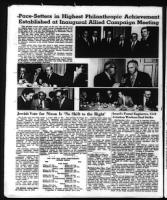

-Pace-Setters in Highest Philanthropic Achievement
Established at Inaugural Allied Campaign Meeting
This pictorial record shows some of the men who set the pace
for highest goals In the 1973 Allied Jewish Campaign-Israel Emer-
gency Fund. They were the participants in the session on Nov. 29,
at the home of Mr. and Mrs. Paul Handleman in Bloomfield Village,
at which the sum of $5,700,000 was pledged.
The top, right, photo, shows (from left) Paul Zuckerman, na•
tional chairman of the United Jewish Appeal, major beneficiary of
the Detroit campaign; Max M. Fisher, chairman of the Jewish Agency;
the guest speaker, Baron Elie de Rothschild; Paul M. Randleman
and Samuel Frankel. general chairmen of the 1973 drive; and Alan
E. Schwartz, chairman of the Jewish Welfare Federation's executive
committee.
Center photos show (from left) Irwin I. Cohn, former campaign
chairman; Dr. Leon Fill, 1973 vice-chairman, William Avrunin, Fed-
eration executive vi4-president, and Sol Eisenberg, former campaign
chairman. At their right are cabinet member Barney Keywell and
the campaign treasurer, Samuel Hamburger.
In bottom photo (from left) are: William M. Davidson, associate
chairman, Irving E. Goldman, industrial and automotive division
leader; and past l'JC president Irwin Green.
At their right are: David Handleman, chairman of Federation's
capital needs committee; former AJC chairman Louis Berry, Daniel
M. Honigman, AJC-IEF associate chairman; and Arthur Howard and
Irving Seligman, pre-campaign chairmen.
' t irs-rD
^
Jewish Vote for Nixon Is `No Shift to the Right'
The 44 per cent vote total
for Richard Nixon in 23
"Jewish" precincts around
Detroit represents the most
dramatic factor in a post-
election survey conducted by
the Jewish Community Coun-
cil.
resent a major shift to the
right. The suggestion can
plausibly be advanced that
at least in the imagery of this
campaign, Nixon emerged
as the "middle grounder" in
comparison with his op-
ponent.
"It was generally conceded
that Nixon would improve on
his 1968 record (16 per cent),
but the 44 per cent vote
proved to be greater than
the preliminary speculation
suggested," according to the
summary of the survey,
whose totals were printed in
an earlier issue of The
Jewish News.
"Within this perception,
the Jewish support which
Nixon's candidacy received
was merely a continuing ex-
pression of the conventional
pattern of Jewish voters.
While expressing a strong in-
clination for a middle-of-the-
road position on the presiden-
tial level, Jewish voters were
overwhelmingly attracted, as
usual, to the so-called liberal
position in respect to other
candidates and issues (viz:
abortion, congressional and
legislative)."
The summary, written by
Council community
affairs
associate Harold Dubin, con-
tinues:
"McGovern's surprising and
impressive victory over
`rlumphrey in the May pri-
mary seemed to suggest that
he had established a solid
base of support among De-
troit Jewish voters. There
was no hint that Jewish
."oters were abandoning their
longtime Democratic allegi-
ance. In November, McGov-
ern was not able to capitalize
on his performance in the
primary, and in some cases
he lost votes in the inter-
vening months."
At the same time, Dubin
writes, "The large Jewish
vote for Nixon does not rep-
Tiff DETROIT JEWISH NEWS ,1
52—Friday, Dec. 8, 1972
• • •
The question of busing, for
example, while it may ac-
count in part for the Jewish
vote for Nixon, "was prob-
ably a more important con-
sideration in the statewide
and congressional contests.
"The busing issue was a
hot item during the primary,
yet McGovern won at a
when he was identified, by
many, with a pro-busing
position. Any significant Jew-
ish anti-busing sentiment
would have surfaced at that
time in a greater vote for
Humphrey or Wallace.
"The busing factor should
not be discounted; however,
there is reason to doubt
whether on the presidential
level it was as important an
issue as suggested by some
commentators.
• • •
1968 AND 1972 VOTE COMPARISONS
JEWISH AREAS
1968
1972
OAK PARK
Nixon-39 Pct.
McGovern-60 Pct.
ROYAL OAK TOWNSHIP
Nixon-12 Pct.
Nixon-34 Pct.
Humphrey-87 Pct.
McGovern-66 Pct.
SOUTHFIELD
Nixon-18 Pct.
Nixon-49 Pct.
Humphrey-81 Pct.
McGovern-50 Pct.
HUNTINGTON WOODS
Nixon-32 Pct.
Nixon-47 Pct.
Humphrey-67 Pct.
McGovern-53 Pct.
TOTAL
Nixon-18.5 Pet.
Nixon-44 Pct.
Humphrey-80 Pct.
McGovern-55 Pct.
Proposition A (daylight saving time) 755--- Yes
Proposition B ( abortion reform) 81 `i. —Yes
Nixon-12 Pct.
Humphrey--86 Pct.
"Another factor which may
account for the Jewish vote
is the administration's well
publicized aid to Israel (since
1971) in the form of arma-
ments and financial credits.
While there was nothing in
the McGovern record to sug-
gest an unfriendly attitude
toward Israel, McGovern was
faced with the reality of
Nixon's performance posed
against McGovern's
prom-
ises.
"As a result, the Rogers
Plan was forgotten, and So-
viet Jewish statements that
Israel's Postal Engineers, Civil
Aviation Workers End Strike
JERUSALEM (JTA) — A and to negotiate others.
six-day long wildcat strike
El Al managed to rush out
by postal engineers ended
Monday evening after the
workers were assured that
their demands for higher
seven flights before midnight
Saturday while foreign air-
lines,
alerted in
advance
that the end of the strike
good faith.
planes to be ready for Sun-
day takoffs.
The strikers had agreed
early Monday to return to
work on the promise of re-
newed negotiations. But the
truce was in effect barely 30
10,000 passengers who had
been delayed by the strike
were flown out of Lod and
wages and improved condi-
tions would be negotiated in
minutes when the engineers
walked out again because
the President's visit to
Russia was followed by more
repressive measures (the
education tax) were
ig-
of remarks by Transport and
Communications Minister Shi-
mon Peres implying that they
nored."
could expect no new offers.
Golda Hit of Party
after Histadrut Secretary
General Yitzhak Ben A,haron
JERUSALEM (J T A) —
Aharon Yadlin, secretary
general of the Labor Party,
said that it was the party's
wish that Premier Golda
Meir remain in office.
• • •
The second walkout ended
promised the workers that the
new negotiations would not
was in sight, flew in their
By morning an estimated
normal schedules were re-
sumed.
The 60-hour walkout had
suspended all traffic at Lod
and other airports except for
military flights and flights
bringing in immigrants.
Israel World's Second
in Incidence of Strikees
TEL AVIV (ZINS) —In
incidence of labor strikes,
Italy ranks number one in
be bound by earlier agree- the world, with Israel a
ments.
close second, according to
The six-day strike blacked Gideon Ben Israel, director
out Israel's television system of labor relations in Israel's
British Like Her, Too and played havoc with tele- ministry of labor.
LONDON — Israeli Prime phone and telex communica-
Four years ago, Israel ex-
Minister Golda Meir ranked tions as workers refused to perienced 100 labor strikes;
repair
equipment
that
broke
third as the most admired
in 1969, there were 142; in
woman in Britain, according down.
1970, 163; in 1971, 169; and
Traffic at Lod Airport was
to a Gallup Poll.
She came in behind Queen back to normal Monday fol-
Elizabeth and "My Wife" in lowing the settlement late
the eyes of the men who re- Saturday night of a 21/2 day
sponded to the poll. Princess strike by civil aviation work-
ers, the longest aviation
Anne ranked fourth.
The most popular men strike in Israel's history.
were President Nixon and
The strike ended when the
Prince Philip, who tied for government agreed to meet
1
first.
some of .the wage demands
in 1972, 72 during the first
nine months of the year.
There are far fewer strikes
in the private sector than
in the public sector. This is
seen as a curious paradox
for a socialist-minded regime,
where the national trade
union organization, Histadrut,
controls the majority of jobs.