

re
The Great Musical Heritage
Tribute to A. M. Klein
Judith Kaplan Eisenstein's Topical Outlines
of the Jewish People's Musiic Culture
The Passing of 'an Entire Jew'
By STANLEY F. CHYET
Professor of American Jewish
History, Hebrew Union College-
Jewish Institute of Religion,
Cincinnati
The world of "Anglo-Jewish"
letters has suffered a number of
in recent
irreparable losses
Maurice Samuel, Judd
months:
Teller, Paul Goodman, and most
recently the Canadian poet Abra-
ham Moses Klein. It is, one sup-
poses something of a commentary
on the quality of North American
Jewish intellectual life that the
poet Klein was the least known of
the three. (Goodman, too, was a
poet of course, but was better
known for his other writings.)
Born into a Polish immigrant
family in Montreal in 1909, Klein
had the benefit of a superior Jew-
ish education and during the late
1920s, while a student at McGill,
began contributing poems to Ca-
nadian Jewish Chronicle and Ca-
nadian Mercury. Before long, pub-
lications "south of the border"
like Poetry and Menora Journal
added to his reputation. His first
volume, "Rath Not a Jew"... ap-
peared in 1940. It was followed
by "The Hitleriad" and "Poems"
in 1944, "The Rocking Chair" in
1947, and an allegorical novel,
"The Second Scroll," in 1951.
Klein's poems were deeply, in-
tensely Jewish, communicating his
often poignant identification with
the Jewish fate and Jewish values,
And Torah scrolls penned by some
scribe, now dead,
And prayer-shawls woven in an
. eastern loom,
And
palm-leaves shipped to the
Uncomforted,
And candlesticks to light some
Sabbath gloom,
And little sacks of holy earth to
spread
Under a pious skull in a far tomb.
Among Klein's admirers was
Ludwig Lewisohn, whose respect
for the Canadian poet's achieve-
ment is amply documented in the
Klein file maintained at the Amer-
ican Jewish Archives on the He-
brew Union College campus in
Cincinnati.
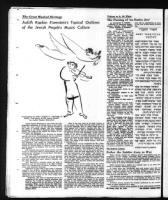
Frontispiece by Marc Chagall in "Heritage of
Music: The Music of the Jewish People"
by Judith Kaplan Eisenstein
•
Judith Kaplan .Eisenstein is one of the very dis-
tinguished authorities of Jewish music in the world.
From her early youth she has devoted herself to
the study of musical origins. She has mastered
knowledge in the field of liturgical music, national
hymns, the songs of the ghetto, the hymns of sur-
vival after the Holocaust.
(She is the daughter of Dr. Mordecai M. Kaplan
and the wife of Dr. Ira Eisenstein, the two outstand-
ing leaders in the Reconstructionist movement).
From 1929 to 1954 she was the teacher of music
pedagogy at Teachers College of the Jewish Theolog-
ical Seminary, has taught at Chicago College of
Jewish Studies and presently is on the faculty of the
School for Sacred Music of Hebrew Union College-
0,A i sh Institute of Religion. She has BA, MA and
PhD degrees.
She enriched the Jewish music library, and the
Union of American Hebrew Congregations has just
published her "Heritage of Jewish Music: The Music
of the Jewish People."
The new work is encyclopedic. It is an immense
creation embodying the music of the ages, the Yid-
dish and Ladino folk tunes, Hebrew melodies and
the songs of Israel.
Mrs. Eisenstein's collected works are fully il-
lustrated, and the frontispiece is by Marc Chagall.
There are reproductions of historic paintings, sculp-
tures and numerous drawings.
Significant in this work is the author's laborious
research, her brilliant explanations, the definitive
factors in many of the musical selections that are
reproduced and annotated. There are the charts pro-
viding the historic dates for the many songs, from
1000 BCE to the present.
Primarily, this work is important for its in-
gathering of the major musical selections that
preserve the wealth of available songs, those
used in prayers and by the masses as folk ex-
pressions. While, as the preface by Edith Sam-
uel states, it is neither a song book nor a his-
tory, It contains the elements of both. As Miss
Samuel states:
"This is the first book of its kind—insofar as
we are aware—that deals with the music of the Jew-
ish people topically, that is, under broad topics of
wide appeal and concern. Anyone who has the
capacity to tap his foot to compelling rhythm or
the urge to sing out—off key or on—or the curiosity
to dip into a rich and incredibly varied musical
culture or the desire to enjoy what is for many an
entirely new era of musical experience—in short,
anyone of whatever age, station and interest in life
today—will find himself drawn into "Heritage of
Music: The Music of the Jewish People.' And what
a heritage it is!"
Musicologists will be enlightened by Mrs. Eisen-
stein's explanations of the retention of ancient Jew-
ish melodies. Musical instruments were used in the
Temple in Jerusalem. "The orchestra," Mrs. Eisen-
stein states, "has been one of the great glories of
the Temple. With the final destruction of the Tem-
ple, the instruments were stilled." She points out
that the Levites' "art of making and playing the
nevel and kinnor, the trumpets and the instruments
of 10 strings, disappeared with the Temple." But
"the old signal horn, the shofar, survived, and so
did its chant. Mrs. Einstein makes this interesting
additional comment:
"In some parts of the world where the Jewish
communities were never exposed to the great de-
velopment of Western music, in places like Yemen
or in Bokhara, high in the mountains of western
Asia, the chant survived in its ancient form without
— as far as we know — significant change. Thus
we can consider the melodies used by the Jews in
such remote settlements to be the oldest survivors
of song once heard in the Temple."
Whether they are the cantillations or the songs
of theater and klezmer, the humor of the jesting
badhan, or the festival theme, the hazan's chants,
Mrs. Eisenstein has defined them with skill and has
accompanied her descriptive work with the music
of the ages. Her work is indeed a most impressive
contribution to the Jewish literary cultural treas-
ures.
In 1945, Lewisohn wrote that in
Klein "the Jewries of English
speech had at last found a poet,"
one who "lived and felt as a Jew
and as a Jew only; he wrote out
of his self ... a Jewish self."
Klein never "looked at Jewish
'themes from without ... He was,
from the first, an entire Jew, a
disciple of the disciples of the
sages, a Hasid, though dwelling
— and why not? — in Canada, a
familiar of Rashi and the Berdit-
chever, a vessel and also himself
a source of tradition."
Emotional troubles would take
their toll of Klein during the clos-
ing decades of his life, but in 1972
Lewisohn's encomium remains as
The Hebrew Column
true and as appropriate as when
it was first written nearly 30 years
ago.
4
1;prl
ritti‘ "pax n'rnn
rP:i'? 7P 5
rq*5 ritrar17.i 11,)1 ? nno x
pz:17 .n,nrt nras nsi 1,7a
nrrn rnsi -rian ,117art
nTPPI? 11'47m17? nnax
ass-,rt ,x4.*77 nianiva iris
- Ippx
.nrintt
60 D1
nnpx rR91rin
niinn
D'I?i17 1?
9-t2z$ -pp`t
•4n1 17; D,1n7pn
- na'7 nrstin trn
atisi wViia;
- CO? triDg na D n trios
- n
x]*]
111'1.1'3329 171t3H71 171017 171317/73
92.m
- 1M-117 . 7 !
162 frkiy03 1711 -14770
v-r»'?
nytz,
03 'tinn
T»t:1 vi'kt
KV'?
1134 arry#
1 17g 40 - 0 n'?srt
.flts?. trait
rnmqfmrinn
it spa' ,(Erpit, 120) ron0
714i n:t7i'2;:t7T ry'rr)7
RV'? mini,
. 1-117417
nip iDni
ni=inn, Tann 1100 rift
n int7;1w;'111.7 *??ErriP'?
rr'mia'aPp
'OR
nT 1.7 *P7? ) ?
0'17)
crnin ltrann
Arn -rm ni313n7a -ni5:n
il ia nr)ca.; 01 rilr4T1
- span na4V tarrrp
."?1
7141V 717174 . -175'?
ng , n7?'70
(n13%,?izt nn39ri,-1? nx4irt7)
Esther the Soldier Goes to War
Esther Stovey enlisted for military service immediately upon the
completion of her studies. Normally, after initial training. Esther
should have become a clerk in one of the military camps somewhere in
the country, however she chose another road. Together with 60 other
girls in the army she volunteered to teach aleph-bet to new immi-
grants living in a far-off immigrant village.
Esther turned into a fighter in a special type of an army that
strives to eliminate illiteracy in Israel.
In Israel there are 162,000,000 men and women who did not
learn to read and write in any language whatsover. These include
40,000 "veterans" spread over the country. In the areas of the new
settlers (120 settlements), more than half the population does TO
know how to read and write.
This situation pressed upon the ministry for education and culture
to bring an elementary education to thousands of homes in Israel.
Professional teachers, women in the army and civilians enlisted to this
operation.
So Esther Stovey reached the Peduim settlement in the western
Negev to teach aleph-bet for a year.
Translation of Hebrew column published by Brith lerith Olnrwlih•
43—Friday, Sept. 22, 1972
ale°'
.1.^"
THE DETROIT JEWISH NEWS