

I
Purely Commentary
Literary Peace Prize of the German Book Trade
for Dr. Janusz Korczak 11-lenryk Goldszmit), Physi-
cian, Author, Humanist, Who Defied Nazi Beasts
The
Belated Tribute to Dr. Janusz Korczak, Hero in Defiance of Nazism
Th-.. is an histor-e day in the annals of remembrance_ It is a time for reaffirmation of the faith that
tyranny cannot survive, that justice will not perish from the earth and the just will he rewarded.
September 1 was chosen as the day on which one of the great heroes of the last war, the human-
itarian Janusz Korc , ak. is to he honored mothilmously
Ile Was a brithint writer, and his children's stores are classics. He was an eminent physician, and
he had rice med hi, life to work with youngsters :'n orphanage.
Th.. Nazis offered him the hribe of survival if he w ere to render his services to them and abandon
the children's hr.rne to which he had dedicated himself lie refused to abandon the youngsters and defied
the Nazis. III` carried two youngsters in his arms as he led the entire group of children on their way to
thegas chambers in Trehlinka. in 1942.
Today the Peace Prize of the German Book Trade o
he presented in his name .
•
Janusz Korczak was his pen name, and he became known by it Ilis real name was Dr. Ilenryk
Goldszmit His many children's books already have been published in Germany in recognition of the labors
of a groat writer who became a martyr under Nazism.
Ile left no heirs, and the demands had been made that the 10.000-Deutschmark German Book Trade
Peace Prize should he given in his spirit, for humanitarian causes. and especially to aid children.
In 1958. the Central Council of German Jews recomMended that the Leo Baeck Prize should go to
Erwin Sylvanus. and he was selected for it as the author of the play "Korczak and the Children."
In the current instance, an effort was made by Polish authorities. since there are no Korczak heirs.
F. have the prize en to the Warsaw Orphanage which had been d'rected by Korczak. The plea was that the
money would be used for'r hurranitarian causes for children in Warsaw. But the Council of German Jews
counteracted there are no longer any Jewish children in that orphanage, as a result of the mass discrim-
ination ago mist JeWs in Poland
By Philip
Slomovitz
Writing of the Warsaw resettlement in his "The Final
Solution," Gerald Reitlinger describes the scene surrounding
Janusz Korczak's removal--along with the children—from his
orphanage in summer of 1942:
"Such evidence could only confirm what in principle had
been known from the first. Contrary to the proclamation, hospital
inmates and even typhus patients were taken in rickshaws in the
very first days to be 'resettled.' On July 28, anyone in the
streets could see the march of the Janusz Korczak orphanage,
complete with nurses and staff, from its premises in Dzielna St.
At the head walked the white-haired Dr. Korczak himself, carry-
ing two babies, a picturesque and universally beloved figure.
No one could suppose that the Germans would saddle themselves
with such a burden in the labor camps of Russia."
With a Janusz Korczak Final Brith Lodge in existence in Berlin. established as a tribute to Korczak's
memory, there also was the proposal that this lodge should supervise humanitarian endeavors with the
Korczak fund. A suggestion made by Michael Wroblewski, chairman of the Polish Korczak Committee, who
1- now an exile fre..n Poland living in Sweden, that the fund he administered by an International Korczak
('immittee to he established in a neutral country, now serves as a solution to a quandary that would other-
wise hake disgraced the memory of a man who placed honor and the dignity of children above personal
security
o n Oct I. at the international BoOk Fair, the Korczak Prsze will be presented to a selected committee
in the Pauluskirche in' Frankfurt.
The citation for the- Korczak..T'eace Prize reads:
"The Pole. Janusz Korcmk, 1878 1942. was a doctor, educationalist and writer. From 1907 he
rnn a Jewish children's home in• Warsaw later a further home for working class waifs. In many pub-
lications he indicated the rialit of the child to enjoy respect and education and the urgency of this
right for the inhere of every society. lie erase not only an important theoretician of peace policy and
but he hiniself practiced what he preached in an exemplary manner in his children's books.
Ile Iti'ed and died with the children entrusted to him in the Warsaw ghetto in the Treblinka death camp.
"At a time when the efforts to achieve peace are more and more recognized not only as a
political prob/ern but as an.ednrational assignment, we are honoring Janusz Korczak the great educa-
tionalist who realized at an early stage what we must all learn: that the obligation to achieve peace
1/7,,,t be instilled into the child."
Dr Finch Dairrenroth, lecturer in education at the Justus Liebig University in Giessen, Germany.
erbiraltIOn
121'27111'`? 311- 1:P - 7r .7
3, - V/11 -12 -7111
JANUSZ KORCZAK
1879-1942
who had done much research about Korczak and the events that marked the horrors to which he and the
children in his orphanage were subjected, stated in a comment about the hero who defied the Hitlerite
niters
- elan.) speeches in Germany and Poland confirm: 'The circle of people who made the acquaintance
of Dr Korczak-and worked with Rim is becoming smaller: but the circle of those who are interested in his
e Mcatomal views. his educational system and his literary works is becoming ever larger'."
In his instructive - Deutschland-Berichte." issued in Bonn, Germany, Rolf Vogel released this im-
portant review of the life and activities of Janusz Korczak:
- tham, in Warsaw -died in Tre-
blinka. - that might well tie the In-
scription for a memorial tablet for
the Polish writer and educational.
1st After all, his great humanist
life and de a th is bound lip with
these two places On July 22.
1878, perhaps 1879, a son was
horn to the Warsaw couple. lozef
and Cacilie.
The attorney Gold-
szmit was not - very exact se lth the
register of births, when tie made
the entry for his little lienryk, for
otherwise the old "Janusz" would
riot have had to write on July 21.
1942: - Tomorrow I shall be bring-
ing to a close my 63rd or 64th year
For many years, my fattier did not
worry about a birth certificate for
WI'
Lath:- I had difficulties on that
account. Mother called it criminal
neglect- as an attorney. father
should not have neglected the mat-
ter of the forth certificate. "
Ilenryk grew up in an atmos-
Idler , of Jewish tradition and
Polish customs and culture. Thi:
was by no means easy. particularly
after the illness and death of his
father. In 1898. Ilenryk Goldsznat
began to study medicine in War-
saw University. To complete his
studies in Warsaw, he went to
the uni‘ersities of Berlin. Paris
and Landon. Partly through the
influence of the Berlin professors,
Adult Baron Baginsky (1845-1918i
and Ileinrich Finkelstein (1865-
1942 i, the attention of the student
was taken beyond the purely medi-
cal to the educational sphere.
At the age of 20, lienrvk Gold-
szmit entered for a literary com-
petition with the play, "Within des
Wages " Tins was the first time
that he used the pseudonym of
Janusz Korczak.
Henry k Goldsznitt was to attain
national fame and worldwide od
nuration and recognition with this
11,11,11`
2—Friday, Sept. 1, 1972
In the satirical periodical, "Sta-
cheln," Korczak published his
novel. "Der Lackai," in 1901. He
surprised everyone with his socio-
critical work 'Kinder der Strasse,"
as with his "Albernheiten." the
early feuilletons out of "Stacheln "
Jan Adolf Hertz said of Dr.
Janusz Korczak in 1907 that "he
hod recognized a decisive wound
which was becoming ever more
dangerous for the social organ-
ism, that of education."
The doctor joined the army for
the Russian-Japanese war of 1904-
1905 and when he returned to his
beloved Warsaw he saw the old
commitments with an even' keener
eye In 1911, he left his excellent
practice as a doctor. As we learn
from his novel. "Das Salonkind.
1914". I can feel the unknown
foices gathering together inside
me and they will rise up with
light which will accompany me
until iny last breath. I feel that
I am near to reaching the goal
out of the abyss of my soul and
harriness will arise out of it."
The building of the children's
home 1 Dim Sierot I in Warsaw
made his decision easier. A note
made by Korczak later shows that
this did net happen without pain.
In this children's home. Korczak
was able to remain faithful to his
medical duties and at the same
tune implement his educational
ideas What Janusz Korczak util-
ized in the was of insight, reflec-
tion and experiment during the
many years of his dealings with
children is outlined 'impressively
in his large book of sketches "How
One Should Love a Child." This
hook did not, however, come into
being in a study', not at an ordin-
ary writing desk; it took shape
during the years of the First
World War when Korczak had to
wear uniform once again On the
THE DETROIT JEWISH NEWS
way to the front, in the trenches,
between attack and defense, the
doctor sat over his sketches and
reflected on how a child should be
loved.
Korczak also wrote clown his
observations of educational every-
day life in the studies, "Bobo,"
"Schmetterlingsbeichte" and "Un-
gluckswoche." Then he met
Maryna Falska (1877:1944). And
from 1919 onward they worked
together on the "Nasz Dom" (our
house), in the first place in Prus-
kow, and later in Bielany. "Fidele
Padagogik." "Katjus der Sauber-
er" and "Der eigensinnige Junge"
are worthy of mention among Kor-
czak's literary work in the 1930s.
Korczak received a shock dur-
ing the September of 1939 when
'the National Socialists prepared
for the "Final Solution of the Jew-
ish Question " The setting up of
the Warsaw Ghetto on the basis
of the ordinance of Oct. 16. 1940
served the same. The epoch of
the ovens began as the follow-
ing years of suffering are still
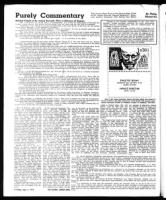
This is the stamp honoring Janusz Korczak which was issued in
Israel in 1962 on the 20th anniversary of his death. The legend reads:
Janusz Korczak—Friend to Children, Father to Orphans, 1879-1942.
called in Poland today. The "old
doctor" with his 200 waifs and
strays had to move into the "stony
world" of the ghetto. condi-
tions of unceasing horror" (Igor
Newerly), Dr. Korczak tried to
secure for his children a remnant
of carefree life in the midst of the
inferno.
The situation had hardly changad
by July 22, 1942, when the be-
ginning of the deportations to
Treblinka and the systematic ex-
termination of the Jews was ush-
ered in.
Korczak says in his ghetto
notes: "The image of this quar-
ter of the city changes from day
to day. Prison. 2, Sickness. 3, Balz
Platt. 4, Asylum. 5, Playground
Hell. Monaco.
When Korczak wrote this, his
hope that the gates of the ghetto
would open again and lead to free-
dom had long since disappeared.
Countless evidence of Dr. Kor-
czak's last days at the beginning
of August 1942 is contained in
letters, ghetto diaries and reports.
Korczak rejected determinedly
any thought of liberation without
the children. He led his pupils into
the gas chambers of Treblinka.
"The end of an educationalist such
as there had never been before
—so heroic his life, so heroic his
death," wrote Franziska Baum-
gartner Tramer some years ago.
The most important writing of
the' doctor in German translation
showing Korczak's knowledge of
the child and his education have
circulated very quickly in our coun-
try. At the same time, they have
imparted knowledge about the
"Polish Pestalozzi." His two vol-
umes about "Ilanschen" are to be
found among the classical chil-
dren's and youth books in our li-
braries. Korczak was not a system-
atic thinker. His quality . lies in
seeing, in bringing to our notice
and in illuminating. lie is eminent-
ly successful here with his liter-
ary sketches, drawings and wood-
cuts. One expert critic put the doc-
tor in the category of a Jean Paul,
Holderlin and Pestalozzi. Barbara
Nordmeyer has described Janusz
Korczak as a "genius of humane-
ness." That is more than litera-
ture.
Dr. Janusz Korczak (Croldszmit) had already been honored with a postage stamp by Israel. The Ger-
man tribute is a belated admission of one of the great crimes committed by the Nazi regime and con-
doned by too many political and social criminals. The continuing tragedy is that Korczak is still referred
tee as "a Pole." lie was a Jew and only in that capacity was he able to display heroism that perpetuates
his name among the great humanists in mankind's history.
While martyred heroes are being remembered and some are honored posthumously, it is often
tragically disturbing to know that criminals also emerge in a spurt of glory as if they had played no role
at all in the littler cruelties.
Suddenly, Leni Riefenstahl was announced as a returnee to the Olympics. Perhaps, as she claims.
she was merely a friend of Adolf Hiller and had not shared in the guilt of the Nazi era. But she was of
the Hitler entourage'
It is true that at the Olympics the Israelis are playing a role of honor. But it is not easy, now
that the international games are played in Munich, that another German city, Berlin, was the scene of the
}filler maniacial outbursts in 1936.
We shall never forget the courage of Raoul Wallenberg and Janusz Korczak. Neither can we
forget the horrors that were Unposed upon them, upon humanity, in the effort that was exerted to besmirch
history'
It is heartening to know that the humanists among the Germans react as we do to the era of
terror, that they condemn the outrages and honor the martyred dead. Perhaps it will secure perpetu-
ation of the decencies without which man cannot live and will assure prevention of a repetition of any-
thing akin to what has gone down as the most barbaric occurrence in history under Hitler and the Nazi
horde,
ii