
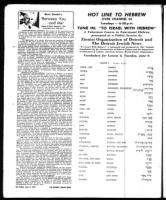

HOT LINE TO IHEBREW
Boris Smolar's
'Between You
... and Me'
Miter in.Chief Emeritus, JTA
(('opyright 1972, JTA Inc.)
CONTEMPORARY HISTORY: The history of the American Jewish
Committee is part and parcel of the history of American Jewry. As
one of the major and most influential Jewish organizations in this
country, the American Jewish Committee has had an impact not only
on Jewish life in this country but also on the fate of Jews in other
countries.
The appearance of a volume reflecting and analyzing AJCommittee
activities for 60 years—from the first year of its existence till 1966--
is therefore a most welcome event. It brings into perspective many
aspects of contemporary Jewish history. It throws light on the rivalries
that existed among Jewish organizations in this country and describes
the times when these very same organizations found ways to coordinate
activities in the interests of American Jewry and of Jews in other
countries. And—what is especially important—it helps our younger
generation understand the problems and the fears faced by American
Jewry only a few decades ago.
Naomi W. Cohen, the noted historian, in her 650-page book titled
Not Free to Desist"—published by the Jewish Publication Society—
traces the development of the American Jewish Committee from a
small defense agency formed in 19436 by a small number of Jewish
notables to w hat it is today--an organization of about 50,000 active
me-n13ers with a record of historic achievements.
She presents this record against the background of general and
Jewish history starting with the fight of the early leaders of the AJCom-
mittee against the anti-Semitic regime of Czarist Russia—to the Holo-
caust—including combating well-organized Nazi propaganda against
Jews in the United States.
OVER CHANNEL 56
Tuesdays — 6:30 p.m.
TUNE- IN: "TO ISRAEL WITH HEBREW"
A Television Course in Functional Hebrew
presented as a Publics Service by
Zionist Organization Of Detroit and
The Detroit Jewish News
"To Israel With Hebrew" is sponsored and produced by The Tarbuth
Foundation for the Advancement of Hebrew (Culture and the Department
of Education & Culture, American Section, -,World Zionist Organization.
Vocabulary for Lesson 4, ;Tuesday, June 6
LESSON 4
LARGE, BIG
(GADOL)
PEOPLE
(ANASHIM)
MANY
(HARBEH)
HALF
(CHATZ I)
BUS
(OTOBOOS)
AUTO (S)
(MECHONPT , MEC HONIYOT
RIDE
(NOSIM)
NOISE
(RAASH)
QUIET
(SHEKET)
TOWER
(MIGDAL)
HEAD, TOP
(ROSH)
SEE
(ROEH)
SEASHORE
(SFAT HAYAM)
CULTURE
(TAR BUT )
PORT
(NAMAL)
QUARTER
(SHIKUN)
ARTIST (S)
(OMAN, OMANIM)
IMPORTANT REVELATIONS: "Not, Free to Desist" is a history
of the American Jewish Committee, but it is not a "company history."
In reading it, one secs that the author used a free hand in selecting
the material, in organizing it and in evaluating certain phases in the
AJCommittee work from the point. of view of an impartial historian.
At some points, Miss Cohen does not hesitate to inject pin-pricks into
the old leadership of the AJCommittee. She believes, for instance,
that the Committee may have appeared irresolute and timid in its
approa.eh to Nazism when Hitler's ascent to power was already
on the horizon in 1932. However, she stresses that no one else—not
even the leaders of the American Jewish Congress—had better ideas
at that -time of how to respond to the crisis.
Miss Cohen also does not fail to put it on record that the AJCom-
mittee - remained aloof - to protest measures advocated by other nation-
al Jewish organizations when news was received in New York on June
30, 1942. of the mass murder of over a million Jews by the Nazis. A
few months later these reports were confirmed by the State Depart-
ment The AJCommittee then joined an ad hoc body called together
by Stephen S. Wise, which prepared a memorandum to be delivered by
hand to the White House_ On December 8, a delegation composed of
the presidents of the American Jewish Committee, American Jewish
Congress, Rnai Britt'. the Jewish Labor Committee, and the Union of
Orthodox Rabbis pleaded with Roosevelt for action by the United
States, in concert with other countries at war with the Axis, to save
what remained of European Jewry. By the time of that interview, two
million Jews had perished, Miss Cohen points out
When more and more desperate messages from the Jews in the
Warsaw ghetto began to reach Jewish leaders in this country, a Joint
Emergency Committee on European Jewish Affairs was formed in New
York, consisting of a dozen of the most prominent American Jewish
organizations. Judge Joseph Proskauer, the leader of the AJCommittee
was a co-chairman of the joint c-riergency body. But even then he had
to explain privately to many of the AJCommittee leaders why he
found it necessary to work with Zionists and to reverse his position on
public demonstrations, Miss Cohen reveals.
' She also reveals that in a number of unpublicized moves. Judge
Proskauer and Stephen Wise worked together harmoniously, and that
both repeatedly urged before government officials on the urgency of
rescue cmerations. She minces no words in criticizing the governments
of the United States and Britain for their failure to rescue Jews from
Nazi hands even when this was possible.
THE AJ(' "NEW I.00K": The first part of "Not Free to Desist"
-the part which deals mostly with the action of the AJCommittee on
behalf of Jews in European countries- is written more emotionally
than the second part which deals primarily with the activities en the
American Jewish scene. In the second part, the author deals especiallv
with the "Slawson Era," the years since 1943 when Dr. John Slawson
became executive vice president of the AJCommittee.
The Slawson Era saw the AJCommittee venture forth in a number of
new directions, she emphasizes. It was Slawson who gave the AJCom-
mittee a "new look - by expanding its membership and introducing the
idea of forming chapters throughout the country. Slawson expressed
ideas differing sharply from traditional AJCommittee philosophy. Ile
posited as axiomatic the need for the AJCommittee to collaborate with
the Jewish community. His approach was, "one cannot do things for
the Jewish people; one must do them with the Jewish people." This,
Miss Cohen points out was a far cry from the stewardship approach
of the Louts Marshall era. Slawson's approach called for the accept-
ance for the fact that the American Jewish community was no longer
a teeming mass of Yiddish speaking immigrants.
Slawson rejected the melting pot theory entirely, on the grounds
that it led to complete assimilation. lie advocated the strengthening
of the spiritual and cultural resource's of American Jewry. It was par-
ticularly important, he insisted. to forgo instruments for Jewish sur-
vival in the United States for the fate of the Jews now rested largely
in the hands of the American Jewish community.
Not all active members of the AJCommittee in 1944 were happy
about the change's in a structure or the Slawson educational approach,
but Slawson's determination in the face of opposition brought the
American Jewish Committee to the heights it now enjoys. Miss Cohen
devotes a good deal of space to Slawson's arguments in favor of
strengthening Jewish identity work
43—Friday, June 2, 1972
THE DETROIT JEWISH NEWS
y Ian •-1 rlt -)
MARKET
-pox
*TT ' TT
(SHUK)
pi tzi
4
PAPGA (S)
(METZ IA , METZ TOT)
STORE (S) , SHOP (S)
(cnr7r,
WANT
(ROTZE , ROTZIM)
MY LADY
(GVERET)
mina
HOI.7 MANY, HOW MUCH
(KAMA)
RISE (DOES IT COST)
(OLEH)
nn
r-
70.17
FALAFEL
(FAL'AFEL)
SQUARE
(KIKAR)
CAFE
(BET KAFE)
THEATRE
(T E AT RON)
CHANCY T)
El;
r1
, 27.),;172m
•
~
1Dr,Cl1 11
o , mil ,1•s11
m7m
T
7) 33
T.
;imp n'm
•
vit-.3x'79