

r
Purely
Ommentary
'
PARIS, France — One of the great names in
modern Jewish history — Dr. Max Nordau — re-
tains affection and interest in fields of historical
research, primarily because of the significant
labors of his daughter, Maxa
Nordau, an artist of great dis-
linction, an eloquent, public
speaker, a keen student of
Jewish and world history in
her own right.
On our visit with her we had
an opportunity to get the reac-
tions of the great lady just as
she was preparing to leave for
a two-month visit in Israel
with her daughter, Claudy-
Gabrielle Nordau.
Maxa Nordau
Mme. Nordau plans to utilize her stay in Israel
for renewal of friendships with her late father's
several surviving associates in Zionist leadership
and to gain renewed inspiration from painting in
Medinat Israel. We found her inspired by a new
interest in her father's works—in the fact that
several postgraduate university students are doing
research for planned literary and biographical
books on Max Nordau.
The name Nordau is imperishable in Zionist
and Jewish history. During the first few World
Zionist Congfesses he was the keynote speaker,
and his interpretations of Jewish experiences in
the trying , years Of the latter part of the last and
the first years of the present century remain
among the classics in evaluative historical analyses.
Several books have been written describing
the life and works of Dr. Nordau, among them the
one by Prof. Meir Ben-Horin of Dropsie Univer-
sity. Several of Dr. Nordau's great classics are
being reprinted, among them "Conventional Lies"
and "Degeneration."
Dr. Nordau had begun to practice medicine
as a gynecologist, then turned to psychiatry. He
devoted many years to writing his works that be-
came very controversial.
He was Theodor Herzl's most eminent asso-
ciate and was among the first to join the Zionist
ranks, becoming a participant, actively, in the
World Zionist Congresses.
Maxa Nordau, who was born in Paris, re-
calls Dr. Herzl's visit in their home. She speaks
with great affection about her father's friend, the
founder of the political Zionist movement.
"Dr. Herzl was tall, handsome, his bearded
_face illumined a kindliness toward all who met
with him, and as a mere child I felt the impact
of genius," Mme. Nordau recalled.
Max Nordau was born in Pest (Budapest) in
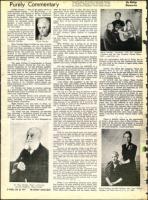
Dr. Max Nordau—From a Painting
by His Daughter, Maxa Nordau
2 Friday, July 23, 1971
—
THE DETROIT JEWISH NEWS
Max.iNordo's Fame' Gains Renewed, 1nte:rest
in Student Research and Activities of His
Distinguished Daughter, Artist Maxa Nordau
1849. He died in Paris in 1923. He had lost his
possessions which were confiscated during World
War I when, as a native of a country with which
France was at war, he was declared an enemy
alien and he and his family gained asylum in Spain.
Maxa Nordau, reminiscing, spoke only of the
happy days, of the historic role played by her
father.
And she recalled also the great labors in behalf
of Zionism and Israel by her husband, the eminent
engineer, Claude Greenblatt, who passed away two
years ago. Their daughter is named for him and
for Max Nordau's father Gabriel as Claudy-Ga-
brielle.
Claude Greenblatt was the engineer who drew
the first plans for the Tel Aviv Harbor and he
rendered many other engineering services to
Israel.
Mlle. Nordau, too, is piling up an enviable
record as a playwright—her plays received good
reviews in Paris—and as a journalist.=-She is an
accomplished musician and has appeared in num-
erous concerts, and now she is a free-lance scien-
tific writer. She makes her home in Paris with
her mother.
There is an affectionate relationship between
the Nordaus and the Greenblatt family, and Maxa
and Claudy were to be guests in Israel of their
nephew and cousin, Yehuda Grinblatt, in Tel Aviv.
*
*
For her paintings—they are exhibited in a
score or more of the world's leading museums and
art galleries—Maxa Nordau has won many awards.
Many homes in London and Paris, in Israel and
other countries, point with pride to her works
that enrich them. Israeli embassies, homes and
museums in South Africa and other places boast
of possessing Mme. Nordau's art works.
"Like father, like daughter" is the way the
famous art critic and author, Irenee Mauget, de-
scribes Maxa Nordau in a brochure that has been
distributed in French and English. Viewing Maxa's
works, Mme. Mauget wrote:
"-Not only do I visit the many art galleries of Paris,
but I also stop at the windows. Time and time again I
stayed with emotion and delight in front of a store in
the Rue de la Pair, looking at one of Maxa Nordau's can-
vases in which she expresses the poetry, the soul of those
landscapes of which every name arouses in us so many
deep memories of our childhood—for it is precious, this
wealth of ideal we collect at the beginning of our life,
and we dilapidate it but too easily.
"There is remarkable unity and also much diversity
in Maxa Nordau's considerable work. One is caught, se-
duced, enchanted by her evocation of the Biblical Land.
There is another side to her talent, quite different at
first sight, yet animated by the same longing for a gen-
erous ideal: it is the realistic but deeply human way in
which she depicts scenes of popular life: the bustle of
workyards or the melancholy of lonely suburb streets at
night; there she discloses her thirst for justice and kind-
ness. This is why I consider her exhibits at the Salon
Populiste as among her best. This Populist movement, this
Populist Salon, which we created and launched aver 30
years ago ! The pioneers' generous effort is too soon for-
gotten ! ... .
"Shall we turn now towards grace and beauty?—for
we can find with Maxa Nordau the full, flexible, shady
brilliant scale of colors and feelings. We bow to feminine
beauty . . . to Beauty !
"Nude is too often equivocal and unhealthy, says
Vlaminck; not with Maxa Nordau. That woman in her
dressing-room, that beautiful modern Eve, has the sensu-
ous beauty of a healthy, splendid plant, grown in full
nature. •
"And here we find exquisite candor in the little girl
in Victorian dress, the child with a dove, holding a sym-
bolic bouquet of flowers in her little fingers. That child
so pure . . . and so modern, has already the dreamy, a bit
anxious, look of those who think of future in our troubled
times. What path will she follow in life? What fate will
be hers?
"Documentation is not absent from Maxa Nordau's
work. She travelled extensively. Here we can see a
square in New York, faithfully described. And here we
have exotic charm with those Bukharian women, a soft
and mysterious smile hovering on their lips.
"We go back to populism, but with a somewhat cruel
fantasy, with The Snout', an ore-grinder. Man cannot build
but at his own image; so we see 'portraits of machines'
with their entirely anthropomorphic physiognomies.
"Maxa Nordau's art is simple, true; look at this 'Black
and White'. How attractive is that guileless face, so kind
and melancholy! How Human!"
*
*
*
There is an interesting personal item about
the Nordaus. On their previous trip to Israel, they
took their cat with them. It was a sensation in the
French press, about "The Tourist Cat to Israel."
When Maxa and Claudine left for Israel, shortly
By Philip -
Slomovitz
Maxa Nordau (standing) with ber daughter
Claudine and her late husband Claude Green-
blatt, --and their cat.
after our conversation with her in Paris, she in-
formed us that the cat that replaced the earlier
one who died in the interim is again being taken
by them to Israel.
*
*
*
Indeed, like father like daughter. When the
Nordaus were in the U.S. during the last war,
Maxa wrote a letter to the now defunct New York
Herald Tribune, in 1944, calling attention to her
father's prophecies, in "Degeneration," warning
of an impending Nazism.
An activist like her father, Maxa Nordau
utilizes every opportunity to help offset manifesta-
tions of anti-Semitism. From her father she gained
a love for Hebrew and while her own knowledge
of the language is limited she expresses joy over
her daughter's interest in studying it.
Just as Maxa has absorbed all of the philoso-
phic and psychiatric works of her father, so, also,
is her knowledge of his Zionist utterings complete.
She joined with us in appreciation of an interest-
ing reference Dr. Nordau had made, in one of his
World Zionist Congress speeches, to the half-assim-
ilated Jew. He had referred to such people as
having "deluded themselves into the belief that
they were good Jews because they loved Heine,
believed in Daniel Deronda, and left nothing to be
desired in their praise- of luger and `sholent.'
They protested that they were `Auch Juden' (also
Jews). I say they are merely 'Bauch Juden' (belly
Jews)."
*
There is historic justice in the opportunity
to recall a great name—that. of Max Nordau—and
fo rejoice in the fact that his heritage is honored -,
so nobly by his daughter, Maxa! With added glory
in the granddaughter, Claudy-Gabrielle.
Maxa Nordau and Her Mother, Mrs. Max (Anna
Nordau, on Their Visit in U. S., in 1942.