
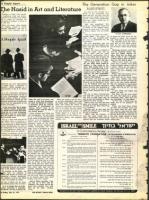

'A People Apart .. .
The Generation Gap in Jokes
The Hasid in Art and Literature
Hasidism
filled with legends.
:t emphasizes song and prayer.
t glories in the image of the Rebbe
Ind it seems to welcome the
lescriptive in imagery as much as
he folk tale.
There are many works dealing
with religious groups in Jewry,
ncluding Orthodoxy, that are il-
ustrated. Few, however, are as
By DAVID SCHWARTZ
(Copyright 1971, JTA Inc.)
Joe said he was working on a
history of the generation gap.
Adam and Eve, Joe said, were the
only ones who couldn't blame their
parents. "I envy future generations
about this," Adam would say, sit-
ting in his rocker.
"Quit your grumbling," Eve
would say. "Most folks would envy
us sitting in our country home,
paying no taxes and if you want
to blame anyone, you can blame
me."
"And you can blame the snake,"
laughed Adam. "You know," he
added, "the right to blame some-
one else is guaranteed by the
Constitution."
The first generation gap, Joe
said, came with their children, then
DAVID SCHWARTZ
no longer be given straw for the
making of bricks, the Israelites
said, "Well this is the last straw."
The Israelites must have had a
good deal of this black humor.
After all, they were the descend-
Adam and Eve were blamed for ants of Isaac, which means laugh-
ter.
"raising Cain."
mpressive as a new work entitled
'A People Apart — Hasidism in
tmerica," which emerges as a
)roud product of the E. P. Dutton
It is an immensely interesting
vork because the text is by one of
he very distinguished American
Fewish writers, Arthur A. Cohen,
'hose preliminary studies for the whole Jew and all of Jewry, but
.abbinate qualify him to define the acting to effect and disseminate
iistory and the aspirations of the its claim. Its Hasidut is eminent-
ly practical, being the concrete
-fasidic movement.
expression of commitment to
At the same time, the 16 pages
Ahavas Yisrael' (Love of the
of unusual Hasidic photographs
Jewish People) and the unity of
by Philip Garvin make this work
the Jewish people."
stand out as a most fascinating
Cohen explains that Philip Gar-
illustrative work on a movement
that has gained so much atten- vin's photographs "are not intend-
ed as a systematic documentation
tion in recent years.
of the whole of Hasidic life. They
This is a large book and the 24- function, as do the Hasidim them-
)age Cohen essay on Hasidism is selves, more by indirection and
)oth a history and a definitive tract selectivity. Some of the rituals
► n the movement. It deals with the
:urrent developments as well as
he background of the great idea
hat has inspired so many and is
io!., invading many new spheres.
evoked by Garvin's sensitive and
probing photographs will strike
many Jews as primitive or curi-
ously quaint, but they are more
than this, much more. This book,
Kabala is explained, and the role like the Hasidim themselves, is a
)f mysticism as defined by Prof. reminder to Jews and a witness to
non-Jews, that 'eternal life is plant-
ed in our midst.' The eccentric
garb, the beards, the disinterest in
appearance are only the outward
marks of the Hasid, outward marks
too often regarded by sophisticated
people as sufficient indices of per-
sonality and character. How bi-
zarre the psychology of the cul-
turally different? Hasidim regard
the outsider not with jealousy or
longing, but with the same degree
of curiosity with which they are
themselves regarded. The diffe-
rence between them and us is that
they are certain of their goal and
their work. We may know more
3ershom Scholem and other schol- about the difficulties and problems,
irs provides material for thorough more about right logic and the
While the pictures tell the story,
so do their explanatory notes and
the Cohen essay enhances a book
filled with charm—the charm of
impressive characters who emerge
here as in fiction and who match
the most attractive in cinema. "A
People Apart" is a work of art,
supplemented by the literary en-
chantment figures who approach
nobility.—P.S.
PI Friday, July 16, 1971
—
scientific objections, more indeed
about everything than they do, but
there is little question that we are
very much confused about the goal
and the work. There is something
to be learned about their stead-
fastness and their witness."
And so Cohen concludes: "One
can only say to them with the
Psalmist: 'Be strong and let thy
heart take courage; Yea, wait
thou for the Lord.' (Psalms
27:14)."
THE DETROIT JEWISH NEWS
Historians, however, rarely col-
lect the humorous stories. You
can't get college degrees for
jokes. Some day, no doubt, you
will be able to get a bachelor
of jokes degree—after all, bache-
lors are very fond of jokes.
"When I was a youth," Joe said,
"there was a popular story about
Cardinal Gibbons asking a rabbi at
a dinner, 'When are you going to
begin eating ham?' The rabbi an-
swered, "At your wedding, your
Eminence!' "
Today, with some priests marry-
ing, that joke would not do.
And there are so many stories
about Jews talking with their
hands. There was the one about the
Jew in the boat which capsized.
The Jew managed to reach shore
safely, although he couldn't swim.
"How did you do it?" he was
asked.
"I just talked and talked and
talked," he said.
And there was the story about
the Jew who stood in a group,
completely silent. "Why don't you
say something?" he was asked.
"In this cold, I should take my
hands out of my pockets?" he
replied.
Today, you hear these stories
no more, but probably Adam and
Eve heard some not very diffe-
rent. Anyway, Adam and Eve, look-
ing at the miniskirts, imitating the
fig leaf dress and the long hair of
the men, might wonder if there
really was such a thing as a gen-
eration gap.
int-wp
ISRAEL'IS ► ILE
A Conversation Series
1
;tudy of the Hasidic inspiration.
The doctrine of the Zohar, the
'En sidle tales, the influence of
kavana and Avoda—of service and
enthusiasm — become understand-
ible realisms vis-a-vis the Hasid
Is they are related by Cohen.
He has a tribute for the domi-
iant Hasidic group when he states:
"It is no wonder that the Luba-
vitcher movement is eminently
worldwide, not only claiming the
I asked Joe what he thought it
was that made Cain kill his
brother. "Well," said Joe, "there
are different explanations. One is
that Cain killed Abel because the
latter tried to tell him an old joke."
"There is a saying," Joe said,
"that if Adam were to return,
the only thing which would be
familiar to him would be the
jokes. That implies there is not
much of a generation gap as far
as jokes are concerned. But we
cannot be sure of this," Joe said,
"because the past generations
have left only a fragmentary
record of their humor."
Who knows, Joe said, the jokes
the Israelites must have told about
Pharaoh and the Egyptians? There
is an old Midrash story that the
leaders of the Israelites, desiring to
expose Pharaoh, who professed to
be a god, made it a point to call
on him when Pharaoh was in the
john.
No one in those circumstances
ever looks like a god even to him-
self. This is quite funny and we
may be sure the Israelites in Egypt
enjoyed the story merrily.
There is also, Joe said, the story
about one Israelite remarking to
Pharaoh that the Bible listed him
as a carpenter.
Pharaoh said he had read the
Bible and nowhere was it said that
he was a carpenter.
"Well," said the Israelite, "it
says you made Joseph into a
ruler." And perhaps when Pharaoh
ordered that the Israelites should
Released by:
By Shlomo Kodesh
TARBUTH FOUN DA TiON FOR THE ADVANCEMENT OF HEBREW CULTURE
GRANDPA AT THE CLINIC
7
Cast: Grandpa and a physician in a Clinic.
Doctor:
Grandpa: Oh, it's not good, something is very wrong. I have pains, lots of
pains. I suffer from stomach disorders and all my bones ache.
Its not good.
Doctor:
Please, grandpa, don't exaggerate. Thank God, you look pretty
well. Please undress and lie down on the couch. That's it. Now,
let's examine you thoroughly. Please breathe, breathe deeply. The
blood pressure is a little low. Not bad, not bad at all. At this
age low blood pressure is better than high blood pressure.
Grandpa: To tell the truth, I don't interfere with my blood pressure. I don't
raise it so that it will be high, and t don't lower it so that it will
be low. It's none of my business...
Doctor:
Naturally. Blood pressure is a concern of the Holy One, blessed
be He, and not of "Flesh and Blood." But what do I see? You've
gained weight. I asked you not to gain weight.
Grandpa: What can you do? You grow old. Each day you get older. The
"machine" is out of order.
Doctor:
maps -noi'f:;i9o•-tereintIVO
tn.-to? 24171*,?eoln 11;a: irltriii?*#•;:o
Shalom, grandpa, how are you? How do you feel? Is anything
wrong?
The "machine" is not out of order. It's actually running well.
But, grandpa, the trouble is that your teeth are working too
much.
5;i0 '71. 2 .0'11
hyp,;o
,a#?
ritp_?;
nolo ht
,0'115!
Hi?
ht5i) r► ;t3
Iritt pro
.17-1 225 '71?#7
for
himself. Do something in the house. Look at a book.
Grandpa: You're right. I always say to myself: you mustn't go to the
refrigerator...
Doctor:
There's a time for everything. Eat at mealtimes and -that's enough.
Besides, grandpa, age is age. les hard to turn you into a young
boy.
Grandpa: Who's asking you to turn me into a young boy? On the contrary,
Doctor, help me to become older....
.r9orj '71; rni`T.toqorih'?
$5 .11,4p tin? at rn5'pbY 'th
rt 5
...tTp pa)? xi, 7-i!
?e71 ton lint stii-ruj'? .Q.17 ny
pi'? tnt?-$5x
. 17Rtrppm Tain7 a'? tioit: 't:t
main tntri•1
nn 59tt
...o5R5Ro n77 -71pDo-;71. -Int. b7 ,1_9t3i'
tr.71 nnyn ,t90 ,59rt
?Hitt? rn? 3Lno
rt"?Fio rtRy7 reri .n'?p,`?Rp
-
npwr;:i
'7a nnr ninon 1'4 olOrit
.nitny7 nn rt3 .ottpry? .T0 . 1?
m
mp? ErnFio:1 into'? , -rlp,o17 rrt1.1
frigerator, to the buffet, and one nibbles something.
A smart fellow like yourself always finds an interesting occupation
in? .r1o;Le5 x5 ,?91? ,;17:V3 :R011
m7;.Y 1"1' ?; 31Yr.IP ' rrt 3vitc,r. Pil?`?
T.Tryi infix rain tx,
rrr.1V iniN 0 '17? 'rx
There's nothing to do. There's the appetite. One goes to the re-
That's it. "Idle hands make mischief." It's not good to be idle.
Kt, ;lit :ion
ninotlo
pia DI - Trit? 717P9
Grandpa: That's true too. One sits at home all day. One loafs around.
Doctor:
- rivp
'771
1i
oro
.',o3nrt`? niot.07.-otton 57 art tert n'?tprj-
Irrain tritriv .npr ripvtos7) in*17? -ran
Zirit
—1 1RT 5ntaa5 Iun$ '''?n7Lr17?im 12-1 T7 'rT1T
tco 71 390 ,n?? yin .7 - ninonxt inn ot?im
"nn?
'iv ,t9 rtrt
-
5L,
nVP.,
nr9 Tim nit71):"; 9F3 teR173 ,7?
-
pr rin:0?
Excerpted from the book "Israel With A Smile", published by Tarbuth Foundation, 515 Park Ave., N. Y. C. 10022