

v•■••■■■•■•■•
Authoritative Historical Data, Large
Pictorial Collection in Abrams Classic
Boris Smolar's
'Between You
. and Me`
Editor-in-Chief Emeritus, JTA
(Copyright 1971, JTA Inc.)
ON THE ALERT: American Jewry supports Israel generously and
wholeheartedly when it comes to philanthropic and economic aid. But
does it properly support activities needed to maintain a friendly politi-
cal atmosphere in the United States toward Israel? Does it, for
instance, give to the American Israel Public Affairs Committee the
full financial support it deserves? . . .
The American Israel Public Affairs Committee conducts herculean
work in Washington against anti-Israel efforts there. It stands guard
against anti-Israel propagandists, whether they come from the Arab
side or from the side of influential American elements interested in
helping the Arab cause. It seeks to expose—in an effective way—
various moves in the capitol detrimental to Israel. It reaches important
government officials, members of both branches of Congress, leading
figures in the clergy, in the labor ranks and institutions moulding
public opinion in this country. It works openly.
No other Jewish organization in the United States duplicates the
unique function of AIPAC on Capitol
Personal contacts by AIPAC leaders with American lawmakers
and with members of other branches of the U.S. government have
created quite a number of friends for Israel in Washington. They
have contributed in no small measure to the cementing of goodwill
between the United States and Israel.
The usefulness of AIPAC has been proven ever since its establish-
ment in 1954. It has helped in many critical moments to improve the
attitude of the U.S. toward Israel. As an American group, AIPAC is
exercising the right of American citizens to petition their government,
to speak and publish their views.
LACK OF FUNDS: With all this important work—AIPAC is highly
respected in the State Department and among members of the U.S.
Congress—this representative body of American Jewry is suffering
from insufficient funds. It conducts its work on a very meager financial
basis. It depends on contributions from individuals, and these do not
come in generously. nor in a large number.
Less than one-tenth of 1 per cent of the approximately 6,000,000
Jews in this country are enrolled as members of the AIPAC. Mem-
bership in this highly important group begins with $25 a year. There
are individual contributors who, realizing the importance of AIPAC's
work, make larger contributions; but not nearly enough to permit the
leaders of the group to develop a fuller and more active program.
AIPAC advocates legislation, and is, therefore, registered with
the Congress under a domestic lobbying law. This deprives it of the
privilege of tax exemption. It cannot, thus, be financed by tax exempt
organizations such as the Jewish Federations and Welfare Funds or
by private foundations. It must depend on contributions from individuals
which are not deductible from income tax. This explains why the
income of AIPAC is so meager. Not many people are eager to con-
tribute to good causes, if they cannot deduct part of their contribution
from their income tax.
examining the Crusades, ritual murder charges,
the Inquisition.
There was the Jewish experience during the
Renaissance, the Jewish adaptations to new values,
the period of great scholarship and the role of
Haskala and Hasidism. In every instance, as during
the darkest ages, the authors described the schol-
arly efforts of the Jews of various periods, the roles
of men like Saadya Gaon, of the Tosaphists, as
well as of the false messiahs.
The illustrations depict the creative efforts
during the periods under review.
History proceeds with the a c co u n t of the
time of the Frankists as well as those who were
influenced by Moses Mendelssohn, the French Revo-
lution, Moses Montefiore, Benjamin Disraeli, the
tragic chapter of the Dreyfus Case.
The anti-Semitism of the time closest to us. –
Nazi era, the Zionist struggle are given empl,
in the course of the delineation of the emergence
of Israel. There is a totality that gains importance
throughout this work.
And because the illustrations are so vital, the
reader, and the art collector who acquires this book,
will feel obligated to Harry N. Abrams for making
it possible.
Modern art plays as important a role here as
the ancient, the photographs of old synagogues,
of tapestries and pottery. Mane-Katz, Aharon
Giladi, Marcel Janco, Amedeo Modigliani, a score
of other noted artists are fully represented here.
There are reproductions of Hagadot and prayer
books that are magnificent.
The Bible reproductions are of special merit, and
the ancient archeological findings will delight the
many who have now become enchanted with arche-
ology.
Illustrated Torah Scrolls and spiceboxes of un-
usual interest will be found in this collection.
Thus, from the Patriarchs to our time, through
the years of Israel's struggles and battles for sove-
reignty, Abrams' "Picture History of Jewish Civi-
lization" contains a wealth of historical data and
many art treasures. It is a work that will be valued
for its story and its pictorial form.
—P.S.
There are more than 230 full-colored illustrations
in "Picture History of Jewish Civilization," an im-
mense work that confirms the important role of the
Harry N. Abrams Publishing Company's specialty in
producing works of art.
That so many important pictures denoting Jewish
historical structures, religious objects and explana-
tory art works should appear in a 248-page book
at once indicates this volume's significance. And
its authoritative status is additionally evidenced in
the editorship which benefits from the scholarship
of five distinguished authorities.
With. Dr. Bezalel Narkiss as editor-in-chief—he
is assisted by co-editors Dr. Samuel Abramsky,
Prof. David Flusser, Prof. Abraham C. Schalit and
Dr. Michael Ziv—this work gains value from
five professorial experts in dealing with Jewish
history.
It begins with the Israelite Monarchy—Saul to
the Babylonian Conquest—and proceeds to analyze
in popular fashion the entire Jewish historical pano-
rama.
All the eras, leading up to "The Return to Zion"
and covering the current experiences, are analyzed,
and the brevity of the work, while emphasizing the
significance of every period in Jewish historical
development, makes this work a popular one for
the lay reader.
At the same time there is the great attraction
for the experts and the knowledgeable in the vast-
ness of the collection of illustrations that depict
religious symbolism, structural achievement in
the architecture of several ages, the archeological
findings and major artists' interpretations of Jew-
ish life, customs, observances.
After covering the various ages, the historic rec-
ords of Palestinian and Babylonian Jewries, the
happenings under the rule of the Roman Empire,
the period of Jewish life in the Eastern Roman
Empire, the Asian chronicles that included the
Islamic and the Khazars as well as the Karaites
and other factors in that sphere; then turning to
the " 'Court Slaves' of the European Kings," the
authors deal with "Four Hundred Years of Horror,"
-
AIPAC LEADERSHIP: It is hardly necessary to emphasize that
those American Jews who, as American citizens, are interested in a
friendly attitude on the part of the U.S. government toward Israel,
should understand that just as their generous contributions for philan-
thropic causes in Israel are important, so also are contributions to
AIPAC.
Judging from the comparatively small number of contributors to
AIPAC, it seems to me that there are many Jews in America who do
not comprehend the role played by AIPAC in Washington in improving
friendship and goodwill between the United States and Israel. They
should make it their business to learn more about AIPAC and to give
it financial assistance, if the fate of Israel is close to their hearts.
Irving Kane, the noted national Jewish leader who is chairman
of AIPAC, emphasized at the two-day national conference of the Com-
mittee—some sessions of which took place in the House of Representa-
tives 'building and in the Senate building—that now is especially the
time which makes it difficult for AIPAC to operate with a minimal
staff and a tiny budget. There is a divergency today between U.S. and
Israel policies which requires increased and constant vigilance and
effort.
Reiterating these views was I. L. Kenen, AIPAC's executive vice
president and very able editor of the "Near East Report" which is the
"Bible" on the desks of many members of Congress and other influen-
tial figures in Washington. Kenen is the spark plug of AIPAC. He has
been its executive officer since 1954 and is well liked in Washington
government circles.
, ,t1,
‘11.
,
'
Crossing of the Red Sea, from a
prayer book which belonged to the
pious Rabbi of Riesen, Germany,
about 1470. Moses is depicted as a
rabbi, with the angel guiding him
hovering above a mountainous
landscape. The miniature is shown
in triple enlargement from the copy
in the Israel Museum, Jerusalem,
in the Abrams collection.
Cardinal Bea World Prize Awarded to ORT
NEW YORK — At ceremonies
May 25 at the Federal Palace in
Bern, Switzerland, ORT is to be
presented with the Cardinal Bea
International Prize in recognition
of its worldwide humanitarian
service.
Daniel Mayer, chairman of the
executive committee of the World
ORT Union, former French min-
ister of labor, will accept the
award from Dr. Rudolf Gnagi,
Swiss president, in the presence
of Cardinal Willebrands, chairman
of the prize committee.
Announcement of ORT's designa-
tion was made by the International
Foundation Humanum, which was
established following Vatican Coun-
cil II to "promote the dialogue
between the Church and the world
... with the obligation to cooperate
with all men of good will whatever
be their religious convictions."
The Cardinal Augustin Bea Prize,
named for the man responsible for
formulation of the Council's decla-
ration of conciliation to the Jews,
in the fields of promotion of peace,
human progress and social justice."
The citation accompanying the
prize notes that "more than one
million people have received ORT
assistance since its inception . . .
From its beginning, ORT's empha-
sis has been on the dignity and
self-fulfillment of the individual."
Two other agencies who will also
receive the award are Christian
Aid, the development agency of the
British Council of Churches, and
was created in 1969 by the Inter- Miseror, the Episcopal Agency for
national Foundation lIumanum to Development Cooperation of the
he granted for "exceptional merit German Federal Republic.
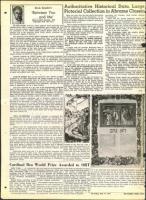
"It is not good that man should be alone." Illuminations were :added
not only to sacred works but also to books on Jewish law during the
Middle Ages. Evenha-Ezer, the third of the four works on Jewish law-
(Arba'a Turim) by Jacob ben Asher, which deals with personal and
family matters, is represented by a wedding scene. This photo from
"Picture History of Jewish Civilization" shows a page from the manu-
script of Arba'a Turim written and illuminated in Mantua in 1436;
it depicts a Jewish wedding in Italy in the middle of the 15th Century. -
De Rossi Manuscript, Vatican Library, Rome.
48—Friday, May 14, 1971
THE DETROIT 1EWIS6 NEWS