

Allied Campaigners Aim to Enroll
26,000 Contributors in 1970 Drive
"Workers are taking a little
In the wake of last week's open-
ing of the 1970 Allied Jewish Cam- time each day to reach the people
paign - Israel Emergency Fund, assigned to them. Some are de-
volunteer workers are striving to voting an entire day or a part of
reach the 12,000 contributors who it to making sure that each of
have not yet been contacted this their prospects knows the full story
year, Maxwell Jospey, chairman, of the great needs for Jewish
communal services here at home
said.
and in Israel," Jospey said. He
Jospey stated that there were
pointed out that when people
great hopes that the total num-
know the full story of the people
ber of contributors would reach
that their money helps they do
26,000 this year in comparison
not hesitate to incease their pledge
to 24.000 in 1969. There have
by
as much as 100 per cent.
been 1,058 new contributors so
Volunteer workers are hurrying
far during the pre-campaign and
to complete as much of their
campaign periods.
Cleveland Education Bureau Issues
Facts Teaching Holocaust to Youth
concentration camps and how
Recognizing the need to keep the
they functioned, and by repro-
youth fully informed about the tra-
ducing excerpts from the poems
gedies of the 1930s and 1940s ' 1 I
of youngsters written in the
especially the horrors that resulted
camps a better idea is given o.
from the Holocaust, the Cleveland
the reactions to the terror from
Bureau of Jewish Education has
the sufferers.
prepared a collection of historical
data on the subject for 5th, 6th and
Special chapters describe the
7th graders.
Yellow Badge edict and the reac-
Complied by Bea Stadtler, a tions of pride to wearing a symbol
member of the staff of the bureau of Jewishness from young and old;
and of the Cleveland College of the Danish rescue efforts; the War-
Jewish Studies, this mimeographed saw Ghetto revolt, and emphasis
hook opens . with an explanatory is given to the efforts to rescue
statement by Mrs. Stadtler and Jews undertaken through Youth
continues with the descriptions of Aliya.
the series of events that com-
This 45-page pamphlet serves an
menced with the Kristallnacht in important role in keeping the
Germany.
young knowledgeable about the
There is a description of the tragedies during the Hitler era.
Drivers, Optometrists Boost Campaign
assignment as possible before the
first report meeting just prior to
Passover on April 19. 10:15 a.m.,
at the Jewish Center.
The second report meeting is
planned for just after the holidays
on April 30, 12:15 p.m.. at the
Fred M. Butzel Memorial Building.
The victory dinner is the following
week on May 6.
Present Indications are that
Detroit Jewry will raise more
money this year in response to
climbing costs and the crisis con-
ditions in Israel, but it will take
concentrated effort on the part
of the volunteer workers and
that of the contributor, Jospey
pointed out. A total of S9,041,000
was reported at the opening din-
ner last week.
Organizations any individuals
are making special efforts in this
year's drive.
In honor of its 50th anniversary
the Radomer Aid and Ladies So-
ciety, one of the largest lands-
manschaften here, has made a
S1,000 contribution to the Israel
Emergency Fund. Officers of the
organization which made the gift
are Nathan Wolok, president; Mrs.
Nathan Wolok, treasurer; Mr.
Ely J. Katz, financial secretary;
and Mrs. Joseph Finkel, recording
secretary.
Pre-campaign leaders are con-
tinuing to meet to complete the
solicitation of prospects whose
commitments were not :.e•ureci
before the opening dinner.
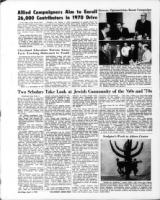
Presiding at the annual breakfast of the Laundry and Linen
Drivers Local 285 is Isaac Litwak (left), president and business
representative of the local. Seated are Arthur S. King (left), presi-
dent of the local, and Robert Steinberg, chairman of the services di-
vision of the 1970 Allied Jewish Campaign-Israel Emergency Fund.
The breakfast was the kick-off of the local's joint drive for the cam-
pzign and the Histadrut campaign.
The optometric section of the professional division, Allied Jew-
ish Campaign-Israel Emergency Fund, is having the greatest year
in its history, according to Dr. Paul Charles Feinberg (left), co-
chairman of the section. With Dr. Steinberg are (from left) Dr.
Ernest Gaynes, adviser; Dr. Eli M. Brown, professional division;
Dr. Morey Firestone; Dr. Ben B. Ravitz; Dr. E. Leon Firestone,
Dr. Sheldon Powell, and advisers.
Two Scholars Take Look at Jewish Community of the '60s and '70s
(Continued from Page 1)
these are a decline in education
for the majority but a greater in-
tensity of training for the minority.
The fact that the Reform move-
ment is opening day schools, that
Jewish camps and Israel experi-
ences are proliferating and that
there is a growing tendency toward
'Judaic studies on campus was
viewed as a positive element in
the picture.
Dr. Gordis complained, how-
ever, that "We don't have enough
time, money and security for
teachers. We have to begin mak-
ing Jewish education a respected
profession."
Further, "You can't educate a
child by sending him to Sunday
school. We must extend the num-
ber of hours."
Dr. Gordis, folinder of the oldest
Conservative day school in this
country, voiced strong support for
the movement but deplored the
fact that only one in 20 Jewish
children attends a day school.
Also stressing the importance of
informal, post-elementary educa-
tion, which has been seriously
reduced with the "dissolution of
the Jewish family," he said, "If I
could educate only one sex, I
would choose the female; and if I
could choose only one age, I would
choose the adolescent."
Dr. Ginsberg suggested that be-
yond the teaching of reading and
writing, "the amount of time and
effort required in teaching Hebrew,
a difficult language, be expended,
and the emphasis shifted" to Bible,
history, ceremonies and other
Judaic subjects.
Disagreement from his colleague
was strong. "Language is more
than just language," Dr. Gordis
said.
Hebrew-oriented studies are
vital, he stated, adding that the
Jewish community of Alexandria,
Egypt, once a vital wealthy Jewry.
"disappeared, not because it
wasn't exposed to anti-Semitism—
because it was. But it was a com-
munity without Hebrew."
Dr. Ginzberg described educa-
tion as an "inter-generational
job," with the involvement of
48—Friday, April 3, 1970
parents extremely important. Dr.
Gordis agreed: "Nothing is more
calculated to motivate a child
than to see his parents looking
into a Jewish book or wrestling
with Hebrew."
Turning to the college genera-
tion, Dr. Gordis called this group
the "most neglected" of all. He
said the Jewish community, which
spends $6 a year on each college
student, must increase its support
to Hillel through federations and
synagogues.
Drs. Gordis and Ginzberg ex-
pressed gratification at the increas-
ing interest in Jewish matters
among students and faculty and
noted especially the growing "Hay-
ura" communal movement, an
attempt by young people to dis-
cover a way of living meaningfully
as Jews.
Less optimistic was Dr. Gordis
view of the effect college education
is having on the rate of intermar-
riage in this country. He claimed
the rate has mushroomed, and in
the next generation, when almost
all Jewish youth will attend col-
lege, the number of intermarriages
will increase still further.
(As an example of the intermar-
riage trend in this country, Dr.
Gordis cited the recent engage-
ment to a non-Jew of the grand-
daughter of the late Henry Mor.
genthau Jr., secretary of the treas-
ury under President Roosevelt.)
Dr. Ginzberg said that while he
was not advocating intermarriage,
not every such union could be
classified as a loss for Judaism.
He also considered as a loss the
Jew who has no affiliation at all.
"Even an atheist Jew is still a
Jew," Dr. Gordis countered.
Conceding that intermarriage is
"the price we pay for living in on
open society," Dr. Gordis said it
can be fought only with the "crea-
tion of positive Jewish values.
associations, environment." And
where intermarriage does take
place, "every effort should be
made to win the non-Jewish part-
ner for affiliation within the Jewish
fold."
Dr. Gordis grouped intermar-
affection of young people from
Jewish ranks. Alienation and
conversion to Christianity have
not only stayed with us, they are
common among a large group of
self haters who are "culturally
and spiritually not Jewish," said
Dr. Gordis.
"We have always had our un-
educated Jews," he said, "but now
we have those who are well edu-
cated generally yet totally unin-
formed Jewishly."
Dr. Ginzberg saw the "youth
crisis" and the appeal of the New
Left as similar to that of the 1930s,
when communism promised to
solve the big problems of the world
and scorned the little ones.
He attributed much of the prob-
lem to affluence ("money is no
longer satisfying to the young")
and suggested that the only counter
is good values. Yet "the family
doesn't worship together, ceremon-
ial life at home is attenuated, the
Sabbath transformed."
"We've used up the tremendously
important experiences of the Holo-
caust and the creation of Israel,
and that is a serious matter," said
Dr. Ginzberg. This "erosion of the
European sources of Jewish mean-
ing" has taken with it a vital stim-
ulus, he said.
But Dr. Ginzberg feels that "the
state of Israel continues to have a
subconscious hold on Jews who are
far from Judaism" — although
there is some erosion in the third
and fourth generations—and he
sees an increasing interest in aliya
-among a minority.
He lamented that the crisis in
Israel has "deflected the Jewish
community from coming to grips
with the problems of education
and the relation of American Jews
to Israel on a meaningful level."
Dr. Gordis agreed that Israel
has much to say to young people
—the kibutz movement as a so-
cial experiment, for example—
but has had to push all to the
background in favor of defense
needs.
"Young people without back-
ground can't be won over with
nostalgia or mysticism," said Dr.
Gordis. "But there are Jewish
THE DETROIT JEWISH NEWS i values with relation to race, to war
riage under the category of dis•
and peace, sex and family.... The
emphasis on the college level
should be that Judaism is not
parochial and narrow, but rather
has the values of a Jewish heri-
tage."
In other areas the two scholars
took up:
• Conservative-Orthodox-Reform
relations: Apart from the extreme
right (ultra-Orthodox) and extreme
left (ultra•Reform), "there is a
gradual accommodation. They
won't merge though." The Con-
servative is dedicated to the au-
thority of the Law, with room for
growth, and the Orthodox maintain
that the Law is Divine, while the
Reform insist the Law's authority
is not Divine. . . ."Uniformity is
not a blessing, but we could use
a greater degree of cooperation
between movements."—Ginzberg.
• Unity in the Jewish commu-
nity: "There is a good deal going
on that is of little value—too much
duplication in effort, competition
and waste of money and manpow-
er. Unity is not involved, but the
structure in which all organiza-
tions can express themselves in
the proper framework"—Gordis.
Soviet Zewry: "The problem
of Soviet Jewry is a particularly
important and neglected area
... Jewish leadership doesn't get
a good mark for its neglect of
this issue"—Ginzberg.
What is a Jew? "The psycho-
logical sense of Jewishness and the
legal definition are different. We
have no alternative but to keep the
old definition. Otherwise it will
split the Jewish community right
down the middle." Every effort
should be made, however, to admit
those who wish to accept Judaism
—Gordis.
Sculptor's Work to Adorn Center
"Design for Sculpture," shown above, will grace the outdoor
approach to the Albany Jewish Community Center, an affiliate of the
National Jewish Welfare Board (JWB). To be executed in bronze by
Natan Rapoport, internationaly known sculptor, it suggests hora
dancers circling a tree whose branches represent the menora and the
tree of life. It will symbolize children and families in joYous activity
at the center.