

Literary Classics, Major Works Dealing With Talmudic,
Biblical, Judeo-Christian Topics in Ktav Reprints
ly because, in critical times, re- ; lined, and the kaddish, presented
Ktav Publishing House has sees actually had been. The num- "Judaism and Christianity" and.
ligion has failed to realize the in the original with an accompany-
emerged as a valuable participant ber and distinction of the scholars while the Jewish continuity is
opportunity, and partly because ing translation, is supplemented
in the presentation of major Jew- on each side, or those who try to affirmed tie Christian scholar has
one of the contradictions in his- with explanations of the inscrip-
ish literary classics. Its managing harmonize them. are not equiva- his full say
tory seems to be that religion is lions on tombstones, the Yiskor,
Bernard Sharstein• has lent to our actually knowing who
head.
with "Law and Religion in Is -
h e but limited control: the El Male Rahamim and other
fated
fa
d to
t hav
A. R. Gibb among the
evinced genuine understanding of the Pharisees were in the same l a m - by
rules related to the period of sad-
over opposing forces."
the need to reproduce and to per- way we know who the Catholics essays of note. the concluding one
He undertakes to advise: "People ncss.
petuate the major works about were and who the Lutherans were by Rosenthal. "Medieval Juadisin
In the very first chapter, "The
must
learn
to
master
themselvus
t
o
i
an
Jews Judaism, the relations with in the 16th century. The Pharisees the
impor tantly
o
h basic ic La
It i s and their surroundings before they Jew Believes," we have evidence
Jews with other faiths, the Talmud could not already have been active
of the sincerity of approach to
and Bible studies. Utilizing the in the time of Zerubabel and at the wor th n oting that Rosenthal de- attempt to better the world. God
a desire to inculcate knowledge.
modern means of reprinting not- same time not have been there at Glares: "The identification of Tora will do the rest without them."
The author goes to the root of
Meanwhile, in his essays about
able works that are out of print all until the Hasinoitt-on period. with wisdom is as old as the
the subject, quoting the texts of
by means of photo offset, he has, They . were either there or they llebrew wisdom literature. The the great in Israel, he outlines the
Bible testimony, tracing the be-
on behalf of Katy, made available were not. Specific, unambigious Maccahean have incorporated cer- higher objectives for a moral law
ginnings of Jewish affirmations
the most important works of ear- and decisive data could answer the thin Greek ideas and customs. as envisioned by prophets and
of faith, indicating how Judaism
her years for Jewish scholars and question one way or the other — and These did not hellenize Judaism, lawgivers.
differs
from Christianity, ac-
Kittel's
are
not
merly
personal-
for lay readers who seek knowl- this without any value judgment but rather created a developed
claiming the Jew as a citizen of
edge about their people's teach- as to whether the Pharisees were J u d a ism which held successfully ity sketches: they are a delving
not hypocrites
the world because "many com-
ings.
but this kind of its ground against Hellenism , ," into history, and in his prolegome-
mandments may be fulfiled only
It is in this fashion, as well is non Dr. Gaster provides, in num-
The numerous works, many of source just does not exist. . . ."
in
the company of fellowmen."
amplifications
the
full
platform
for
both
faiths,
erous
annotations,
which already have been reviewed
Delving into wisdom and apo-
The student who utilizes this
in these columns, are so splendid-
calyptic literature, the first of that the reader arrives at an based on modern research and new
volume meets the Prophets, learns
the three volumes especially fea. understanding of the differences findings.
ly reproduced that the photo off-
Kittel is accepted by Dr. Gaster about the Talmud and its contents,
tures writings of Prof. Oesterley, in faiths, the emphases. the Jew-
set process resorted to matches in
a
distinguished
historian
with
is
informed about the role of the
ish
continuous
culturally-inspired
as
and
the
research
into
Jewish
appearance direct printing pro-
whose views the Bible student rabbi and how he acquires semiha,
sources presents an immensely teachings.
cesses.
must
reckon.
The
availability
of
and
in the chapter "The Bridge to
valuable collection of thoughts
Noteworthy among the newest
Prophets, kings, warriors are "Great Men and Movements in God" gets a perfect idea of the
mingled with historic data that
such works is the three-volumes-
makes this accumulated work of the heroes in "Great Men and Israel" in its present edition pro- significance of the house of wor-
in-one "Judaism
supreme importance to theologic- Movements in Israel" by the late vides students in our time with the ship, the functions of the hazzan
and Christianity"
al students, with equal value for Prof. Rudolf Kittel of the Univer- views and findings of one of the and other related data.
just
- e-issued
From the brit mila, to the pidyon
the intelligent lay reader and sity of - Leipzig, now reprinted as great Christian scholars of the
with a very schol-
, part of "The Library- of Biblical earlier years of this century.
ha-ben, to the huppa, throughout
students from all faiths,
a rty prolegome-
study
Studies"
by
Ktav
Publishing
House.
life,
the symbols of Judaism
non by Prof. Ellis
There is the continuity of
emerge here understandably, forti-
Rivkin of Hebrew
and research in the second volume Dr. Harry M. Orlinsky, as editor
of
the
Ktav
series
"The
Library
of
fied with definitions that create for
Union College-
in which Pharisaism again pre-
Jewish knowledge. That's what's
Jewish Institute
dominates as the subject of discus- Biblical Studies," has contributed
to an effort to provide and make
so
vital about Rosenbaum's "To
of Religion. The
sion. Here we have an evaluative
Viewing Bar Mitzva as "the gate
available the classics dealing with
Live as a Jew."
eminent Chris-
study of Islam, an account of
biblical
studies,
with
historical
re-
to
Jewish
life"
and
recognizing
-
tian scholar Dr.
France in the 13th century and
the Renaissance and Reformation search, in the publishing projects that it is "hardly the end of the
Dr. Rivkin
W. 0. E. Oester-
journey," Samuel Rosenbaum u n-
ley's "The Age of Transition" and under review. Attention is given to of Ktav House.
dertook to encourage supra-curric-
the works of such eminent Jewish the Feudal Period and Pharisaism I Prof. Kittel's scholarly work , ular activities through special stu-
scholars as Dr. Herbert Loewe, and Hellenism are major as topics first printed in 1929, appears in an dies, and for that purpose he pre-
For a fuller understanding of the
r ,rz.-
Dr. Erwin I. J. Rosenthal and for discussion and elaboration.
authorized trans- pared the text of "To Live as a values of Jewish teachings as they
other teachers representing Jews,
H. Loewe edited the second vol- *'
lation from the Jew" in which he has incorporated clash at times during discussions
Catholics and Protestants, mark a ume and the third volume was
German by Char- the basic subjects to be mastered of ecumenism, the basic Christian
collection that ranks this work edited by Erwin I. J. Rosenthal. In
lotte A. Knoch by every candidate for a Bar or ideas must be understood in rela-
e- and C. D. Wright. Bat Mitzva.
among the most impressive relat- the latter the law and religion of
tion to Jewish backgrounds. In this
ing to studies of Judeo-Christian ancient Israel, with emphasis on
1 An illuminating Ktav Publishing House has pro- respect, among the important vol-
teachings and relationships.
Babylonia, Assyria and the Samar-
..t prolegomenon by duced the text—in its English con umes reissued by Ktav Publishing
Dr. Rivkin, in his 56-page essay itans are under review.
Prof. Theodor H. tents with accompanying Hebrew House is "The Jewish Sources of
> Gaster adds con- prayers and required material to the Sermon
introducing this noteworthy vol-
This is where Prof. Herford
on the Mount" by Dr.
ume, takes note of the fact that the
deals extensively with the law
siderably to the produce what the author calls Gerald Friendlander, first publish-
merits
of a work "Jewish Skills." The result is a ed in 1911.
reprinted lectures "have an intrin-
and Pharisaism, and the Rev. Dr.
sic historical interest, since they
T. W. Manson's topic is "Jesus,
that was well re- highly commendable work, excel-
With an informative prolegome-
Dr. Gaster
ceived 40 years lently produced by the discriminat- non
represent a noble effort to foster
Paul and the Law," adding sig-
by Prof. Solomon Zeitlin, this
both non-denominational scholar-
nificantly to the discussion of the ago and is additionally valuable ing publisher, serving a vital need volume is highly resourceful in
ship and an ecumenical spirit."
Christian aspects in this three- for Bible and history students as an inspirer to educational efforts presenting an enlightening back-
Participation of Jewish scholars
volume analysis of "Judaism and today.
growing youth.
ground related to the important
Moses, "as one of the greatest for the
in these collective efforts is ap-
Christianity." The Chiristology in
Splendidly edited by Rabbi subject.
in Israel," is the first of the not-
plauded and the roles of Rosenthal,
this essay is evidenced in the
Abraham
J.
Karp,
this
work
This volume is part of the
able great personalities in Israel serves as a guide to Jewish
H. Loewe and Dr. Erwin J. Rosen-
conclusion: 'To the two ques-
series "The Library of Biblical
dealt with in Kittel's book. The
thal are especially noted.
tions: What does God offer to
the
knowledge,
could
be
a
textbook
Studies"
edited by Prof. Harry
lawgiv er
he
Dr. Rivkin makes this interesting
man? and What does God re-
of great merit for our schools,
Orlinsky,
g t delineator
t
neaor
o f the
th moral l
observation:
quire of man? the New Testa-
fulfills the function it is intended
Significant in this- study is the
law, and the author emphasizes
ment returns one answer: the
"When one considers that even
by the author.
proof that the New Testament
that while be had given the basic
- " as To visualized
after World War II, Toynbee
life of Christ." He emphasizes
Live as a Jew" emphasizes teachings are not original, that
rules for higher standards there
could "fossilize' the Jews before
"There is no place of final aa-
was left
much for
f oer
le muc
other
prophets the Law,' as taught in Jewish tradi- much is derived front Jewish tradi-
thority left for the Law in the
Christianity was even born, not
tion. the festivals and the Holy tion, that while there are some
ki n.
d
to
teac h man
New Testament. As a means of
to speak of the diaspora Jewry
David. Samuel and Saul, De- Days,- the synagogue and prayer, original sayings in Matthew and
salvation it is declared to be
of late antiquity and the Middle
the music of the Jew which pro- Luke, and the other Gospels
Ages, the acknowledgement in
effective, a mere stop-gap, ren- horah, Elijah, both Isaiahs, Jere- vides an opportunity to teach the quoted, the major sources are
these volumes of a creative Jew-
dered obsolete by the salvation miahs, Ezra. Nehemiah. the Mac trope and the melodies using in from the Jewish traditions.
h
are among the his-
ish continuity represented some
wrought by God in Christ. As a cabers—these
Torah and Haftorah readings, the
There is a point made that "vitu-
revelation of the moral demands toric figures who are defined and calendar and a score more of vital peration seems to be a marked
thing of an introductory break-
probed
and
analyzed
by
the
emi-
through to the hyphenation of
of God it is declared to be super-
subjects
that
need
to
be
known
for
characteristic
of the Gospel teach-
seded by the better revelation nent Christian scholar.
Judaism and Christianity, which
a full understanding of Judaism.
ing" with references of "dog and
There creeps in a note of pes-
given in the life and teaching of
in our day is simply taken for
Judaism as a fortress is our life swine" applied to heathens being
simism from time to time, and Dr.
Jesus."
granted."
receives impressive treatment in viewed as "un-Jewish."
Kittel, frequently linking the pa ,t
Thus we have the two contrast- with the
With Pharisaism as the binding
Especially emphatic in noting
expresses the this volume that emerges as a
motif in these volumes, oversha- ing and often conflicting views in vi
labor of love for the creative au- the differences between the Jewish
view t h at:
thor. Re g ulations relating to and Christian teachings are the
dowing the vast amount of other
"Thus far religion has not
material, the writings of so emi-
brought about ideal morals, part- mourning for the dead also are out- following concluding assertions by
nent a Christian authority as R.
Friedlander:
'To Live as a Jew":
Bar Mitzva Guide
Sermon on Mount
Sources Probed
Travers Herford are especially
. On this score. too,
noteworthy.
from the prolegomenon of Dr. Riv-
kin it is worth quoting this com-
ment:
The Pharisees could not hate
been all that the definitions of
scholars have found them to have
been on the basis of their reading
of the sources. Some definitions
are a bsolutely incompatible with
one another, and though we may
give assent to one of this scholar
or that scholar, the Pharisees who
lived and breathed were w hat they
were, and not what our reasoning
-
from the sources, at any given
moment, imagines them to have
been. Neither Schuerer nor Moore,
nor Herford nor Finkelstein nor ,
Zeitlin determines who the Phari-
36—Friday, November 28, 1969
411.
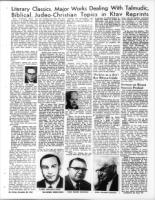
RABBI ABRAHAM KARP
THE DETROIT JEWISH NEWS
PROF. HARRY ORLINSKY
PROF. SOLOMON ZEITLIN
"Quite contrary to the spirit of
Judaism is the principle of non-
resistance, inculcated by the
sermon. Equally un-Jewish is the
asceticism demanded by Jesus.
The principle of having no care
for worldly things is also origin-
al. In all these cases Judaism
prefers to adhere to her old
paths, and for this reason the
Sermon on the Mount cannot be
regarded as the ideal meeting-
ground and bond of union be-
tween Jew and Christian. This is
not to condemn the teaching of
the sermon. It has its parts to
play in the religious training of
the world. The Gentiles have not
displayed any desire to accept
the heavy yoke of God's king-
dom (i.e. the Torah), Instead,
they have gladly exchanged this
(Continued es Page 37)