

Purely Commentary
Israel's Strength Rooted in Biblical Inspiration
Millenial speculation has absorbed many peoples over the puzzle
revolving around Israel's survival. Indestructibility marks our history,
and the Psalmist's assertion "lo omut Id ekhye"—(I shall not die but
live . . . to declare the works of the Lord) has become commonplace.
Not only other faiths, people from all
nations, but Jews, too, have marveled.
But the knowing, the informed, the in-
spired, know the reason. It is so easy to
find in the Bible!
This is a certainty about the People
Israel. About the state of Israel it has
been said that the "ein breira"—"there
is no alternative" is sufficient explana-
tion for the ability of the Israelis to with-
stand all attacks, to defy. threats. What
else can they do but strive for survival?
One defeat and the State is doomed!
But there is another reason: the lack
of fear! Israel's uniquely dramatic and
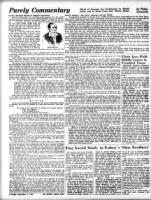
Moshe Day an
fascinating leader, Minister of Defense
Moshe Dayan, had an interesting explanation, and he drew for his
inspiration upon the Bible.
It is no secret that Dayan is not a religious man. Yet, like all his
compatriots, regardless of their non-observance, his learning is steeped
in the biblical.
Also: Dayan, like most Israelis who have been reared on Hebrew,
knows very little Yiddish. Yet he drew upon Yiddish to provide the
proper definition for Israel's power to survive.
The heroic' Israel defense minister had spoken at a convention of
Mizrachi-Hapoel Hamizrahi in Jerusalem, at the headquarters of the
Chief Rabbinate, Heihal Shinano, and he was confronted with a question
—this is where the Yiddish comes in—which he considered even more
difficult than the military queries that were addressed to him. He called
it "the most Jewish question," in which he was asked: "Mr. Defense
Minister, vos vet zein der sof?" ("Where is it all going to end?"). And
the man who figured prominently in Israel's successes over vast enemy
armies turned philosopher but remained practical. At the outset he
insisted upon quoting "what will be?" instead of saying "what will be
the end?" He explained his attitude:
I said "What will be?" and not "What will be the end?"
I did so because it seems to me that the emphasis in this Jewish
question is on the way and not the final objective; on the pro-
cess anj the struggle, and not on the final station. "Menuha
venahaM"—tranquility and home=have always 'wen an ardent
desire for our people and not a reality. If, from time to time,
we achieved them, it was only as temporary stops along the wag,
pauses to replenish our spirit and draw strength and courage
to go on with the struggle. That is why it is better to say "What
will be?" than "What will be in the end?"
Then came the lengthy discourse in the course of which he turned
to the Bible, drawing upon the vision of Abram (Abraham) and the
admonition to the first Jew:
R 1 ' 71 - `2 R
In the new translation published by the Jewish Publication Society
of America, the verse in Genesis 15:1 with the assurance "fear net,"
reads:
. . the word of the Lord came to Abram, in a vision, saying,
'Fear not, Abram,
I am a shield to you,
our reward shall be very great.'"
It is this "al-tir'ah"--"fear not"--that assumes such great signifi-
cance in the life of Israel the People and Israel the State—and the
Dayan speech will no doubt be recorded among the great utterances of
our time by an Israeli leader. It is so impressive, so inspired and so
valuable for the story of Jewish refusal to be obliterated that we quote
it at length:
This question came into being with the first Jew, Abraham—or
to be more precise, when he was still called Abram. He had to inherit
no fewer than ten nations (Genesis 15:18-21): "The Kenites, and the
Kenizzites, and the Kadmonites, and the Hittites and the Perizzites, and
the Rephainz, and the Amorites, and the Canaanites, and the Girgashites;
and tlie-Jebusites." And he was the only Jew in the world!
----Under the circumstances, it is only natural that the demographic
problem occupied him. On top of everything else, he was already 85
years old and childless.
Then the first Jew. Abram, turned his face Heavenward and asked
the Jewish question: What will be? His interlocutor, "the Most High
God, possessor of heaven and earth," said to Abram in the vision:
"Fear not, Abram!" (Genesis 15:1).
I will come back to the significance of this "Fear not." Now I wish
to say that in the next generation, too, in Isaac's time, the Jewish ques-
tion was not solved. Isaac wandered with his wife Rebecca in Egypt,
and then in Phillistia: he had quarrels over water with his neighbors,
finally despairing of ever reaching an arrangement of "agreed and
secure borders" and deciding to emigrate from the land. Then God ap-
peared to him and said (Genesis 26:2): "Go not down in Egypt; dwell
in the land of which I shall tell you." And to Isaac. too, God appeared
in the night. and said to him. (Genesis 26:24): "I am the God of your
father Abraham: fear not
This "fear not" took hold and went on to become our people's
motto, in the statement: "Fear not. 0 Jacob My servant."
Now I should like to dwell on the significance of what I call the
Jewish worry, and also of the "fear not."
All through the generations the Jewish worry has been a twofold
one: concern for the individual Jew, and concern for the nation as a
whole. Concern for the physical fate of the individual Jew, and concern
for the spiritual continuity of the Jewish nation. Concern for the
physical well-being of the Jews of Iraq ,and concern for the spiritual
future of the Jews of the Soviet Union.
Not one single Jewish encounter in the history of our people, not
one single Jewish assembly, not one single session of thought has
considered itself absolved of this twin concern for the lives of Jewish
individuals and for the future of Jewry; and the future of the Jewish
People in our time, as in the Second Temple period, means the destiny
of the Jewish State.
All through the generations we have been destined to struggle
over these two subjects. That is the way it was in the past, and I must
say that it is hard for me to see, at least in the near future, a Jewish
"Scandinavization," a Jewish "Swissification." Therefore I think that
the central, fundamental answer that we are able to give to the ques-
tion "What will be?" is: We shall continue to struggle. It seems to me
that today, as in the past, our answer to "What will be?" must center
on our ability to face difficulties, on our ability to cope with more than
just promises of absolute and final solutions of our problems. We must
grind ourselves spiritually and physically for a long process of struggle
2 Friday, September 5, 1969
—
THE DETROIT JEWISH NEWS
Word of Courage for Fearlessness to World
Jewry and to Israel From Gen. Moshe Dayan
By Philip
Slomovitz
Israel's Lesson — For Jewry, America and the World
Prospective tourists to Israel were unable to secure hotel reservations for the Holy Days.
The moral: tourism has not been interfered with by Arab terrorism. That was a major aim of
fedayeen and El Fatah. Will they learn anything from it to induce them to seek peace?
Tourists were interviewed in Israel about their state of mind, in view of the unending
threats from terrorists. Many said they had less fear in Israel than in New York. Some have
said Detroit or Los Angeles or could have used the names of many other American cities.
The moral: there is something intriguing about the confidence Israel inspires, the faith it, holds
for those who know how Israelis are determined that am Yisrael hat---that the people Israel
lives and will not - die. Another moral lesson: America could learn from Israel and from
many European countries where there is security devoid of panic.
Another valuable lesson from Israel: No one evades the draft in Israel. The country's
youth, and the elders who are in the reserves, are not looking for means of escaping responsi-
bility towards people and state. Of course, it is a struggle for life, for the protection of men,
women and children, and all share in the duty to their fellow men.
Under such conditions, of fearlessness, of devotion and dedication, how can the terrorists
hope ever to succeed?
These are the encouraging elements in a situation in which all of us are closely linked
—as partners in a duty to protect Israel and to avert calamity.
Neither the terrorists nor the UN wish to learn the lessons cited. The distress is in the
role of the American delegate to the UN: what a sad lot which must take orders from the
State Department constantly to appease Arabs and the Kremlin!
Ulster Jews Walk
Middle Course in
Troubled Times
more than for the setting of a timetable for the attainment of "tran-
quility and home."
It is in this context that we have to see the "Fear not, 0 Jacob
My servant." "Fear not" does not mean "Don't worry." This bidding
of the Creator to the Jewish People was not intended as an insurance
policy freeing us of worry and saying: Leave it to Me, possessor of
heaven and earth, to solve all your problems. On the contrary: "Fear
BELFAST, Northern Ireland—A
not, 0 Jacob My servant" means: Jacob, don't be faint-hearted, don't
be a coward! It is our destiny to live in everlasting struggle, and we "Jewish viewpoint" in the struggle
between
Catholics and Protestants
dare not fall into a funk!
War, struggle can be carried on also when there are difficulties would serve no purpose as far as
and limitations. It is possible to wage war even when there is a lack the small Jewish community here
of funds, manpower, technological means, etc. But one thing is im- is concerned, so they are remaining
possible: to fight when you are afraid! "Fear not, 0 Jacob My servant" quiet.
means: Don't funk, Jacob, because there is a long, hard struggle ahead
The community in . Ulster, 1,300
for you. This was the charge given to Abraham, the first Jew; to Isaac
who came to settle in the Negev among the Gentiles, and to Jacob-Israel. out of a total population of 1,500,-
The Jewish People is endowed with two "means" that will enable 000, tries to keep a middle ground
it to endure in its outgoing struggle. One is faith. I don't mean reli- between the two sides. Neverthe-
gious faith particularly, but faith as the antithesis of despair: faith less, they stand ready to cooperate
as an iqnoculation that was injected into the spirit, the lifeblood of
crisis, according to
the Jewish nation on the day it was born; the faith of the Jewish to ease the
people in its way, in the justness of its cause, in its future; faith that Rabbi Vivian Berman, spiritual
safeguards and immunizes against despondency, impotence, defeatism, leader in Belfast.
and inaction.
The publisher of the Belfast
The second is the "fear not," the basis and pre-condition of the
Jewish Record, Joffre Hurwitz;
ability to stand up to the struggle and to overcome, in all times and
said the vast majority of Jews
in all changing conditions.
I had an example of the bedrock foundation for standing up to favor moderation and civil-rights
reforms for the Catholic
changing conditions- when I visited a outpost at Neve Ur in the Belson
ity. But at the same time other
Valley last week. I was scrounging around in the earth piled around one
Jews see the problems as a re-
of the positions to collect sherds from the settlement that existed on
a
the
skeleton
of
upon
the spot in the Canaanite period, when I came
ligious question that they would
warrior, with a food plate lying at his head and his bronze sword at his
rather stay away from.
side.
Understandably, the men at the outpost showed interest in. this Harold Smith, who holds the
warrior who had preceded them by 3,500 years in defending the site. highest elected post of any Jew
All of them expressed their admiration for Joshua's fighting men who here, as a member of the ruling
had fought and conquered the land with such weapons—with 30-centi- Unionist Party and of the Belfast
meter-long bronze swords. They had guts !
City Council, explained that Jews
That is true, but it would seem that even in those days it was are loyal to the coa5titutional ar-
necessary from time to time to repeat the "fear not" to the nation. rangement that makes Northern
Joshua, even after he had won the battle and taken captive the Icings Ireland a part of the United King-
of Jerusalem, Hebron, Yarmut, Lachish and Eglon, deemed it necessary
to assemble his senior staff, the "captains of the men of war," and say dorn. Thus, they would oppose an
to them (Joshua 10:24-25): "Fear not, nor be dismayed, be strong and end to partition and the absorption
of good courage." For Joshua, who was not only a military commander of Ulster into the Catholic Repub-
but also a leader of his people, apparently was of the view that "Fear lic of Ireland to the south.
not, nor be dismayed, be strong and of good courage" is necessary
Remaining impartial has its ups
for the Jews in time of peace as well as in time of war.
There is a necessary postscript to this item: Dayan's above and downs too, according to one
quoted views formed the text of a speech he delivered at the Israel resident, who recalled that "Years
Forces Command and Staff College. Like him, his fellow Israelis ago, when bands of Protestants and
constantly retrace the treks of the Bible in their daily life, in their Catholics used to stop people in the
studies, in reviewing Jewish history. There are no dividing lines road, they would ask whether the
on this score between the biblically-minded people and the more traveler was Catholic or Protestant.
extreme religious observers. It is one people that Dayan spoke of Jews thought they were safe by
—and to! And the inspiration is from the sacred Scriptures whence proudly telling the truth. It didn't
comes much of our strength. Is it any wonder that the wiser among work. They then wanted to know
Israel's antagonists often think twice before they undertake to iwhether he was a Protestant Jew
afflict State and People Israel? or a Catholic Jew."
Fine Social Study in Raboy's 'Nine Brothers'
ranch in North Dakota, from ter as be was in writing Yiddish
An unusual and most dramatic
1911 to 1913, worked on his fa- scholarly work and in delineating
story marks the appearance of the
ther's
farm in Connecticut, work- stories based on his vast expell-
novel "Nine Brothers" by Isaac
ed in factories and in his spare once.
Raboy, published by Yiddisher
time wrote a score of books. The heroes in "Nine Brothers"
Kultur Farband (YKUF). Equating
His "Nine Brothers" was trans- reflect the life's lessons learned by
the text with the life story of the
author, it becomes apparent that lated from the Yiddish by Max Raboy and the struggles, the urge
Rosenfeld and an enlightening fore- for farming, the turn to writing,
the tale is autobiographical.
word by Itche Goldberg, who is an
It is necessary to know the back- authority on Yiddish literary writ- all reflect the author's life.
ground of the author, who died in ings, throws much light on the
A splendid novel appears here in
a sanitarium in Los Angeles, Jan. eminent Yiddish author's creative a good English translation. As the
8, 1944.
efforts. The portrait of Isaac Raboy foreword by Itche Goldberg indi-
ro-
Isaac Raboy had a checquered which greets the reader as he cates: "Raboy moves from a
career. A native of Zawalye, Rus- opens this well written novel is by mantic realism in his earlier works
to a social realism in his later
sia, his childhood years were spent his son, Mac Raboy.
writings. His hero is essentially the
in Rishkan, Bessarabia, where he
Raboy's novel has special
same—Isaac, I, or whatever other
acquired a love for nature.
merit as an evaluative work on
name he may bear. He is always
the early stages of Jewish immi-
He came to the United States
the same young man imbued with
gration to this country. While
in 1904 and in 1906 he published
a deep love for the soil, a sensitive
"Nine Brothers" is a fine ro-
his first stories. It was the begin-
understanding of animals, a lasting
mance, it is also a sharp criti- longing for tranquility and a burn-
ning of a long career as a writer
cism of human indignities which
while among his major loves was
ing compassion for man."
were felt daring trying times by
agriculture. Be enrolled in the
Indeed, it is a social study, a
newcomers to this country.
Baron de Hirsch Agricultural
As an observer of developing work well worth reading — and
School in Woodbine, N.J., in 1908,
graduated is 1910, worked on a events, Raboy was as much a mas studying.