
`The Jewish Experience in America'
Immense Literary Gift to America in Rabbi Karp's Notable
5-Volume American Jewish Historical Society Essay Collection
a creative community of Ameri-
cans who, while laboring within
the Jewish sphere, in their syna-
gogues and schools and in behalf
of fellow Jews everywhere, were
making concrete contributions to-
wards the upbuilding of America.
Thanks to the efforts of a dis-
tinguished American rabbi whose
dedicated research labors assured
the gathering of the most valuable
historical material relating to the
history of American Jewry, the
record of our people in this coun-
try is now more intact, and the
basic works on the economic and
political as well as the spiritual
and cultural factors in American
Jewish life now are incorporated
in a five-volume set of books that
will surely be rated among the
distinct contributions to our lit-
erature.
Rabbi Abraham J. Karp of
Temple Beth El, Rochester. N.Y.•
accomplished the superb task of
selecting the studies that had been
conducted by the American Jew-
ish Historical Society, and they
are now available in the five vol-
umes entitled "The Jewish Ex-
perience in America." Published
by Ktav, in cooperation with the
American Jewish Historical So-
ciety, the collection deals with
five eras in American Jewish his-
tory: Colonial Period, Early Re-
public. Emerging Community. Era
of Immigration, At Home in Am-
erica.
• • •
It is evident from the chrono-
logical arrangement indicated by
these periodic delineations that
the more than 300-year history of
American Jewry is covered in
what has resulted in a labor
of love by an able rabbinic re-
searcher and editor.
Rabbi Karp, in addition to hold-
ing the pulpit in Rochester. serves
as visiting associate professor of
Jewish history at the Jewish Theo-
logical Seminary in New York. He
is professor of theology at St. John
Fisher College in Rochester and
is the author of "The Jewish Way
of Life."
Jewish traders are referred to
in the earlier volumes with re-
gard to the Michigan territory
and its pioneering settlers.
A Michigan history apparently
is yet to be included in forthcom-
ing Jewish Historical Society Pub-
lications, and the Detroit story is
thus far unrecorded in these vol-
umes.
• • •
Essayists whose evaluative
labors now form the source of
information about the Jews of
America drew their information
from newspapers, advertise.
ments, circulars, congregational
minute books and from recorded
American historical archives.
•
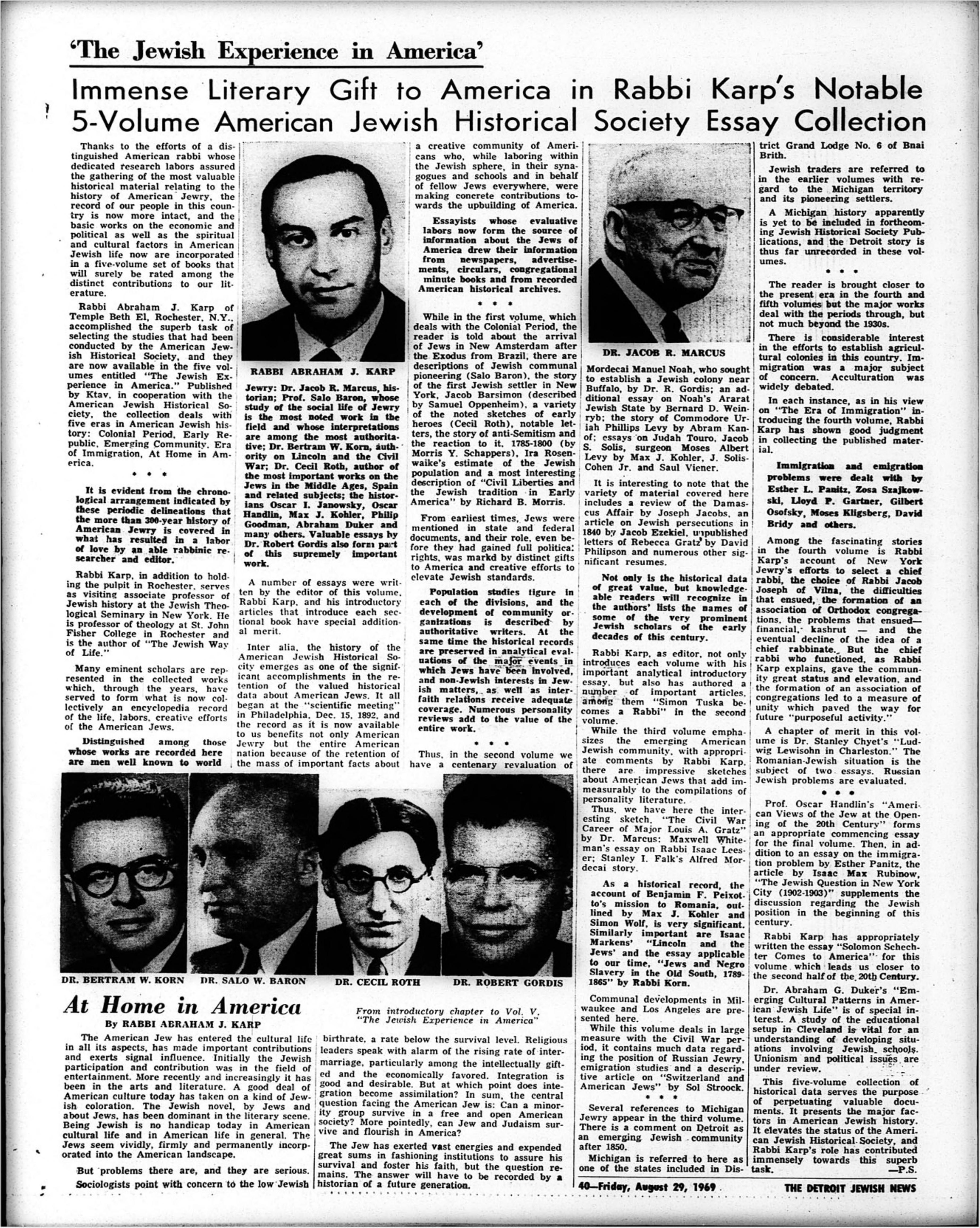
RABBI ABRAHAM J. KARP
Jewry: Dr. Jacob It. Marcus, his-
torian; Prof. Salo Baron, whose
study of the social life of Jewry
is the most noted work in the
field and whose interpretations
are among the most authorita-
tive; Dr. Bertram W. Korn, auth-
ority on Lincoln and the Civil
War; Dr. Cecil Roth, author of
the most important works on the
Jews in the Middle Ages, Spain
and related subjects; the histor-
ians Oscar I. Janowsky, Oscar
Handlin, Max J. Kohler, Philip
Goodman, Abraham Duker and
many others. Valuable essays by
Dr. Robert Gordis also form part
of this supremely important
work.
A number of essays were writ-
ten by the editor of this volume.
Rabbi Karp. and his introductory
articles that introduce each sec-
tional book have special addition-
al merit.
The reader is brought closer to
the present era in the fourth and
fifth volumes but the major works
deal with the periods through, but
not much beyond the 1930s.
• •
While in the first volume, which
deals with the Colonial Period, the
reader is told about the arrival
of Jews in New Amsterdam after
the Exodus from Brazil, there are
descriptions of Jewish communal
pioneering (Salo Baron), the story
of the first Jewish settler in New
York, Jacob Barsimon (described
by Samuel Oppenheim). a variety
of the noted sketches of early
heroes (Cecil Roth), notable let-
ters, the story of anti-Semitism and
the reaction to it, 1785-1800 (by
Morris Y. Schappers), Ira Rosen-
waike's estimate of the Jewish
population and a most interesting
description of "Civil Liberties and
the Jewish tradition in Early
America" by Richard B. Morris.
From earliest times, Jews were
mentioned in state and federal
documents, and their role, even be-
fore they had gained full politica:
rights, was markd by distinct gifts
to America and creative efforts to
elevate Jewish standards.
DR. JACOB R. MARCUS
There is considerable interest
in the efforts to establish agricul-
tural colonies in this country. Im-
migration was a major subject
of concern. Acculturation was
widely debated.
Mordecai Manuel Noah, who sought
to establish a Jewish colony near
Buffalo, by Dr. R. Gordis; an ad-
ditional essay on Noah's Ararat
In each instance, as in his view
Jewish State by Bernard D. Wein- on "The Era of Immigration" in-
ryb; the story of Commodore Ur- troducing the fourth volume, Rabbi
iah Phillips Levy by Abram Kan- Karp has shown good judgment
of; essays on Judah Touro. Jacob in collecting the published mater-
S. Solis, surgeon Moses Albert ial.
Levy by Max J. Kohler, J. Solis-
Immigration and emigration
Cohen Jr. and Saul Wiener.
problems were dealt with by
It is interesting to note that the
Esther L. Panitz, Zosa Szajkow-
variety of material covered here
ski, Lloyd P. Gartner, Gilbert
includes a review of the Damas-
cus Affair by Joseph Jacobs, an
Osofsky, Moses Kligsberg, David
article on Jewish persecutions in
Bridy and others.
1840 by Jacob Ezekiel, tripublished
Among the fascinating stories
letters of Rebecca Gratz by David
Philipson and numerous other sig- in the fourth volume is Rabbi
Karp's account of New York
nificant resumes.
Jewry's efforts to select a chief
Not only is the historical data rabbi, the choice of Rabbi Jacob
of great value, but knowledge. Joseph of Vilna, the difficulties
able readers will recognize in that ensued, the formation of an
the authors' lists the names of association of Orthodox congrega-
some of the very prominent tions, the problems that ensued—
Jewish scholars of the early financial, - kashrut — and the
decades of this century.
eventual declin e th
ea id
or f a
Rabbi Karp, as editor, not only chief rabbinate. But the chief
rabbi who functioned, as Rabbi
introduces each volume with his Karp explains, gave the commun-
Population studies figure In
each of the divisions, and the
development of community or-
ganizations is described by
authoritative writers. At the
same time the historical records
Inter alia, the history of the
are preserved in analytical eval-
American Jewish Historical So-
uations of the majoi events in
Many eminent scholars are rep- city emerges as one of the signif-
which Jews have been involved,
impOrtant analytical introductory ity great status and elevation, and
resented in the collected works icant accomplishments in the re-
and non-Jewish interests in Jew- essay.
but also has authored a
which, through the years, have tention of the valued historical
ish matters, as well as inter- number of important articles, the formation of an association of
served to form what is now col- data about American Jews. It all
among
them "Simon Tuska be- congregations led to a measure of
faith relations receive adequate
lectively an encyclopedia record began at the "scientific meeting"
unity which paved the way for
coverage. Numerous personality c vo om
lue m s e.
in
Philadelphia.
Dec.
15,
1892.
and
a Rabbi" in the second future "purposeful activity."
of the life, labors, creative efforts
reviews add to the value of the
the record as it is now available
of the American Jews.
entire work.
While the third volume empha-
A chapter of merit in this vol-
to us benefits not only American
sizes the emerging American ume is Dr. Stanley Chyet's
Distinguished among those Jewry but the entire American
• • •
Jewish
community,
with
appropri-
wig
Lewisohn in Charleston." The
whose works are recorded here
nation because of the retention of
Thus, in the second volume we
are men well known to world , the mass of important facts about have a centenary revaluation of ate comments by Rabbi Karp. Romanian-Jewish situation is the
there are impressive sketches ' subject of two essays. Russian
about American Jews that add im- Jewish problems are evaluated.
measurably to the compilations of
• • •
personality literature.
Prof. Oscar Handlin's "Ameri-
Thus, we have here the inter- can Views of the Jew at the Open-
esting sketch, "The Civil War mg
of the 20th Century" forms
Career of Major Louis A. Gratz" an appropriate commencing essay
by Dr. Marcus: Maxwell White- for the final volume. Then, in ad-
man's essay on Rabbi Isaac Lees- dition to an essay on the immigra-
er; Stanley I. Falk's Alfred
Mor- tion problem by Esther Panitz, the
decai story. article
by Isaac Max Rubino•,
As a historical record, the "The Jewish Question in New York
City
(1902-1903)"
supplements the
account of Benjamin F. Peixot.
to's mission to Romania, out- discussion regarding the Jewish
lined by Max J. Kohler and position in the beginning of this
Simon Wolf, is very significant. century.
Similarly important are Isaac
Rabbi Karp has appropriately
Markens' "Lincoln and the written the essay "Solomon Schech-
Jews' and the essay applicable ter Comes to America" - for this
to our time, "Jews and Negro volume which leads us closer to
Slavery in the Old South, 1789- the second half of the, 20th Century.
DR. BERTRAM W. KORN
DR. SALO W. BARON
DR. CECIL ROTH
1865" by Rabbi Korn,
DR. ROBERT GORDIS
Dr. Abraham G. Duker's "Em-
Communal deVelopments in Mil- erging Cultural Patterns in Amer-
•aukee and Los Angeles are pre- (can Jewish Life" is of special in-
From introductory chapter to Vol. V.
sented here.
terest. A study of the educational
"The Jewish Experience in America"
By RABBI ABRAHAM J. KARP
While this volume deals in large setup in Cleveland is vital for an
The American Jew has entered the cultural life
measure with the Civil War per- understanding of developing situ-
birthrate. a rate below the survival level. Religious
in all its aspects, has made important contributions leaders speak with alarm of the rising rate of inter-
iod, it contains much data regard. ations involving Jewish_ schools.
and exerts signal influence. Initially the Jewish
ing the position of Russian Jewry, Unionism and political issues are
participation and contribution was in the field of marriage. particularly among the intellectually gift-
emigration studies and a descrip- under review.
ed
and
the
economically
favored.
Integration
is
entertainment. More recently and increasingly it has
tive article on "Switzerland and
This five-volume collection of
been in the arts and literature. A good deal of good and desirable. But at which point does inte-
American Jews" by Sol Stroock.
historical data serves the purpose
• • •
American culture today has taken on a kind of Jew- gration become assimilation? In sum, the central
of perpetuating valuable docu-
ish coloration. The Jewish novel, by Jews and question facing the American Jew is: Can a minor-
Several references to Michigan ments. It presents the major fac-
about Jews. has been dominant in the literary scene. ity group survive in a free and open American
Jewry appear in the third volume. tors in American Jewish history.
society?
More
pointedly,
can
Jew
and
Judaism
sur-
Being Jewish is no handicap today in American
There is a comment on Detroit as It elevates the status of the Ameri-
cultural life and in American life in general. The vive and flourish in America?
an emerging Jewish community can Jewish Historical. Society, and
Jews seem vividly, firmly and permanently incorp-
The Jew has exerted vast energies and expended
after 1850.
Rabbi Karp's role has contributed
orated into the American landscape,
great sums in fashioning institutions to assure his
Michigan is referred to here as immensely towards this superb
survival and foster his faith, but the question re-
one of the states included in Dis- task.
But problems there are, and they are serious.
mains. The answer will have to be recorded by a
Sociologists point with concern to the low Jewish historian of a future generation.
40 — Friday, August 29, 1969
THE DETROIT JEWISH NEWS
At Home in America
•
trict Grand Lodge No. 6 of Bnai
Brith.