

Statesmen From Many Lands Honor Eshko 's Memory ,
(Continued from Page 1)
half mast, and all places of enter-
tainment were closed. Mourning
for a man who was one of the pil-
lars of the world Zionist movement
and of the Yishuv, the Jewish
community of Palestine, as well as
one of the founders of the state
of Israel, was mixed here with con-
cern the effect of his sudden death
would have on the domestic politi-
cal situation and on Israel's inter-
national position.
Mr. Eshkol and his closest asso-
ciates, Minister Without Portfolio
Pinhas Sapir and former Foreign
Minister Golda Meir, were firmly
in control of the Israel Labor Party
machinery and were able to keep
personal rivalries with regard to
the succession in check. The party
with its political alignment. with
the Mapam Party, has a parliamen-
tary majority. Mr. Eshkol's an-
nouncement that he would seek
to retain premiership after the Oc-
tober general elections had avert-
ed a bitter struggle within the
party by Defense Minister Moshe
Dayan, Deputy Prime Minister Al-
Ion, and possibly others, to suc-
ceed Mr. Eshkol.
Israeli officials dismissed as
utter nonsense claims immedi-
ately broadcast by the Arab
terrorist organization El Fatah
that Mr. Eshkol had died as a
result of wounds suffered when
the terrorists shelled his resi-
dence in Degania last week.
They pointed out that Mr. Esh-
kol had not been in Degania
since the beginning of, the month.
(United Press International cor-
respondent Jacob Friedler, who
visited Degania Tuesday, said
rockets fired by the guerrillas
caused neither damages nor cas-
ualties.)
Levi Eshkol was one of the last
of the members of the Second
Aliya to hold high office in Israel.
Of his contemporaries and associ-
ates over a half century, David Ben
Gurion, whom he succeeded as
prime minister, is in the politilal
background now, and Mrs. Golda
Itleir, the former foreign minister,
no longer holds public office al-
though she remains a power in the
Israel labor party.
A native of the Ukraine, Levi
Shkolnik (he changed his name in
1948 when Israel's statehood was
established) emigrated to Palestine
in 1914 and worked as a laborer.
When the Jewish Legion was es-
tablished, he volunteered and saw
service along with Mr. Ben-Gur-
ion and the late Itzhak Ben-Zvi, Is-
rael's second president. As a cor-
poral in the Jewish Legion, he
witnessed the dedication of the
Hebrew University on Mount Sco-
pus and in Jerusalem and, almost.
50 years later, as prime minister,
participated in the dedication of
its building there after the road
to Scopus had been opened up in
the Six-Day War.
He was a founder of the colony
of Degania Beth, at Lake Tiber-
ias, where he maintained a
home and was an active member
of the Jewish labor movement all
his life. His political rise was
slow and laborious and his role
was overshadowed by the great
luminaries of the Zionist labor
movement—Mr. Ben-Gurion, the
late Chaim Arlosorof and the
late Moshe Sharett. First in the
Zionist movement and the Jewish
agency and then in the Israel
government, be proved himself
in difficult assignments with the
portfolio of agriculture and fi-
nance.
Mr. Eshkol became prime minis-
ter and minister of defense on
June 26, 1963, when Ben-Gurion
stepped down in his favor and he
held both posts until May, 1967
when on the eve of the Six-Day
War, he surrendered the defense
post to Gen. Dayan.
Previously Mr. Eshkol and Ben-
Gurion had split over the so-called
"Lavon Affair" and Ben-Gurion
sought the defeat and removal
from the political scene of the man
he had designated to succeed him-
self. In his struggle with Mr. Esh-
kol over the case, Ben-Gurion
seceded from the Mapai party with
a group of his followers, among
them Gen. Dayan, set up and inde-
pendent labor party (Rafi) and
began to build up Gen. Dayan as
a challenger to Mr. Eshkol and as
a future prime minister.
The major threat to Israel's ex-
istence posed by the Arab states
in May 1967 led to the establish-
ment of a government of national
unity and, ultimately, to the re-
turn of Rafi to a new United Is-
rael Labor Party — a step that
Ben-Gurion bitterly opposed. Mr.
Eshkol displayed superb political
skill in creating the new labor
party and in welding together the
dissident elements which had
broken away from Mapai over the
years. But even his critics con-
ceded that he was more than a
politician and was entitled to be
called a statesman with a complete
grasp of Israel's domestic and in-
ternational problems.
Mr. Eshkol professed himself
to be a Socialist but of the
Fabian brand. He never be-
lieved that socialism in itself
would solve the "Jewish prob-
lem" and he cooperated with
The Detroit Israel Bond Organization mourns
the passing of the Prime Minister of Israel whose
life and work were dedicated to the historic rebirth
of the Jewish people in its restored homeland. He
guided the State of Israel through perilous times with
wisdom, courage and humanitarian statesmanship.
His career and 1- is leadership were a banner of inspir-
ation and faith not only to thepeople of his country
but to the Jewish people throughout the world.
His many achievements in agricultural settle-
ment, redemption of the soil and economic develop-
ment will live forever as a glorious chapter in the
epic of nation building.
We share the grief
of his people.
ROBERT BRODY
and
sorrow of his family and
LOUIS E. LEVITAN
Detroit Director
General Chairman
MRS. MORRIS L SCHAVER
Women's Division
Chairman
other parties and people of
other views. Above all, a prac-
tical man, he knew and was
prepared to take steps that other
Socialists regarded with dismay
to attract capital to Israel and
to develop the country's econ- _
oniY.
In his foreign policy. Mr. Eshkol
represented the trend in Israel
which was prepared to go to great
lengths to achieve a stable peace
and which considered that a bad
peace was preferable to a good
war. He was ready to make com-
promises but he was firm on such
issues as the permanent unifica-
tion of Jerusalem. His personal
efforts at diplomacy—his visits to
Britain and the United States —
were successful and had tangible
results but, basically, Mr. Eshkol's
major interests were economic
problems and home affairs gen-
erally.
Mr. Eshkol was not so preoc-
cupied with the problems of Israel
as to forget the Jewish communities
overseas. He was deeply inter-
ested and concerned in develop-
ing as strong ties as possible be-
twen the Diaspora and the state
and he was deeply concerned over
the problems of the Jews abroad
—the threat to the Jewish com-
munities in the Soviet Union and
Poland, their suffering in the
Arab states, the threat of assimila-
tion and alienation in the more
prosperous lands. He was also con-
cerned that younger Israelis know
more about their Jewish heritage
and their kinship with the Jews
outside Israel.
Mr. Eshkol was married twice.
He had four daughters by his first
wife, Elisheva. He remarried in
1964 and is survived by his second
wife, Mrs. Miriam Eshkol. .
Tributes Pouring In
NEW YORK (JTA)—United Na-
tions Secretary General U Thant
was among the first of the world's
leaders Wednesday to mourn the
death of Israel's Prime Minister
Levi Eshkol.
U Thant sent a message to
Foreign Minister Eban which said
he was "deeply distressed" to
learn of the death and asked
Eban to "convey to the members
of the government and the prime
minister's family my profound
sympathy and sincere con-
dolences."
In Washington, Israel's ambas-
sador to the United States, Gen.
Itzhak Rabin, termed Mr. Eshkol
"a man of the people ... an archi-
tect of Israel's democracy." In a
statement, the- envoy said that
"from the days of his youth when
he labored as a pioneer farmer
draining swamps in the Jordan
Valley until his last hours as prime
minister . . . he devoted his whole
being to Israel's rebirth."
The embassy and Israel's eight
consulates throughout the United
States announced a seven-day
mourning period and lowered its
flags to half staff.
All the legations opened memo-
rial books on a table that also
bore a picture of Mr. Eshkol and
a memorial candle.
The first Washington figure
to the embassy there was Sen.
Edward Kennedy, Massachusetts
Democrat. He arrived at 9:15
a .m.
Ambassador Rabin sent an offi-
cial note on the death to the Wash-
ington diplomatic community and
cancelled all official functions. The
embassy was to have given a
reception Sunday for the Israel
Chamber Orchestra after a per-
formance in the capital.
A spokesman for the Israel con-
sulate in New York said that the
orchestra would continue to give
its scheduled concerts in various
parts of the United States this
week but probably would change
its program to music suitable to
the organization's mood.
A number of American Jewish
leaders notified the consulate that
they would fly to Israel to attend
the funeral.
Two cabinet ministers in the
United States were to return im-
mediately to Israel. They were
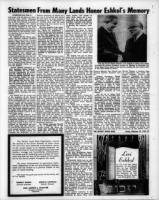
The late Israel Prime Minister Levi Eshkol is shown here being
welcomed by former President Lyndon B. Johnson at Randolph Air
Force Base, Texas, prior to the two-day meeting the two leaders held
at the LBJ Ranch in Texas.
Finance Minister Zeev Sharef and
Housing Minister Mordehai Ben-
tov.
Torczyner, Zionist
Jacques
Organization of America presi-
dent, sent a cable to Allon.
Arthur J. Goldberg, Ameri-
can Jewish Committee president,
pledged in a cable to Allon
"our renewed efforts to help
create the just and lasting peace
in the Middle East that would be
the finest memorial to Levi
Eshkol."
(As we go to press, local
groups have not cancelled their
meetings, but the Jewish Na-
tional Fund announced that two
scheduled events will be utilized
as memorials to the departed
leader. Local groups, including
the Jewish Community Council,
the Jewish National Fund and
the Zionist Organization of De-
troit and the Israel Bond Organ-
ization, issued messages of con-
dolence).
Among the Jewish organizations
that expressed, condolences were
the United Synagogue of America,
representing 826 Conservative
synagogues in the United States
and Canada, and the Central Con-
ference of American Rabbis,
spokesman for the 1,000 Reform
Rabbis of the U.S. and Canada.
Messages were also sent by the
THE DETROIT JEWISH NEWS
Mirachi Women, a religious Zion-
ist organization who called Mr.
Eshkol brilliant, effective and
quiet—an "exponent of Jewish
idealism"; Bnai Israel, the Ameri-
can fraternal Zionist organization,
which termed him a "Lion of
Judah"; and Bnai Brith, which
said he was a "pragmatist and
visionary" and cited his "self
effacing humor, Yiddishkeit and
constant concern for the faith in
the cultural unity and advance-
ment of the Jewish people: "
From Montreal, it was repOiled
that cables expressing sympathy
were sent to the Israel government
by Samuel Bronfman, Canadian
Jewish Congress honorary presi-
dent, who spoke for the Canadian
Jewish community and by officials
of the CJCongress and the Zionist
Organization of Canada. A memo-
rial meeting sponsored by the
Jewish organizations of Canada
is being scheduled.
Arthur J. Lelyveld of Cleveland,
American Jewish Congress presi-
dent, and Dr. Joachim Prinz of
Newark, chairman of its commis-
sion on international affairs, said
in a statement that Mr. Eshko] had
been "a friend and beloved col-
league." They said he had la-
bored tirelessly to establish Israel
as the example of justice and
democracy in the Middle East."
Friday, February 28, 1969-37
In His Life We Were
Blessed. In His Death
We, of the JEWISH
NATIONAL FUND,
Stand Bereaved. May
the Blessing of His
Memory Serve to Guide
and Strengthen Us.