

Purely Commentary
Roosevelt-Frankfurter Letters:
Collection Reveals Unique
Friendship, Jewish Interests
It was a David and Jonathan friendship
between Felix Frankfurter and Franklin D.
Roosevelt and their correspondence, from
1928 to 1945, in the impressive volume
"Roosevelt and Frankfurter," annotated by
Max Freedman, published by Little, Brown
Co., is a major work serving as a com-
mentary on the crucial years in this coun-
try's and in world history.
Even after Roosevelt became President,
it was "Dear Frank" and, of course, the
letters to Frankfurter were addressed to
"Dear Felix." The major events that
affected this nation's role economically,
politically, in the international arena, enter
into consideration in the exchange of letters
which began just before Roosevelt became
governor of New York. This volume had
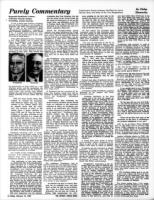
Frankfurter
Roosevelt
the good fortune of being edited by a well
informed writer, and the annotations, the
explanatory comments and the resumes of
world events that precede each chapter
indicate the expertness of Max Freedman's
skillful gathering of facts linked with the
letters.
FDR had many friends. Henry Mor-
genthau Jr. retained his association
with Roosevelt longer than any other
member of his Cabinet. Others were
on intimate terms with the Presi-
dent. The exchange of letters in this
volume shows a deeper affection be-
tween FDR and FF than has been in
evidence in any other collection of cor-
respondence gathered in a volume like
the one presently under review. In fact,
the "gift of opportunity" Frankfurter
acknowledged on his appointment to the
U.S. Supreme Court was rated by him
(Jan. 30, 1939) as one "I would rather
have had at your hands than at those of
any other President barring Lincoln."
Freedman constantly refers to Frank-
furter's loyalty to the Zionist cause, to his
intercession with Roosevelt in behalf of a
free immigration policy for Jews who were
clamoring for—settlement in Palestine as an
escape from Nazism. Frankfurter's enthus-
iastic report on his Palestinian visit was
submitted to the President. The Supreme
Court justice frequently sent memoranda to
Roosevelt on the question of Zionism and
emphasized his interest in the movement
and made his appeals in its behalf.
As a matter of fact, Freedman found it
necessary, in his introductory essay which
analyzes many issues and evaluates the
Frankfurter position, to state the following:
"The publication of this book wipes
an undeserved stain from Frankfurter's
name and gives us a chance to make
some reparation for a wrong done him.
During all the years of the Nazi terror,
Frankfurter was criticized in Jewish
circles for being too timid and hesitant
and conventional in his protests against
this organized barbarism. He was
accused of putting his personal safety
ahead of the safety of the Jewish people.
He grieved over these attacks; they hurt
him deeply; but he offered neither de-
fense nor explanation. We can now see
that Frankfurter did not hoard his in-
fluence for reasons of personal security.
Ile used it with the President and other
senior officials whenever he could redress
an injustice or bring hope to those who
felt forsaken. This record is impressive.
Still more impressive was his constant
2—Friday, February 16, 1968
Frankfurter's Zionist Interests, His Pleas for Aid to
German Jews; the Roles of the Two Morgenthaus
recognition that Nazi Germany was not
only the enemy of the Jewish people but
the enemy of world peace. It was on this
larger issue, and ultimately on the fate
of freedom itself, that Frankfurter con-
centrated as he presented his case to a
deeply responsive Roosevelt."
gees, pointing for the first time to the
dangers that began to arise from Nazism.
On April 23, 1934, he wrote the Presi-
dent from Oxford about his Palestinian
visit. He expressed regret that there
was no American building at the Levant
Fair in Tel Aviv that year.
Indeed, the Freedman-edited volume
contains very many indications that Frank-
furter had called Roosevelt's attention to the
Nazi crimes, that he pleaded for Zionism,
that his interest in Jewish affairs was not
relegated to a state secret. Nevertheless,
Freedman's defense is a revelation. If
Frankfurter was criticized in Jewish circles
he may have been one of many who were
criticized for inaction when protests were
necessary on a large scale. Frankfurter
through the years addressed Dropsie Col-
lege and other Jewish gatherings and was
honored at an annual dinner of the Weiz-
mann Institute at the Waldorf Astoria in
New York two or three years before his
death.
He had written the President from
Jerusalem, April 14, 1934. Presidents often
had been advised to visit Palestine during
the Zionist efforts and Israel when Jewish
statehood was attained. The Frankfurter
letter from Jerusalem contained such a
suggestion. Frankfurter wrote:
But Frankfurter could have been con-
sidered a member of Roosevelt's official
family—so strong was his influence with the
Roosevelts. And while another official —
Henry Morgenthau Jr.—dared to speak up
against the indifference of the State De-
partment that bordered on animosity
against Jewish sufferers from Nazism at
the hands of the consular corps that was
under the control of the State Department,
Frankfurter appears to have been unaware
of what was occurring. Morgenthau and his
staff in the Treasury Department presented
the famous memorandum to Roosevelt
charging the State Department with failure
and refusal to act. (See "While Six Million
Died: A Chronicle of American Apathy by
Arthur Morse, published by Random House).
Where was Frankfurter's intercession in
those tragic years?
If Freedman had not presented his de-
fense, this reviewer would have had no
occasion to recall the tragic years and to
of fer the Frankfurter - Morgenthau
comparison!
Frankfurter's deep friendship for
Justice Louis D. Brandeis and for Harold
Laski are indicated in this impressive
collection of letters. As Freedman com-
ments in an explanatory note, Brandeis
"is often referred to as Isaiah in tribute
to his moral force." Freedman's intro-
duction contains also this interesting
note: "In talking with me about this
book, Frankfurter insisted that I must
explain Mr. Justice Brandeis' relation-
ship to President Roosevelt and to the
New Deal. This is indeed one of the most
important points to emerge from this
correspondence."
On this score Freedman further ex-
plained: "Most people, including attentive
students of the Supreme Court, will be sur-
prised by the persistent and unbroken in-
volvement of Justice Brandeis in the New
Deal. For Brandeis had an austere, self-
effacing and monastic philosophy of the
freedom permitted him as a member of the
Supreme Court. He sometimes went to the
White House to see the President, beginning
in 1917 with the Balfour Declaration, on
matters affecting the future of the Zionist
movement. Otherwise he was silent. He
gave no interviews. He wrote no articles.
He made no speeches. Yet the originating
and liberating mind of Brandeis permeated
Washington with its influence. To his apart-
ment came many of the most gifted men
and women in the administration for
counsel and inspiration."
The confidence Frankfurter had in
Roosevelt from the very beginning of FDR's
rise to political fame was just before Roose-
velt was elected governor of New York,
when he defeated a Jewish opponent, Albert
Ottinger. Frankfurter wrote to Roosevelt on
Oct. 9, 1928: "As a Jew I am particularly
happy that your nomination prevented the
New York contest from degenerating into
an unworthy competition for the 'Jewish
vote.' Now all good and wise citizens ought
to be drawn to your standard."
Frankfurter had gone to Oxford, Eng-
land, for an academic term, and from
there, on Nov. 23, 1933, he sent to Roose-
velt a copy of a letter from James G.
McDonald, who was then the League of
Nations high commissioner for refu-
THE DETROIT JEWISH NEWS
"You may be interested in this bit of
fiscal wisdom from the East. This is a most
exciting land—its beauty is magical and
the achievements of the Jewish renaissance
almost incredible. Someday I should like to
tell you all about it, and when you are
through with the White House, in 1941, you
must journey to Palestine."
Then came a message from Oxford,
May 7, 1934, with this revelation:
"There are a thousand things I would
like to talk to you about, among others
about the mischief that the Nazis are
trying to promote all over the world. The
Palestine government found that the
Nazis were pouring in 'literature' to stir
up the Arabs, and Sir Arthur Salter,
who is just back from China, tells me
astonishing experiences that he had
there of Nazi tactics."
Several days later, Frankfurter told the
President of information he received from
Lewis Einstein, who had been U.S. minister
to Czechoslovakia, about Nazi influences
"upon the general European disequilibrium
of the moment."
In January of 1936, Frankfurter apprised
Roosevelt of the dangers that faced
Romanian Jewry.
Frequent references to the Nazi
crimes and to the need for support of
the Zionist cause are contained in sub-
sequent letters from FF to FDR. In the
section dealing with "Munich and Isola-
tionism: 1938," Freedman's explanatory
editorial note comments on the attitude
of the greatness of England, Frank-
furter at first thought that he would see
two of his great intellectual allegiances
united in a happy reconcilation. Then,
with a mixture of anger, indignation and
revulsion, he watched with dismay as
England, in his judgment, violated and
betrayed her obligations as the manda-
tory power. The Zionist leaders of this
country, in the controversy that spread
over the next few years and ended only
with the establishment of Israel, never
had Frankfurter with them when they
saw the President or the Secretary of
State. But except for _Benjamin V. Cohen,
no one could match Frankfurter's con-
stant influence in the highest reaches of
the Roosevelt administration in plead-
ing the cause of Zionism In helping the
refugees."
A strong letter from Cohen to Roose-
velt's secretary, "Missy" Marguerite A. Le-
Hand, is part of the record to indicate
Cohen's firm stand in behalf of Zionism.
Of interest are the references to Joseph
Kennedy's antagonistic stand which was
interpreted as pro-Hitler. There also is in-
cluded in this valuable collection of letters
one from Frankfurter to Nancy Astor de-
ploring her attitude, refuting the charge of
the Jews' control of the press, expressing
disapproval of charges that she sympa-
thized with Hitler's anti-Semitism.
Frankfurter's nomination to the Su-
preme Court was made by FDR on Jan.
5, 1939. He had not been considered for
the post but as time elapsed after the
death of Justice Benjamin Cardozo
he became a favorite. Here is an histori-
cal note in the editorial comments of
Max Freedman: "A more sensitive point
must now be explained. One day a group
of wealthy and important Jews called
on Roosevelt to beg him to make no
effort at all to get Frankfurter appointed.
They were afraid that Frankfurter's ap-
pointment would cause a dangerous
growth in anti-Semitism. They made no
impact on the President, except to give
him a feeling of revulsion. He had no
intention of turning their squalid fears
and ignoble prejudices into acts of na-
tional policy. Frankfurter learned with
disgust of this interview, and with re-
By Philip
SiOMOVitZ
gret that Arthur Hays Sulzberger of the
New York Times had taken part in it.
For years he had the mistaken notion
that Mr. Sulzberger had opposed his
nomination. Mr. Sulzberger in fact never
changed his conviction that Frankfurter
was incomparably the best qualified man
in the United States to fill the Supreme
Court vacancy. He joined the delegation
reluctantly and after repeated entreaties
from friends only because of his belief
that in 1939 anti-Semitism was no imag-
inary danger. Frankfurter was glad at
long last to get the true facts, for he
respected Mr. Sulzberger and always re-
ferred to the New York Times as 'my
paper.' "
Frankfurter took occasion to send to
Roosevelt documents relating to Jewish as-
pirations in Palestine prepared by Chaim
Weizmann and David Ben-Gurion. Inter alia
Freedman indicates that Frankfurter's ma-
terial on Judaism and Zionism went to the
Hebrew University in Israel.
In the many references to Brandeis,
Roosevelt is quoted as having referred to
the man Frankfurter frequently spoke of as
"Isaiah" as having been "a noble figure
... He is greater than Jefferson and almost
as great as Lincoln."
The role of Dr. Stephen S. Wise as
Brandeis' and Frankfurter's associate in
Zionist efforts also is alluded to.
FDR's humor, the puns between him and
Frankfurter and Mrs. Frankfurter—Marion
—are given considerable attention.
Roosevelt was known to have liked to
amuse himself with puns at the expense of
Henry Morgenthau Jr. From the White
House, Oct. 31, 1942, Roosevelt addressed
himself to "Dear Felix" as follows:
"I am awfully glad to have 'Brandeis
on Zionism.' What a great historical pity
that Holmes and Brandeis were born,
one of them thirty years too soon and
the other twenty years too soon! All
mankind suffers therefrom. I really
think the world needs them more today
than it did then.
"By the way, did you note that
Jr., was said by the papers to have been
chosen the next leader of Zion? Eleanor
and I are telegraphing him when he
reaches Miami, on his way home, that
we will not receive him unless he ar-
rives with a long black beard. Incident.
ally also, he will be disowned by his old
man.
"Please do jot down that story of my
namesake on the farm in Bethlehem—
the greatest compliment I ever got."
H.M. Jr. is, of course, Henry Morgen-
thau Jr. His father was an extreme anti-
Zionist. FDR's reference to the namesake
was to a refugee family in Palestine who
had changed their son's name to "Franklin
Delano" in gratitude for the President's aid
to some refugees who settled in Palestine.
Another witticism relates to FDR's en-
thusiasm for "wine tasters." Freedman has
a note about the strong mutual devotion of
Frankfurter and Judge Julian W. Mack, a
one-time president of the Zionist Organiza-
tion of America, in the Zionist cause. Be-
cause of such devotion, Freedman writes,
"Judge Mack touched Frankfurter's life at
many points far more important than an in-
terest in food and wine." There also was
their love of Harvard and a loyalty to high
standards in the legal profession. But
Frankfurther remembered that the meet-
ing with Judge Mack produced enough
'wine taster' stories from the President to
satisfy even the greatest enthusiast. So—
a letter dated June 11, 1935, is incorporated
in this volume, from FDR to Mack, express-
lying the hope of meeting with him "as
soon as things quiet down" because "I have
some 'wine taster' stories that I think will
amuse you."
The Freedman edited book is an im-
mense work, replete with historical data,
of interest to all Americans, and espe-
cially to lawyers and legislators, and
with revealing facts about the noted
jurist's devotion to Zionism.
The volume quotes from a Life maga-
zine article in which Frankfurter was called
"the most influential single individual in
the United States." The intimacy with FDR
certainly gave that impression. The ex-
change of letters between FDR and FF
emphasizes a very strong comradeship—a
friendly relationship that is. a' tribute both
to Dear Frank and Dear Felix.