

Elie Wiesel's 'The Jews of Silence' Brings Moving Report
Revealing Russian Jewry's Adherence to Eternal Heritage,
Proclaiming Faith in Russian Jews' Links With Their Peo le
Elie Wiesel, whose interpretive
works exposing the Nazi crime
and revealing the sufferings that
were endured during the Hitler
era—all based on his personal ex-
periences in concentration camps
as a youth—emerges in a new
role: as a pleader for Russian
Jewry.
ELIE WIESEL
"The Jews of Silence," his "per-
sonal report on Soviet Jewry,"
published by Holt, Rinehart and
Winston, is based on his experi-
ences in Russia, as a witness of
what is transpiring among fellow-
Jews who are in distress but who
nevertheless crave for kinship
with the Jewish communities out-
side Russia.
In a note to the reader, preced-
ing the text of his revealing work,
Wiesel states:
"I act as a witness, and my
responsibilities are limited to
those of a witness. I went to
Russia drawn by the silence of
its Jews. I brought back their
cry."
Indeed, the entire work is the
reconstruction of a cry that is not
audible but becomes evident in
all of the details brought back
from his visits to Russia. He read
their anguish in their eyes —
"e verything is comprehended
within them"—"their eyes flame
with a kind of irreducible truth,
which burns and is not consumed"
and "they remind you of your
childhood, cause you to lose all
faith in the power of language ..."
Like many others, at first Wie-
se' refused to believe the reports
of Jewish suffering in Russia. He
went behind the Iron Curtain. He
met Jews who wanted to transmit
their messages of despair and
they did it in silence—without
revealing their faces.
The entire story, filled with
echoes of fears, marked by en-
counters that are so stirring that
they reveal the full tragedy of
what is happening in Russia, is
so deeply moving that it will
arouse new concern over the
fate of the millions of Jews in
the USSR.
The tragedy of Babi Yar is
grimly retold, and the eminent
author describes how Jews,
massed for the celebration of Sim-
hat Tora, gathered at the Moscow
synagogue to proclaim their faith
as Jews, in a sense defy the perse-
cutors. Yet the threats to their
existence remain.
There was that "night of danc-
ing," when Jews gathered to ob-
serve and to assert their Jewish-
ness, and Wiesel declares t hat
"young Jews in Russia want to
return to Judaism, but without
knowing what it is. Without know-
ing why, they define themselves
as Jews. And they believe in the
eternity of the Jewish people,
without the slightest notion of the
meaning of its mission. That is
their tragedy."
He thereupon cautions against
despair and states in reference to
that Simhat Tora night when young
Jews were jubilantly Jewish in
Moscow's public square.
"This evening gave me new
hope and encouragement. We
need not despair. The Jews in
Kiev, Leningrad and Tbilisi who
had complained to me about the
doubtful future of Russian Jewry
were wrong. They were too pes-
simistic, and apparently did not
know their own children or the
hidden forces which prompt
them, at least once a year, to
affirm their sense of community.
Everyone has judged this gen-
eration guilty of denying its God
and of being ashamed of its
Jewishness. They are said to de-
spise all mention of Israel. But
it is a lie. Their love for Israel
exceeds that of young Jews
anywhere in the world.
"If, on this night of dancing,
gladness finally overcame fear,
it was because of them. If song
triumphed over silence, it was
their triumph. And it was
through them only that the
dream of freedom and commun-
ity became reality. I am still
waiting to see tens of thousands
of Jews singing and dancing in
Times Square or the Place
d'Etoile as they danced here, in
the heart of Moscow, on the
night of Simhat Tora. The y
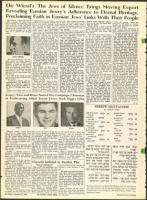
Jospey, Rose and Shaye Named Pre-Campaign Chairmen
of Forthcoming Allied Jewish Drive; Seek Bigger Gifts
danced until midnight without
rest, to let the city know that
they are Jews."
Wiesel brings a great message
from Russian Jewry. He spoke to
many who affirmed their desire
for community with Jewry and
with Israel.
"How much they need to believe
in us," he reports, "came home
to me in a small and secluded
synagogue I had gone to visit dur-
ing Sukkot. There were about 800
Jews there, and I was given the
honor of reciting the Haphtara.
They looked at me in silence as I
chanted the words of the prophets,
but their faces were wet with
tears. Why did they weep? It was
not in sadness or despair. They
wept because they had been made
to see that there are still young
Jews in the world who can read
from the Tora, who have not for-
gotten the melodies of prayer,
who turn to their tradition still as
to a fountain of living waters.
"Without our knowing it and
perhaps without our willing it, we
have become their support. Their
love for us forces their will to
live, although we are always too
busy to reply in kind.
"The Jew I met on a side street
in Leningrad told me that today
the only real Jews live in Russia.
Nowhere e 1 s e. To our eternal
shame, he may be right."
Mostly, Wiesel spoke to Jews
"in and around the synagogue."
He met Jews elsewhere, and:
"Not one of them failed to ex-
press his pain, whether by his
silence, or a twisted smile, or
through words that managed to
hide more than they revealed.
Jews who did not look like Jews,
Jews who perhaps concealed
their Jewishness for a long time,
somehow felt the need to iden-
tify themselves to me, another
Jew."
Thus, he reports, "there are
Jews who will under no circum-
stances let themselves be severed
from their people."
There is a firm declaration of
faith, mingled with an appeal to
Jews everywhere not to be silent
in Wiesel's concluding paragraph:
"I believe with all my soul
that despite the suffering, de-
spite the hardship and the fear,
the Jews of Russia will with-
stand the pressure and emerge
victorious. But whether or not
we shall ever be worthy of their
trust, whether or not we shall
overcome the pressures we have
ourselves created, I cannot say.
I returned from the Soviet
Union disheartened and de-
pressed. But what torments me
most is not the Jews of silence
I met in Russia, but the silence
of the Jews I live among today."
Wiesel writes in French and in
Hebrew. "The Jews of Silence"
was translated from the Hebrew,
with an historical afterword by
Neal Kozodoy. The data in the
Kozodoy essay is valuable for an
understanding of events in Russia.
It contains facts and figures rele-
vant to the Russian Jewish posi-
tion. It incorporates the corres-
pondence with the Sovietish Heim-
land by Bertrand R. Russell.
Appended also is Yevgeni Yev-
tushenko's historic poem "Babi
Yar," the poet's protest against
anti-Semitism in Russia, and the
dialogue on the subject related to
the treatment of the Jews between
Yevtushenko and Khrushchev.
Like Wiesel's other works, "The
Jews of Silence" is not long—it
is a 143-page book. But it is vast
in its coverage, immensely power-
ful as a report by a brilliant ob-
server, outstanding in its literary
qualities. It is one of the very
great books of this era.
—P. S.
HEBREW SELF-TAUGHT
BY
AHARON ROSEN
read (pres. m.s.)
WA? .67
koh-reh
read (Ls.)
rwlip
koh-reht
study (pres. m.s.) 1/#7 .68
loh-mehd
study (f.s.)
Jospey
Maxwell Jospey, Irving Rose
and Max M. Shaye have been
named pre-campaign chairmen of
the 1967 Allied Jewish Campaign,
Hyman Safran, president of the
Jewish Welfare Federation, and
Albert L. Deutsch, campaign chair-
men, announced.
The pre-campaign chairmen will
spearhead the drive for increased
gifts among contributors of more
than $1,000.
Eugene J. Epstein, Lewis S.
Grossman, Malcolm S. Lowenstein,
Harold S. Norman and Richard
Sloan will serve as pre-campaign
vice-chairmen.
Jospey served in the pre-cam-
paign cabinet in 1966 and is a
member of the boards of Federa-
tion and Sinai Hospital.
Irving Rose is chairman of the
committee on capital needs and
serves on the executive committee
of Federation and is a board mem-
ber of the Jewish Home for Aged.
He is former chairman of the
campaign's real estate division.
Serving as co-chairman of pre-
campaign last year, Shaye is a
board member of Federation and
United Jewish Charities and is a
past president of Detroit Service
Group and Jewish Family and
Children's Service.
Serving as vice-chairman of pre-
campaign for the first year, Ep-
40 Friday, December 2, 1966
—
Rose
stein is on the board of the De-
troit Service Group, a member of
the community relations division
of Federation, and former chair-
man of the mechanical trades divi-
sion of the campaign.
Lowenstein headed the mechani-
cal trades division in 1966 when
the division reached the greatest
increase in amount raised over
1965 of any division in the cam-
paign. He is on the board of Fed-
eration and on its capital needs
committee.
Norman, a member of the execu-
tive committee of Jewish Voca-
tional Service, is a board member
Shaye
of the Detroit Service Group and
Federation and was chairman of
the campaign's service division.
Grossman, serving his second
year as pre-campaign vice-chair-
man, is a member of the boards of
Jewish Community Council, Fed-
eration and Detroit Service Group.
He is associate chairman of the
community relations division of
Federation.
Sloan, a member of the board
of Detroit Service Group and a
member of the capital needs com-
mittee, is a board member of
Tamarack Hills Authority.
loh-medet
know (pres.m.s.)
pp
yoh-deh-ah
know (f.s.)
11171i4
yoh-dah-aht
picture
ripnr,
t'moo-nah
.69
.70
pupil (m.)
tahl-meed
i n ?'?1)
class
kee-tah
book
seh-fer
.63
.64
rilt?
.65
.66
ip04
(Direct JTA Teletype Wire
to The Jewish News)
out the planned bridge sabotage in
Zambia, a major producer of cop-
per.
The indictment said that Edoth
and other alleged accomplices
were to have received $25,000
for the operation. Elliott was in-
dicted in New York Federal
Court on charges of violations of
the United States Neutrality Act
after Israeli security tipped off
U.S. authorities about the al-
leged plot.
Eight witnesses for the prose-
cution have been asked to testify
at the trial which will take place
in Tel Aviv. Date for the trial was
THE DETROIT JEWISH NEWS not indicated.
.61
teacher (m.)
moh-re
blackboard
loo-ahl)
4 Israelis Indicted in Zambia Plot
TEL AVIV—An indictment was
returned Tuesday in Tel Aviv Dis-
trict Court against four Israelis
arrested in connection with a bi-
zarre international plot to blow up
a bridge in Zambia in an alleged
bid to upset world copper prices.
The defendants are Violet Elliott,
Israeli-born wife of an American
figure in the case, who holds an
Austrian passport; Raphael Zo-
rani, Elliott's brother-in-law; Eph-
raim Ronen, a former Israeli
army officer and intended broth-
er-in--law to Elliott; and Benjamin
Edoth, allegedly engaged to carry
hebrew course
ool-pahn
111711'
r - x1i7 rir)x
NIT! — rry,
nr.;:q3 ,1,1—
PV
rrip -rr#7 ,npiV ,p-
."141.71P4
npprT-
niAry ,nppn
ripnr1 tn*I-
r-r1 ,rait ynn
,Ty: m nip Ninr.12-
.4,77?zn.), InP'?r1
novl
1:-1717 rryinn
Ln,
,rT.t.31
rninr; -
?rip; xlirp
Reading material in vocalized Easy Hebrew, and also material for
advanced students may be obtained through your local Hebrew
Organization or by writing to:, Brit lvrit Olamit, P.O.B. 7111,
Jerusalem, Israel.
Published by But Ivrit Oka*