

....41111111111
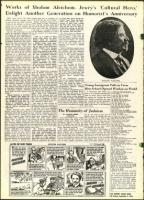
Works of Sholom Aleichem, Jewry's 'Cultural Hero,'
Delight Another Generation on Humorist's Anniversary
Fifty years a f ter his death,
Sholom Aleichem emerges anew
as one of the very great creative
writers of the century, as the hu-
morist who not only inspired the
Jewish masses but who had gained
worldwide recognition.
On the 50th anniversary of his
death, an impressive collection of
his stories has been published by
G. P. Putnam's Sons (200 Madison,
NY16). There have been other col-
lections of Sholom Aleichem stories
in English translations, and, collec-
tively, they form a remarkably fine
library of Yiddish stories. The
newest Putnam work, "Old Coun-
try Tales," selected and translated
by Curt Leviant, especially makes
evident the genius of the Yiddish
writer who had captured the im-
agination of a generation, and
whose works continue to excite the
imagination of another generation
that knows no Yiddish yet admires
the Yiddish stories they can read
in English.
The translator of the stories in
"Old Country Tales," whose intro-
ductory essay to this volume pro-
vides the background for the tales
and evaluates the life and works
of Sholom Aleichem, is associate
professor of Hebraic studies at
Rutgers University, New Bruns-
wick, N. J. Prof. Leviant is a grad-
uate of Brooklyn College, has an
MA from Columbia and his PhD
from Rutgers, has taught English
and American literature in Israel
and has done much translating
from Hebrew and Yiddish. He has
a previously published collection
of translated Sholom Aleichem
works under the title "Stories and
Satires."
Sholom Aleichem is • described
as- "a cultural hero among his
own people" in the introduction.
Dr. Leviant points out that Sho-
lom Aleichem's works have ap-
peared in translations in all
European and Slavic languages,
and in Chinese, Japanese and
Esperanto.
Sholom Aleichem's life, habits,
literary career and his vision in
evaluating Jewish life in his stories
are reviewed in Dr. Leviant's es-
say. The humorist, born Sholom
Rabinowitz, was regarded "as a
classic writer" at the turn of the
century. Dr. Leviant points out
that "although Sholom Aleichem's
name is now synonymous with hu-
mor, he began as a Hebrew satir
ist, in imitation of Mendele Mocher
Seforim (1836-1917), and achieved
a fine reputation as a Hebrew
novelist; in fact, his first `work',
composed when he was 15, was a
Hebrew version of 'Robinson Cru-
soe Throughout his life he never
neglected Hebrew: he corresponded
with his relatives in Hebrew and
hoped some day to translate his ed work with "Tevye Reads the
own works into the sacred tongue."
Psalms" from "Tevye the Dairy-
man," and explains the back-
Sholom Aleichem's brand of lit-
ground of these tales, tracing
erary humor is called "revolution-
ary," and Dr. Leviant states that the first story about Tevye to
1895 and the one in his book as
his use of diction, his classical He-
brew texts and folk expressions having been written in the last
"all point to a complete mastery years of the Yiddish humorist's
of the Hebrew language as a tool life, between 1914 and 1916.
for the creation of a great litera-
The Tevye story is followed by
ure."
"Romance—Final Pages from the
"Just as a reader of Mark Song of Songs," a story from the
Twain could detect the many four-part Sholom Aleichem novella.
"The Song of Songs," Dr. Leviant
dialects which the American
author authentically reproduced, states in his explanatory note, "is
one of the most tender and en-
a Yiddish reader could appre-
chanting love stories in Yiddish
ciate Sholom Aleichem's keen
literature."
ear for - the various differences
within Yiddish," Prof. Leviant
Sholom Aleichem's genius was in
asserts . . . "A reader of Yiddish large measure linked with his love
who is also attuned to the ironic for children, and his children's
modes of Western literature and stories are superb. There are three
stories in the "Jewish Children"
the rich possibilities inherent
section — "Visiting With King
in the interplay of various
linguistic layers must marvel at Ahasuerus," "The Holiday Kid-
dush" and "The Flag"—and they
the achievement of Sholom
may well be considered among the
Aleichem's prose: its scope,
humorist's classics.
texture, adaptability and origin.
"A Job As Easy As Pie" is
ality are at once a perfect mirror
taken from "Mottel the Cantor's
of the language of the people
Son." There are three "Village
and the artistic expression of
Stories," three stories in each of
it."
In this impressively evaluative the sections entitled "Holiday
study of Sholom Aleichem's writ- Tales" and "From Kasrilevke" and
ings, Dr. Leviant declares: "He two tales about "Jewish Soldiers."
succeeded admirably. He created "Railroad Yarns" contains four
a little kingdom and peopled it tales.
In the "Monologues" section
with hundreds of subjects, rich
and poor, religious and free-think- there are six stories, including his
SHOLOM ALEICHEM
ing, gentile and Jew. Not only did famous one entitled "Sticks and
Stones
May
Break
My
Bones."
Sholom Aleichem describe all types
A glossary assists the reader in
of people, but he also chronicled for
posterity the complete rhythm of understanding Hebrew, Yiddish
Jewish life: birth and death, child- and Russian terms.
Dr. Leviant's compilation is new.
hood and old age, feasting and fast-
A 15-year-old high school stu- I came it is three years since
ing, holidays and weekdays, syna- His translation is excellent. His ex-
to this place.my new home to live
gogue, home and marketplace. planatory notes add merit to his dent in an immigrant development in the sand.
Which is why someone once said work. His "Old Country Tales" is town in Israel, told in verse how It was not like the mellah.
It did not feel my home.
that if all records of Jewish shtetl timely and serves a great purpose
life were to disappear, it could in assisting Jewish communities she gained her benefits the hard I was not quiet.
father was not quiet,
easily be reconstructed from Sho- in observing the Sholom Aleichem way, thereby expressing the hope My
mother, they did not know
anniversary during which tributes for a good life in her homeland. my
what to do, how to do.
lom Aleichem's works alone."
little sisters cry,
The types of tales favored by to his memory are paid by Jewish She portrayed "the window on a My
even my brothers, not me,
Sholom Aleichem are analyzed in communities throughout the world. wide, wide world" in' the following I- am too old, twelve years.
—P. S. free verses:
The school is hard, very hard,
the editor's introduction. It is point-
Hebrew, everything, is hard.
ed out that "S h o 1 o m Aleichem
I am angry.
viewed a society he knew intimate-
Other boys from the mellah,
they go to where they build new houses,
ly not through rose-colored lenses,
they pick up stones, they break windows,
but through spectacles of love.
I go to the school,
By MAXIM GORKY
Hence he was able faithfully to
but if I am going to take care of I break a window there.
(1868-1936)
depict—and castigate—his fellow
myself alone, of nothing but my One year, two years, it is better.
father, my mother, know better
In my early youth I read—I have own personal life, it will be use- My
Jews. But unlike many modern
what to do, how to do.
writers, he was not alienated from forgotten where—the words of the less, ugly, m e aningles s. This School is not so hard, I pass.
his society, but identified with it. ancient Jewish sage, Hillel, if I thought ate its way deep into ray. I speak Hebrew not so bad.
For in ' his day there was no great remember rightly: "If thou are soul, and I say now with convic- I am more quiet.
gap between the artist and his pub- not for thyself, who will be for tions : Hillel's wisdom served as a But what will I do
when there is no more school.
lic. Both got to know each other thee? But if thou are for thyself strong staff on my road, which Always
I remember I break the window.
quite well . . ."
alone, wherefore are thou?"
was neither even nor easy.
I feel a little bad,
Dr. Leviant selected the
The inner meaning of these
I believe that Jewish wisdom is But I do not tell.
stories for his Sholom Aleichem words impressed me with its pro- more all-human and universal One day I go home from school,
I see men are building,
book with understanding and found wisdom, and I interpreted than any other; and this not only not
houses, another school,
skill. Each story is prefaced by them for myself in this manner: I because of its immemorial age, not a big school,
Americans are building.
an explanatory note that leads must actively take care of myself, only because it is the first born, For me?
the reader to a fuller apprecia- that my life should be better, and but also because of the ptwerful My teacher says yes.
tion of the value of the narrative. I must not impose the care of my- humaneness that saturates it, be- Now I feel very bad I break the window.
day, school is over,
Thus, he commences his collect-
self on other people's shoulders: cause of its high .estimate of man. Last
I write to m: teacher in Hebrew,
Young Immigrant Tells in Verse
How School Opened Window on World
The Humanity of Judaism
VES OUR TIMES
.grob..1
SHOLOM ALEICHEM
AFTER WIDOW TX 1905 KIRI MN,
OF NO NIS FAMILY WENT 10 SWITZEI-
IAKDAATER,HE MAK SEVERAL LEC-
TURE TOURS THROUGH WESTERN EUROPE.
NOW AND THE U.S. _
_
Al THE AGE Of IT, ASATUIOR OF RUSSIAN, If
E GREATEST YIDDISH NUMOILIST
OF CM TIME WHOSE hOP.KS RAW
BEEN TRANSLATED INTO EVERY UN-
GAGE INCLUDING JAPANESE AND
ESPERANTO, 15 OFTEN REFERRED TO
AS THE •JEWISN MARK
WAS Utak TO TEAR DIE 17-YEAR-011) WON-
Tit OF AVifAlltlY LANDOWNER. TRY FELL
IN LOVE, AND AFEW YEARS LATER SHOLOM
PLEICHHA MARRIED OLGA LOEFF IN t883.
'J/6
NM %USN ItANOWill IN RSA IN
OAHE WAS KNOWN AS A SCHOLAR AND A
HAPDY YOUNGSTER WHO AkYlAYS SAW lid
HUMOROUS SIDE OA SITUATION:
JO
Ioeta,THE MILKMAN'', ONE OF HIS MOST SUCCESSFUL COMEDIES
WAS PRODUCED kY MANCE SCHWARTZ, AND LAID THE FOUNDATION
FOR THE JEWISH MT THEATRE ... HIS "IT'S HARD TO RE A JEW' INTRO-
DUCED MK MUNI TO THE STAGE
A
_71!tv
WHO HE ACQUIRED HIS FATHER-IN-LAWt
FORM AFTER pa LATTER'S DEATH IN
MK SWUM MOWN WINO TO DI-
NOTE IMASIII TO WORM.
Fs'
it
HI W ONE
EPTISTSWWGWA S
ACCLAIMED DUPING NIS OAW LICETIME,NOT
ONLY tY HIS PUSUOUT BY OTHER GREAT
CRITICS SUCH AS GOV AND TUSTOYANS
WAS THE GIFTED AUTHOR Of BELOVED WOWS
WHOg STORIES WILL UVE ON FOREVER....
•
ardskursrit.sw=
is 1914, AMINE OUTIREAN OF WAR, HE EMI-
GRATED TO AMERICA WHERE HE WROTE A POP-
ULAR COLUMN FOR THE WNW OF N.Y.
POORMAN
Sat MODil
b/ 10400A I.
MOM WOW DIED IN NEW YORK IN
1916, AT THEME OF ft AFTER HAVING EN-
RICHED YIDDISH LITERATURE WITH SOME
FORTY VOLUMES OF SHORT STORNI,
NOVUS AND PLOD.
q atvitt•Ii *..
he says good Hebrew,
I tell him I break the window,
maybe they- do not let me go to the
new school.
He says yes, you go.
I go,
The windows are big, I look out,
nobody break them.
I learn English a little,
maybe next year I' start to learn
about building schools
like the Americans.
Last day, school is over,
I go to my old teacher.
I tell him I am not quiet,
but I do not feel bad,
I feel good,
in the summer I will miss
the big ,windows in my classroom.
He tells me "you were on the outside
looking in, now you are on the inside
looking out, that is why you feel good.
That is an American expression."
I look at my school,
I think he is right:
Americans have very good expression.
The Israel Education Fund of
the United Jewish Appeal aims for
the expansion of educational oppor-
tunities, as the year 5727 begins,
by establishing more high schools
in Israel. The fund's officers are:
Joseph Me yerhoff, chairman;
Charles J. Bens le y , president:
Ralph I. Goldman, executive direc-
tor.
THE DETROIT JEWISH NEWS
48—Friday, September 9, 1966