

Remarkable Memoir: Prof. Louis Ginzberg's
Career as Scholar, Zionist, `Legends' Author
Dr. Louis Ginzberg was one of
the very great scholars of the cen-
tury. His "Legends of the Jews,"
issued by the Jewish Publication
Society of America in seven vol-
umes and later condensed into one
volume, will remain among the
classics of all time.
Not only was he a great scholar,
he was a most interesting person-
ality, and his son, Dr. Eli Ginz-
berg, professor of economics at
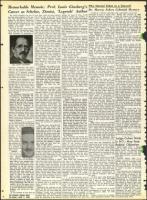
DR. LOUIS GINZBERG
now have, from his son's memoir,
the other side of the coin in the
Louis Ginzberg-Henrietta Szold
"romance" that was the subject of
a major biography of Miss Szold
published two years ago by JPS.
There are many references to
Miss Szold in the Ginzberg
memoir: The assistance she gave
him, as the perfector of his English
after he had come to this country;
her letters to him as editor and
secretary of JPS when his works
began to be published and when
the contract was made for the pub-
lication of the "Legends;" and
other occasions when Miss Szold
acted in an official JPS capacity.
And there is the son's explana-
tion of the reported "love affair."
Eli Ginzberg writes that his
father was reticent to discuss two
affairs—one that involved his hav-
ing been rejected for a professor-
ship at Hebrew Union College in
his early youth—a matter later
touched upon to indicate the puz-
zlement, since Reform leaders
later joined to honor Prof. Ginz-
berg; and "his relationship with
Miss Szold."
"I suspect," the author of the
Columbia University and chair- memoir writes, "that in the first
man of the National Manpower case, he felt self-conscious about
Advisory Committee, provides the
ever having accepted a call to
evidence in a personal memoir, an institution that was so clearly
entitled "Keeper of the Law: Louis
at variance with his beliefs and
Ginzberg," also issued by the Jew- outlook. As far as Miss Szold was
ish Publication Society.
concerned, he indicated that she
Because Louis Ginzberg's name had broken off the relationship,
and that under these circum-
is being written indelibly in Jew-
ish literature, because of the im-
stances a gentleman was under
obligation to keep his lips
portant role he played in advanc-
ing the aims of the Jewish Theo- sealed."
There follows a long explana-
logical Seminary of America, his
son's memoir becomes an impor- tion: Unlike her biographer, "who
tant documentary on the life of a was concerned with the purely
personal aspects of the relation-
great teacher.
Dr. Ginzberg emphasizes that
ship and with whether 'he had
done her wrong,' " Eli Ginzberg
his book is not a biography but
a memoir. Nevertheless, he
concerned himself wth extracting
covers in this work the major
from his father's correspondence
the perspectives about the highly
activities, the basic accomplish-
gifted woman's and the young bril-
ments of the man who was pro-
liant scholar's relationship. He
fessor of Talmud of the Jewish
says Miss Szold fell in love with
Theo logical Seminary of
America and one of the great his father early, he describes the
relationship between 1903 and
luminaries of the seminary.
Prof. Ginzberg had aided many 1907 as "reasonably balanced." He
scholars. He played a role in Zion- goes into great detail to tell about
ism and hs comments on the move- their lengthy correspondence and
ment are significant. His theo- he asserts that it was inconceivable
logical views are of great interest that his father, who wanted chil-
and of considerable importance to dren, might have married a woman
considerably older. The exact de-
rabbinic students.
The Ginzberg saga as related by tail of Eli Ginzberg's explanation
his son tells about the background reads:
"In later years, one of the few
of the great scholar, his studies,
remarks that my father ever
abroad, his at-
made on the subject was to the
tainment of a
effect that he could never have
high role in Jew-
contemplated m a r r y i n g Miss
ish learning, his
Szold, for the simple reason that
ability as a
his pride would never have per-
teacher. C o m -
mitted him to marry a woman so
meriting on the
much his senior; and that one
many letters he
reason for his ever marrying was
wrote, much of
his desire for children, a desire
the material hav-
that could not have been ful-
ing emerged use-
filled by Miss Szold."
ful in the writin
What a pity that so personal a
of a memoir a-
matter should have become a sub-
bout his life, Gin-
ject for public airing, necessitating
zberg states:
a reply to Miss Szold's biographer
"Always
by Prof. Ginzberg's son! But the
deliber-
Szold-Ginzberg relationship never-
ate man, he
theless is called in this book "An
was much
Exceptional Friendship."
more deliber- Eli Ginzberg
The Ginzberg memoir is filled
ate when it came to the written
with data about events that occur-
word. There is no question that
red in the first three decades of
most of his letters were com-
this century, about the manner in
posed with the knowledge of the
which Reform Jews came forth to
possibility, if not the expecta-
assist in the expansion of the Con-
tion, that they might one day
become public. His whole schol- servative Jewish Theological Sem-
arly life had been devoted to inary; the roles of faculty; his suc-
cessor, Cyrus Adler, about whom
weaving large tales from small
soaps of paper, he could not there is much criticism; the pres-
ent head of the seminary, who is
fail to draw a personal ana-
logy—his files would some day revered, and many other person-
become available to those who alities.
Prof. Ginzberg had a keen sense
were interested in the history of
of humor, and it is indicated on
Jewish scholarship. His will was
many occasions reported in the
explicit: all of his papers were
memoir..
to be transferred to the Library
of Jewish Theological Seminary.
Nothing was ordered des-
troyed."
Regarding the rejection of his
father for the Hebrew Union Col-
lege post, the son writes that Dr.
It was because of this that we Ginzberg "would have remained
at Cincinnati." The account of the
incident does not react favorably
THE DETROIT JEWISH NEWS
56—Friday, April 1, 1966
college, Dr. Isaac M. Wise. As Eli
Ginzberg relates the incident, it
forms a bit of interesting history
on how the Reform movement
functioned at the time and on the
dissatisfaction with Wise and his
management of the school.
By the same token, the manner
in which the Conservative seminary
gained Reform support is addition-
ally important in the story of re-
ligious developments in American
Jewry.
Louis Marshall plays a role here,
and the memoir's author appears
critical of the eminent leader's
harping on several occasions on
not having been able to provide
for a deficit of $12,040 for the
Jewish Theological Seminary and
a $4,000 sum to publish scholarly
works. The situation created des-
pondency for Prof. Schechter,
doubts about the interest of Re-
form Jews among others.
The memoir states:
"The leaders of the American
Jewish community were finding it
difficult to cover a $12,000 deficit.
And an additional $4,000 appeared
beyond their easy reach. Even
allowing for the fact that the value
of the dollar at that time was con-
siderably greater, the sums are
hardly astronomical. It seems that
the few insiders were not too
happy with their investment, but
at the same time they were disin-
clined to invite the support of
others, since their action would
threaten their control. This is how
matters stood in 1915 and that in
general is how matters remained
until the end of the 1930s, when
Louis Finkelstein succeeded Cyrus
Adler."
While in Palestine, before the
rebirth of the State of Israel, Prof.
Ginzberg met with the late Chief
Rabbi Abraham Kook. An interest-
ing episode in recorded in the Gin-
zberg memoir:
"Rabbi Kook had an urgent
problem to discuss. Dr. (Judah
L.) Magnes and his friend played
tennis on the Sabbath and Kook
could not persuade them to stop.
He suggested that my father, a
Western man, write an opinion
on the subject; if he disapproved
strongly, perhaps this desecra-
tion of the Sabbath in the Holy
City could be brought to an end.
My father asked Kook whether
he had been correctly informed
that the rate of interest in Pales-
tine was 20 per cent and more.
When Kook admitted this, my
father reminded him that it was
a direct violation of biblical law.
He suggested a deal. As soon as
Kook wrote aganst the prevailng
usury, he would write about the
impropriety of playing tennis on
the Sabbath!"
Who Married Cohen to a Convert?
Dr. Marcus Solves Colonial Mystery
A Cohen is a "Priest," and after ther, and dared to marry her.
thousands of years a Cohen still
During the summer of 1962,
has certain liturgical privileges — while Dr. Marcus was looking for
although he is also subject to a documents on American Jewish
number of ritual restrictions.
history -in Jerusalem; he ran into
He cannot, for example, take to Dr. Isaac M. Fein, of Baltimore,
wife a woman who is a convert to who was there for the same pur-
Judaism, and this—points out Dr.
Jacob R. Marcus, director of Amer-
ican Jewish Archives — meant
trouble for Jacob I. Cohen, when
he wanted to marry the widow of
Moses Mordecai in August 1782.
Mrs. Mordecai had been born
Elizabeth Whitlock, a Christian, in
England, but was converted to
Judaism when she married Moses
Mordecai.
The board of Philadelphia's
Mikveh Israel Congregation
forbade her marriage to Jacob I.
Cohen, warned Hazzan Gershom
M. Seixas not to officiate, and
urged the members of the syna-
gogue to boycott any nuptial cer-
emony that might take place for
Cohen.
Cohen was not discouraged;
he simply flouted Jewish tradition
to marry the woman he loved. The
wedding took place late that Au-
gust in Philadelphia, then occupied
by the Continental forces.
Jacob I. Cohen, the stormy petrel
in this love affair, was a German
immigrant. Wandering into Penn-
sylvania in the days before the
Revolution, he -soon became an In-
dian trader, with his headquarters
in Lancaster, which was then a
"western" town.
When the war broke out, he
moved south, and the late 1770s
found him in business at Charles-
ton, where he became a member of
Captain- Lushington's "Jew Corn-
pany" and fought under General
Moultrie in the Battle of Beaufort.
After the war, Cohen made his
home in Richmond, Va., where he
formed a business partnership with
Isaiah Isaacs, a silversmith by
trade. Isaacs was the first perma-
nent Jewish settler in the state.
During the war, Cohen and
Isaacs, in the largest business in
town, were paid. in land warrants
by their customers, Revolutionary
War veterans. These soldiers had
no real money, for Continental cur-
rency was literally "not worth a
Continental," but after Cohen and
Isaacs had assembled warrants for
several thousand acres in present-
day Kentucky, they sent out a sur-
veyor to locate their grants. The
name of that surveyor was Daniel
pose. Fein told Marcus that he had
seen the ketubah, or marriage li-
cense, of Jacob I. Cohen among the
manuscripts in the library • of the
Hebrew University. Gleefully, Dr.
Marcus said, "Now we'll know who
married the 'priest !' "
A copy of the license was sent to
the American Jewish Archives on
the Cincinnati campus of the He '-
brew Union College and studied
there.
It was easy to make out the
signature of the bridegroom on the
left side of the Hebrew-Aramaic
parchment document, and the
names of the witnesses were duti-
fully recorded on the right side of
the license. But when the parch-
ment was scanned for the name of
the officiant, there was nothing to
be found! Since in colonial Amer-
ican marriage documents the name
of the officiant was usually given,
there could be but one answer to
the mystery.
In all probability, Cohen himself
officiated at his marriage—which,
of course, would have been per-
fectly permissable in Jewish law
(perfectly permissable that is, had
he not been a "priest" about to
wed a proselyte!) He would not
have exposed his friends to the
threat of excommunication
by asking one of them to officiate.
One of the three witnesses was
Haym Salomon, a friend and credi-
tor of James Madison. Salomon
had just underwritten one-third of
the cost of Philadelphia's new syna-
gogue building, and the congrega-
tion would certainly think twice
before throwing him out. Cohen,
too, had just made a loan to the
influential Madison.
Obviously, where the synagogue
authorities were concerned, discre-
tion was the better part of valor,
and so the Philadelphia synagogue
leaders decided to forget about the
whole affair.
How did the license end up in
Jerusalem? It remained in the
Cohen family until the 20th cen-
tury, but then some of the papers
of this famous clan came into the
possession of Dr. Harry Frieden-
wald, of Baltimore, an outstanding
Zionist. Dr. Friedenwald turned
them — including the Ketubah —
over to the Hebrew University.
Jacob I. Cohen ultimately was
elected president of the congrega-
tion which had tried to stop his
Boone.
While Boone was busy locating
their Kentucky lands for Cohen and
Isaacs, and occasionally killing "In-
dins," Cohen went to Philadelphia
as a resident buyer for his firm. marriage!
Philadelphia. was then the metro-
The copy of Cohen's ketubah is
polis of America—in fact, she was in the files of the American Jewish
the second largest English-speaking Archives in Cincinnati.
city in the world—and it was there
Prof. Ginzberg was greatly dis- that Cohen met Elizabeth, then
illusioned by the state of cultural known by her Jewish name of Es-
affairs in this country and he was
very critical of the rich who dom-
nated on the American scene.
There is a report in the memoir
about Ginzberg's crticism of Jacob
H. Schiff. Miss Szold had reported
to him about an anti-Zionist
speech by Schiff. Dr. Ginzberg was
a devout Zionist, and his son's
sketch recalls many of his warm
statements about the Jewish na-
tional movement.
Miss Szold told Ginzberg that
she was in a hopeless minority,
that there was jubilation in the
press over Schiff's attacks on Zion-
ism, that several wondered "how
any one can dare remain a Zionist
since the great and only Mr. Schiff
has spoken his `ipse dixit.' " Prof.
Ginzberg responded at length,
"bitterly," to Schiff's speeches and
much harm. Mr. Rockefeller, the
richest man in the world, is of very
little importance in the Baptist
Church, indeed some of the mem-
bers of this church even refuse
his money, but Mr. Schiff is the
greatest power in American Jewry.
The reason is the smallness and
poverty of the Jews."
The Ginzberg memoir is a frank
statement. Its author doesn't even
hide the fact that he, a son of a
great and devout scholar, was him-
self rather aloof from Jewish
ranks. Writing about Hayyim Nah-
man Bialik he tells about the
great poet's belief that Prof. Ginz-
berg could have contributed much
"to the sound modernizaton of
the Hebrew language," and then
he adds:
"In later years, when Bialik vis-
ited us in New York and found
that I knew no Hebrew, he was
deeply shocked, so shocked in
fact that I do not think he even
asked my father for an explana-
tion."
What a comment this is on the
estrangement of some sons from
the dedicated labors of their
stated:
". . . a great financier and in
his capacity as such he knows that
in giving money for an object you
acquire it, and as he spends large
sums of money for Jewish institu-
tions, he believes himself the
rightful owner of American Jewry.
One would laugh at the stupidity he
shows were it not for the grave
consequences of his stupidity. It
is the tragedy of a small class or fathers!
"Keeper of the Law" is, indeed,
religious congregation that the in-
upon the then-head of the Reform fluential individual may cause so a most interesting memoir.—P.S.
Judge Cohen Weds
in N.Y.; May Face
Rabbis' Objection
NEW YORK (JTA) — Justice
Haim H. Cohn, of the Israel Su-
preme Court, was married here
last week to a woman who had
been divorced from her first hus-
band, then married a second man,
who died.
Because Justice Cohn is a
"cohen," a member of the Jewish
priestly tribe, his marriage raised
the question as to whether his
union is valid under the rules of
the Israeli rabbinate, which forbids
a "cohen" to marry a divorced
woman.
The ceremony was conducted in
a hotel suite here by Rabbi Ed-
ward Sandrow, president of the
New York Board of Rabbis and
spiritual leader of a Conservative
congregation in Cedarhurst,
He said after the ceremony that
the validity of Justice Cohn's mar-
riage under the rules of the Israeli
rabbinate, which is Orthodox, is
a matter of interpretation. "I con-
sulted a number of my Orthodox
colleagues," he said, "and it was
agreed that the bride was a widow,
and not a divorcee." Justice Cohn's
bride is the former Michal Smoira,
an Israeli music critic.