

cation is the preservation of re-
ligious and cultural identity, it is
evident that this attitude repre-
date persons of another faith.
sents an alarming statistic that
`Since the objective of Jewish edu- must be coped with by Jewish edu-
New Start in Jewish Education Planning Urged
NEW YORK (JTA) — The pres-
ent crisis in Jewish education re-
quires a willingness on the part
of curriculum planners and ad-
ministrators to "scrap all cher-
ished preconceptions and start all
over again," a professor of history
told 250 delegates to the National
Conference on Jewish Education,
which concluded its four-day ses-
sion here Sunday.
Dr. Irving Greenberg of Ye-
shiva University, speaking to the
fifth national conference of the
American Association for Jewish
Education, said that the first con-
sideration for the educators to
determine is what is the purpose
of remaining Jewish. "If Judaism
is nothing but democracy or
brotherhood, why not practice
these in the orginal form?" he
asked. He suggested as an experi-
ment,the reversal of the current
practice by startng Jewish educa-
tion at 13, or Bar Matzvah age,
SO that the student can begin his
Jewish studies when he is ma-
ture. "In fact," he declared, "a
good idea would be to scrap the
entire Bar Matzvah ceremony with
its Haftorah ritual, a procedure
which has in the past wasted
thousands of man years."
Recognition of the complaints
of Jewish adolescents that the cur-
ricula of Jewish schools are often
inferior, and their instruction dull,
Was given Sunday in the unani-
mous adoption by the conference
Of a resolution authorizing the
creation of a national youth com-
mission, to look into the situation
as it exists in Jewish educational
institutions of the United States
and Canada.
The resolution urged the Com-
mission to make a survey "to diag-
nose the problems of Jewish youth
and to suggest improvements that
must be adopted to attract and
retain Jewish students in both the
elementary and secondary school
categories." The Corcunission will
utilize the .,ervices of outstanding
scholars, psychologsts and sociolo-
gists as well as educators, in its
studies, and in the drafting of rec-
ommendations.
The conference also voted the
creation of a manpower commis-
sion to study and deal with the
serious shortage of teachers which
confronts Jewish schools through-
out this country and Canada.
Another resolution called on
member agencies of various
Jewish welfare funds to give
primacy in their allocations to
Jewish education, and asked for
bold new financing of the Jewish
school system which trains
600,000 children and employs
17,000 part-time and full-time •
teachers annually. The associa-
tion delegates urged the seeking
of new and large gifts for schools
from foundations.
Dr. Isadore Breslau of Wash-
ington vias reelected president of
the association, with Samuel H.
Daroff of Philadelphia renamed
as chairman of the governing
council.
A major step toward unity and
coordination in the field of Jewish
education was effected when three
lay leaders of major congrega-
tional groups confirmed their or-
gan.lizations' support of the AAJE
as the representative body in this
field.
The association represents 15
constituent national organizations.
The confirmations were voiced by
Joseph S. Wohl, for the Conserva-
tive movement; Earl Morse on be-
half of American Reform Jewry,
and Max Etra, for the Orthodox
community.
At the dinner, Daroff presented
citations to founders and past
presidents who have been active in
the association for the past 27
years.
To solve the teacher shortage
in Jewish schools and to attract
the highest caliber of profes-
sionals to Jewish teaching, Dr.
Breslau recommended special
inducements in recruiting, train-
ing and employment. "We must
give the teaching profession
greater status and the type of
financial compensation it de-
serves," he said.
Declaring that the full, imag-
inative and cooperative use of all
the resources of the Jewish com-
munity is required to determine
the future of Jewish life in the
United States through an effective
system of Jewish education, Dr.
Breslau pointed out that never
before has the Jew been provided
with faciltie's and afforded the
opportunities in freedom to "pre-
serve and enrich whatever identi-
fication he may choose."
Critical views of Jewish schools
by teen-agers were distributed to
the delegates. It was the end-
result of an extended study con-
ducted among 1,051 Jewish stu-
dents by the National Curriculum
Research Institute, a division of
the American Association for
Jewish Education. The survey was
made during 1964, 1965 and early
1966 under the supervision of Dr.
Judah Pilch, director of the Insti-
tute, on college campuses, in sec-
ondary schools and summer camps.
One finding, especially dis-
turbing, the report noted, was
that the Jewish home, "always
considered an impregnable fort-
ress, inspiring and shaping posi-
tive ethical standards," has been
dislodged from its previous posi-
tion of eminence. "We found
that Jewish adolescents, like
their peers in the general com-
munity, are now in full retreat
from the home, which we can no
longer consider an important co-
hesive agent in the Jewish edu-
cational process," Dr. Pilch said.
On the subject of Jewsh re-
ligion, the report found that stu-
dents felt that much of the train-
ing "takes the form of religious
entertainment, utilizing tranquil-
izers, and that its instruction is
frequently dull and vapid."
Most or the respondents indi-
cated that their criticism did not
imply a lack of interest or a nega-
tion of Jewish studies. They felt,
the research showed, that "Jewish
schools must inspire their students
to want to live Jewishly and to
better understand their role as
individuals and members of the
group."
The study showed that 88 per
cent of the respondents who con-
tinued their Jewish education went
to Jewish secondary schools of
their own volition, and that only
12 per cent were influenced to
attend these schools by their par-
ents.
Among those who discontinued
attendance, 36 per cent showed a
lack of interest in further Jewish
studies, irrespective of experence
in the elementary school, and 30
per cent discontinued because of
conflict with public school sched-
ules.
The students queried, Dr. Pilch
stressed, feel strongly that "radical
changes" are needed in present-
day Jewish school curricula. They
believe that instruction should be
more selective, in marked con-
trast to the programs of Jewish
educaton followed during the past
quarter of a century.
A majority recommended that
Jewish schools emphasize and
5 Million Trees Planted
In spite of drought and man- clarify the role of the Jewish peo-
power problems, close to 5,000,000 ple among the nations and re-
new forest trees were planted all lgions of the world today, as was
over the country by winter's end. done heretofore in regard to the
This includes 1,350,000 trees in past.
the Northern Region (Galilee),
The report disclosed that 49 per
1,150,000 trees in the North Cen- cent of those questioned opposed
tral Region (Nazareth, Gilboa and mixed datng, with 41 per cent
Carmel), 1,197,100 trees in the favoring it, and 10 per cent un-
South Central Region (Judea and decided as to whether they would
Jerusalem Corridor) and 799,650
THE DETROIT JEWISH NEWS
trees in the Negev Region and the
South.
Friday, March 25, 1966-11
cators," Dr. Pilch asserted, noting
that the replies to this particular
question conformed to the present-
day trend of behavior of adoles-
cents in general.
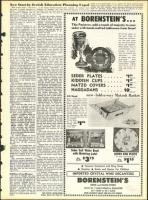
ORENSTEIN'S • • •
AT
This Passover, add a touch of majesty to your
seder with hand-crafted tableware from Israel
Of all the nights in
the year, those of
Pesach are tradition-
ally the ones when
you and your entire
family get together.
What better way to
commemorate t h e
holiday .. to drama-
tize the present-day
festivities . . and
to display your own
good taste . . . than
with these majestic
handcrafted pieces
from the Land of
Milk and Honey it-
self?
SEDER PLATES . • •
KIDDISH CUPS .. .
MATZO COVERS . .
HAGGADAHS . .
• • •
• • •
•
• •
•
• co
$125
AND UP
$ 1125
AND UP
$1150
AND UP
OC
AND UP
4c
new - fold-a-way Matzoh Basket
Gift Boxed
-1(
Fold-a-Way Matzoh
Basket. New different, excit-
ing — Fold-a-Way Matzoh
Basket. Beautifully decorated
in blue and gold on bone-
white washable vinyl with
blue embroidered broder. It's
the easy no-mess way of
serving matzoh and an at-
tractive accent to your holi-
day table setting. Size 81/4x
81/4 to conveniently hold full
size matzohs.
Folds down
flat for easy
storage from
one Passover
to the next.
New —
4(
$ 190
'MOP
Seder Salt Water Bowl
with Matching Ladel
Reg.
75
$8.00
•
$3
SEDER EGG PLATE 4c
for Seder Hard Boiled Eggs
eg.
$3.25
$1111 25
• Passover Cosmetics and Drug Items
Napkins • Books and Games For Children
'X
9'
9'
4(
4(
IMPORTED CRYSTAL WINE DECANTERS
BORENSTEI
BOOK and MUSIC STORE
13535 W. 7 MILE ROAD at SCHAEFER
DI 1-0569 or DI 1-3268
OPEN SATURDAY NIGHT AND ALL DAY SUNDAY
VC************* **********************.k