
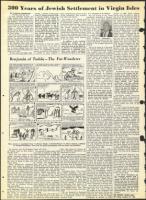

300 Years of Jewish Settlement in Virgin Isles
BY RAPHAEL ROTHSTEIN
wonsky, a member of the prosp-
erous St. Thomas merchant fami-
ly and the brother of the pres-
ent governor of the Virgin Is-
lands, wrote a short history of
the Jews of the Virgin Islands in
response to requests voiced by
hundreds of visitors to the St.
Thomas synagogue, an impres-
sive, lofty white structure built
in the Sephardic style. In his
introduction to Paiewonsky's his-
tory, novelist Herman Wouk, a
resident of St. Thomas, de-
scribed the synagogue as "an
important architectural monu-
ment of the Jewish people in the
New World."
Paiewonsky is today the author-
ity on the history of the Jews of
the Virgin Islands. Thanks to his
efforts in assembling disparate
sources of historical information it
is possible to place together a
(Copyright, 1965, JTA, Inc.)
To most American tourists the
Virgin Islands mean crystal clear
waters, gleaming beaches and duty-
free shopping. Few of the several
thousand American Jews who each
year vacation in the Virgin Islands
realize that the main Island—St.
Thomas — boasts a Jewish com-
munity dating back to 1665 when
the Islands were known as the Dan-
ish West Indies.
The early Jewish settlers on St.
Thomas had been instrumental in
helping the American colonies de-
feat the British in the American
revolution. The story. of the Jews
in the Caribbean often reads like
an adventure story in which they
are seen combating pirates, deal-
ing in slaves, defying Great Bri-
tain and surviving catastrophic hur-
ricanes and fires.
A few years ago. Isidor Paie-
fairly comprehensive picture of the
Jewish settlement's long, complex
and often epic history.
The Island of St. Thomas was
officially settled in 1665 and there
is documentary evidence of Jews
living there from that time. Origin-
ally they came to St. Thomas as
ship owners, chandlers, brokers
and as slave traders. The slave
trading between Guinea and the
Danish West Indies and the export-
ing of rum, molasses and other
products to Europe resulted in rich
profits for these Jewish pioneers
in the new world.
In addition to the merchant
adventurers resident in St.
Thomas there is also proof that
some Jews lived on the Island of
St. Thomas as shop-keepers and
peddlers. It is probable that
these early settlers worshiped
privately for there is no record
Benjamin of Tudela—The Far-Wanderer
300 YEARS BEFORE CoLL/44,31J5,/4/ THE
/2 AA, CENTURY, THERE L/vE0 /4/ sPA/N A
MAN CALLED BEH✓441/N IN /150
PH/ERE TO NOI
BEN✓441/N OF
TuDELA ?
HE TRAVELED FOR /3 YEARS- THROUGH
SOUTHERN EUROPE, AS/A AND AFR/c.4 .
PA4 OFF TO V/S/T MY
FELLOW ✓EwS /4/ OTHER
L.4410.5-1
J
{WHEN HE RETURNED IN //73 HE
WROTE OF H/s ADVENTURES A/ 4
BOOK CALLED TRAVELS OFRA99/
SEN✓AM/N.1
HE WROTE MANS,
AN EXciTING TALE .
The ✓e•ws OF 8,46:040 (NE 14/ROT E )HAL,
RuL ER KNOWN .45 THE EX/LARCH: PR/NCE
OF THE EX/LES . NE WAS IIONOREO BY ALL
44E4 /•
/r /S
THURSDAY
YOUR
EXCEL L ENCY.
All/ IT IS THE DAY TO V/S/T
THE MOHAMMEDAN RULER.
04
1.
HE HAO A SPEC/AL THRONE /4/ THE
CAL /RN's' PALACE, AND THE 0,4L/PI/ H/14-
SELF ROsE-
MAKE kvAY BEFORE
OUR LORD, THE SON
r--cOF DAwof
PRAY BE SEATED,
,v/L..4,9o,
O
-
-
BENJ.-01/N TOLD ABOUT
THE JEWS //Y R4LEST/NE...!
BLACK ../E1Y5
6REET/N6' FROM THE
A/Es-TERN WORLD,
44Y REL4011, -../Eivs/
HE TOLD OF A SEA 9TORM BETWEEN
CEYLON AND ChM/4.
1
" TEE)'
k
THE EA/LoRs IvRAPPEP 7WERSELI/E5
IN CATTLE HOES AND AZuNsEE, /NTG7
THE OCE*44, •6'R/FFhVs CARR/Ea THEM
Ave EXPERTS AT ovE/No.
AND szAss- --4444,4/6., ...
TO SHoRS.
N/S Boat- NAG TO BE TRANSLATED /NTO
MANY LANGUAGES, AND BEN.444-1/411444s
TO co oomv IN 1//STORY Ars- THE F/Rsr
HE PESOR/BED -4 FALSE veAus-N LEADER
IN RER57.4..
/ AM 0,4V/D ALROK
YOUR .HESS/A/ /, SENT
TO LEAD YOU roEVERLASTRYS
/
FREEDOM' J.
1p
AtEo/Et44z rRm/Ezk-R.51/4-R TD re ..4c//
THE OR/ENT 7
-
ANO SAW THE GREAT WALL
THEN OVER /000 YEARS OLD.
This cartoon is reproduced from "A Picture Parade of Jewish - History" by Morris Epstein, published
by Shengold Publishers, New York, by special arrangement with the author and publishers.
Dr. Epstein told the Benjamin
of Tudela story in this accom-
panying essay:
Have you ever heard of the
Jewish merchant seaman of the
Middle Ages? They charted new
ocean routes and sent ships down
the coast of Spain to Italy and
North Africa.
These adventurers exchanged
wares with lands as distant as
China. They visited Mohammedan
countries and brought back to Eu-
rope the first oranges and apri-
cots, sugar and rice, cinnamon and
slippers and sofas and jasmine.
They also carried books and ideas,
and sometimes even passengers.
One of these travelers kept a lively
diary in Hebrew, in which he re-
corded his experiences among fel-
low Jews in Southern Europe,
Asia and Africa.
Benjamin of Tudela started out
from Saragossa, Spain, in 1160.
In thirteen years he visited nearly
300 places in Provence, Italy,
Greece, Cilicia, Palestine, Meso-
potamia, Persia, and India. He re-
turned by way of Aden, Yemen,
Egypt and Sicily.
He arrived in Rome about 1165
and came to Baghdad in 1168. He
observed that the Jews of Baghdad
were governed by Daniel the
Exilarch, or Prince of the Exile,
whose power extended over the
Jews from Persia to Arabia and
to Anatolia. All people honored
him, and every Thursday the
Exilarch went to pay his respects
to the Mohammedan Caliph. Horse-
men escorted him and heralds
cried, "I-milu tarik li Sayidna ibn
Daoud!" (Make way before our
lord, the son of David.) At the
time of Benjamin's visit, there
were 40,000 Jews in Baghdad, and
28 synagogues.
Benjamin observed the Moham-
medan group called Assassins,
who followed their chieftain with
blind obedience. They would even
murder to gain their ends. Their
Arabic name was hashashin, from
the hashish plant which they used
as a drug.
Benjamin kept a list of the num-
ber of Jews living in each place
he visited. He noted their occupa-
tions: silk weavers in Greece, dy-
ers in Palestine, glassmakers and
shipowners in Syria.
One of Benjamin's most remark-
able experiences concerned a false
Messiah who arose among the Jews
of Persia. David Alroy declared
that God had chosen him to deliver
the Jews from Moslem rule and to
lead them back to Jerusalem. Da-
vid's claims proved worthless and
he did much harm by raising false
hopes.
Benjamin's diary, "The Travels
of Rabbi Benjamin," • was pub-
lished in Constantinople long after
his death. The first English trans-
lation appeared in 1840; by then
it had appeared in Latin and
many other languages. Benjamin's
"Travels" became a source book
for historians. They found in it
stories repeated by later travel-
ers, including Marco Polo, who
visited China 20 years after Ben-
jamin.
We are indebted to Benjamin
of Tudela, far-wandering traveler,
for a fascinating account of a
vanished world.
of a synagogue in St. Thomas.
The real growth of the Jewish
population, according to Paiewon-
sky, came in the years following
1781, as a direct
result of the de-
struction by the
British of the
nearby Dutch
West Indian Is-
land of St. Eus-
tatius or Statia,
as it was called,
is a small rocky
patch of land in
t h e Caribbean Paiewonsky
but during the period of the Am-
erican Revolution it figured prom-
inently in the struggle against the
British.
Due to its status as a free port,
St. Eustatius attracted a large num-
ber of Sephardic-Jewish traders
who, together with some Gentile
merchants, prospered by supplying
the hard-pressed American revolu-
tionary forces with military sup-
plies. The supply of arms to the
colonies was a serious cause of
friction between England and Hol-
land. The situation in the eyes of
Britain became intolerable and in
December 1780 Britain declared
war against the Dutch and deploy-
ed a fleet under Admiral Rodney
to wipe out the St. Eustatius
trading settlement. In February
1781 Rodney struck, captured the
island and destroyed the business
center. Describing the island as
a "nest of vipers . .. deserving a
scourging . . ." in a letter to a fel-
low naval officer, Rodney claimed
that had it not been for the St.
Eustatius traders the American re-
bellion could not have subsisted.
Fearful of their future at the
hands of the enraged British,
the Jewish merchants took their
families and whatever they could
salvage from their fortunes and
fled to nearby St. Thomas.
A major source of information
about the early 19th Century Jew-
ish settlement on St. Thomas is a
history ,of the Danish West Indies
written by John P. Knox, pastor of
the Reformed Dutch Church of St.
Thomas, published in 1852. Knox
reported that after the sacking of
St. Eustatius by Rodney, most of
the Jews there came to St. Thomas
and held private prayer meetings
until 1796 when a congregation
was formed and a synagogue called
"Blessing and Peace," was built.
In the two years from 1801 to 1803
the Jewish population of St. Thom-
as increased from nine families to
22 families, due to arrivals from
England, Curacao and other places.
In 1804, the synagogue was de-
stroyed by fire. A small building
served as a house of worship until
1823 when a larger synagogue was
erected to meet the growing needs
of the community. Again in 1831
fire razed the Jews' spiritual cen-
ter and, determined as ever, the
Jews of St. Thomas built the pres-
ent synagogue in 1833.
The first reference to a rabbi is
contained in an account of a dis-
pute which occurred in 1844 over
ritual procedure. Paiewonsky tells
that "A segment of the Congrega-
tion led by Judah Sasso and Mashed
Mara refused to attend synagogue
services one sabbath. Immediate-
ly after the return of the Sefer
Torah to the Hechal, they charged
that Rabbi Carillon proceeded with
the wrong prayers and the Musaph
was completely omitted. A com-
mittee of congregation notables
was formed to investigate and re-
ported that the charges were well
founded. The ritual was then re-
arranged and harmony restored to
the congregation. Rabbi Carillon
left St. Thomas shortly afterwards
for Jamaica and in 1845 he dedi-
cated a synagogue in Montego Bay.
Since 1863 only three rabbis have
served the Jews of St. Thomas. In
1863 Rabbi N.N. Nation assumed
the pulpit of the synagogue and
held it for four years. He was suc-
ceeded by Rev. David Cardoze who
began service in the St. Thomas
synagogue as asistant to Rabbi
Nathan in 1864. Rabbi Cardoze
served until his death in 1914 at
the age of 90. During his reign of
office the fortunes of the Jews in
the Virgin Islands declined. With
the advent of steam, St. Thomas,
which had grown to greatness by
being a trans-shipment center, free
port and port of repair for great
sailing clippers plying the waters
of the Caribbean, faced a difficult
situation. Steamships could be
better serviced in Europe and the
United States. Gradually the is-
land's merchant . class dwindled
and the Jews, who had been so
active in an era of sailing ships,
drifted away from the Island. In
1890 the census reported 141 Jews
in St. Thomas. In 1914 at the time
of Rabbi Cardoze's death only a
handful were left, probably no
more than 40. Rabbi Cardoze was
succeeded in 1914 by Moses D. Sas-
so, who, in 1917, was the only
authorized minister in St. Thomas
on hand to witness the transfer of
the Virgin Islands from Denmark
to the United States. The Jews in
St. Thomas had fared well under
the Danes and had held many posi-
tions of trust. It will be recalled
that in 1814 Denmark became the
first nation to grant the Jews full
civil status.
In 1942 there were only about
50 Jews on St. Thomas, but the
ensuing years, which brought a
large-scale European Jewish im-
migration to America, served to
swell the number of Jews in the
Virgin Islands. One Jewish
storekeeper said that although
there was no official figure, he
estimated the Jewish population
today to be about 80 families or
roughly 200-250 souls. They are
mainly engaged in shopkeeping
and the tourist industry.
Paiewonsky credits Herman
Wouk with being instrumental in
bringing a Hebrew teacher to the
island and spearheading a revival
of Jewish learning. Today regular
Hebrew classes are held at the
synagogue.
A visit to the old Jewish ceme-
tery of St. Thomas reveals epitaphs
dating from the early 19th century.
The gravestones bear the names
of some 80 famous Sephardic fami-
lies such as Athias, Benjamin,
Cardoze, Henriques and Pissaro.
In addition a fewer number of
well-known Ashkenazi families are
represented, listing birthplaces in
Holland, Germany and England.
Several illustrious Sephardic
Jews have hailed from the Virgin
Islands. Judah P. Benjamin, At-
torney General and Secretary of
War in the cabinet of Confederate
President Jefferson Davis, was born
in St. Croix in 1811.
The father of French impression-
ism, the world renowned painter,
Camille Pissaro, was born in St.
Thomas in 1830. His original name
was Jacob Pizarro but he changed
it after emigrating to France as
a young man. The famous Philadel-
phia physician, Jacob Mendes da
Costa, was born in St. Thomas in
1833.
In recent years Sephardic dom-
inance has given away to the in-
flux of Ashkenazic Jews. Michael
Paiewonsky, the 20-year-old son of
Isidor Paiewonsky and nephew of
the Governor, said the Sephardic
ritual now is a conglomeration of
both Sephardic and Ashkenazic in-
fluences and seems to suit every-
one. While visiting the synagogue
I noticed stacks of the Reform
Union Prayer Book. -•
(Zim Israel Navigation Co.
has arranged, starting with a
Nov. 2 schedule, for a series of
cruises - on the S/S Shalom, to
include stop-overs in major Vir-
gin Islands areas. An increasing
interest in Virgin Islands Jewish
communal life has been evidenced
in recent years, and the Israel
liner Shalom's trips serve as an
encouragement in these in-
terests.)
THE DETROIT JEWISH NEWS
40 Friday, October 22, 1965
—