

Dr. Haber Acclaims ORT's 85th Anniversary;
Praises Its Graduates, Tom Cook's Activities
Eighty-five years of an idea, the
work of a great movement which
aims to assure productive pursuits
for Jews in many lands, were ac-
claimed this week
by the organiza-
tion's p7•esident.
Dr. William
Haber, Dean of
the University of
Michigan College
of Literature,
Science and the
Arts, as president
of ORT (Organi-
zation for Reha-
bilitation and
Training c o m -
menting on t h e
advancement o f
Dr. Haber
the movement
during its 85-year existence, com-
mended American participants and
stated:
"The American conununity
has, for 40 years, been a strong
supporter of the World ORT
movement. Until 1947 it sought
financial support by independent"
fund raising campaigns in vari-
ous communities and by appeal-
ing to local federation and wel-
fare funds for allocations. In
1947 and for the past 18 years,
ORT concluded an arrangement
with the Joint Distribution Com-
mittee for an annual subvention
in order to provide partial sup-
port for the ORT budget. It was
fully understood that ORT's fin-
ancial needs could not be fully
met by the UJA-JDC subvention.
Consequently, o u r agreement
with the JDC authorizes mem-
bership income under this provi-
sion. The Women's American
ORT has developed a national
mass organization of some 60,-
000 members with a membership
income of approximately $1,000,-
000. This supplements the JDC
subvention which was $1,850,000
for 1965, a decrease of $100,000
from 1964 as a result of the loss
to the JDC of the German Claims
Conference Funds."
Calling attention to the forma-
tion of men's ORT chapters, Dr.
Haber was especially gratified by
the formation of a new chapter in
Detroit under the chairmanship of
Harry Blatt. He said:
"The men's chapters of the
American ORT Federation are a
more recent development. Such
chapters now exist in New York,
Philadelphia, Boston, New Haven,
San Francisco, Los Angeles, Mil-
waukee. Pittsburg, Cleveland and
some other areas. The object is
twofold: to 'involve' in each com-
munity a group of 'friends of ORT
who would interest themselves in
the organization's work, meet occa-
sionally for educational purposes,
assist in interpreting its activities
and, should occasion arise, repre-
sent ORT's interests in local, feder-
ation and other communal activi-
ties. Our object and hope is that
we can, in time, induce some 10,-
000 men in 50 to 75 communities
to become members of local chap-
ters of the American ORT Federa-
tion. A beginning toward that ob-
jective has already been made, and
membership income from men's
ORT chapters now exceeds $100,-
000."
The effort in Detroit was initiat-
ed under the leadership of Harry
Platt, prominent attorney, former
president of the National Academy
of Arbitrators and currently the
impartial arbitrator under the Ford
Motor Company-UAW Collective
Bargaining Agreement. Platt has
associated with him a group of
sponsors who are assisting it nomi-
nally with annual membership dues
which are limited to S25 per per-
son. The effort has gotten a good
start in Detroit and anproidmately
150 men have already joined. Platt
has plans for a meeting in May
and again next fall when the De-
troit Men's Chapter hopes to reach
the 250 to 300 goal.
As a further comment on Ameri-
can efforts in behalf of ORT, Dr.
Haber stated:
"It is important to emphasize
that strong 'grass roots support'
and understanding of ORT's goal
and program is essential in doz-
ens of American communities if
its constructive work in 21 coun-
tries is to be adequately under-
written. The welfare funds con-
tribution to the UJA provides
only in part for ORT's needs.
The balance from this country
comes from membership activi-
ties under which both the Wom-
en's American ORT and the
men's chapters are affiliates of
the American ORT Federation."
Dr. Haber took occasion to pay
honor to one of the graduates of
an ORT school, a distinguished
resident of Ann Arbor—Tom Cook.
He said:
"He was born in the Ukraine
in 1887. He started to work as a
molder at the age of 12. I am espe-
cially excited about this, since he
was trained at an ORT school and
he is thus one of our pioneer stu-
dents. ORT was not quite 20 years
old when Tom Cook entered as a
student. Sixty-five years ago he
learned- there the habit of hard
work which has never left him.
"He came to the United States
in 1909 to find freedom from the
oppression which he experienced
in Russia. He even saw a bit of
Siberia—and not as a tourist.
Shortly thereafter he came to De-
troit in search of a job. He came
to seek an opportunity to work, to
earn a living by the sweat of his
brow.
"In Detroit he rented a room
with a local family, and when a
brother of the folks with whom he
was living inquired about Cook's
family, he learned that they had
been left behind in Philadelphia
until he could afford to bring them
west. The stranger offered to ad-
vance the money, and the Cook
family was thus reunited.
"Many years later when Tom
Cook, after having visited Flint and
Lansing, decided to settle in Ann
Arbor, he had an opportunity to
repay this kindness. He took into
his home in Ann Arbor the son of
this good-hearted stranger, bought
his books, paid his tuition—often
borrowing it—saw him through a
six-year university career with a
degree from the dental school, car-
rying this generosity to the final
step with a graduation party to
mark the important event.
"And this story leads me to say
something about his wife, Esther,
and their home. It was a sort of
social center. Several students- al-
ways lived there, many came just
to be there—a home away from
home. Young men and girls found
friends there, something to eat,
and much to talk about. After a
football game there was always a
barrel of herring.
"Tom Cook has been interested
in Jewish matters beyond giving to
the UJA and buying Israeli bonds.
The Cook lectures at the Beth Is-
rael Center and his understanding
and support of the Center's prob-
lems mark his interest. He is one
of the founders of the Bnai Brith
lodge. He is a genuine friend of
Hillel, a frequent auditor of its lec-
tures. I watched him and sensed
his deep inner pleasure at the
Sholem Aleichem readings some
weeks ago.
"He is a generous man.
"His charity knows neither race
nor creed. He was probably the
first person in Ann Arbor to con-
tribute to the United Negro Col-
lege fund.
He supplied affidavits for dis-
placed persons and refugees with-
out which they could not have been
admitted to this land.
"The Talmud tells us that no
labor, however humble, is dishonor-
ing—and Tevya Cook has under-
stood that all of his life. He is con-
spicuous in this town for his em-
ployment practices.
"We never cease marveling how
in his advanced, though vigorous,
years he can be found in his foun-
dry alongside his fellow workers—
often stripped to the waist—doing
a day's work, literally by the sweat
of his brow. Such behavior recog-
nizes not only his deep under-
standing of the dignity of labor, its
creativity, its satisfactions, but also
his sense of equality with his fel-
low workers, white and black.
"I never cease to be amazed that
this man, though a 'boss', an owner
of a business, a worker at heavy
labor, is a very quiet person, a
very sweet person—a 'ziesser men-
sch'—who, though he works among
heated furnaces, never permits
heated words to escape his lips.
His voice is never raised; he sel-
dom shows deep emotion. He will
seldom voice any criticism of an-
other. If he cannot say something
good, he says nothing."
men," he writes, "a changeover
from Communism to national-
ism. or vice versa poses few
problems. This would explain
some of the sudden changes
which puzzle and confound West-
ern observers in Asia and in
Africa: one day a Communist,
the next a nationalist or the
other way around. The danger
remains that nationalism, which
now has the upper hand, may
collapse and leave a heap of
disappointment and unfulfilled
expectations and thus give full
rein to Communism."
Tuetsch shows how the Iraqi
IVIuslem party proclaims in its pro-
gram: "The problem of Palestine
can only be solved by force."
He shows how Pan-Arab unity
finds fusion in making Israel its
arch enemy.
"The Arabs assert," Tuetsch
points out, "that they are only
fighting Zionism, that they do
not want to exterminate the
Jews. But none of the many
Arab leaders this writer has
spoken to showed any intention
of putting up with the existence
of Israel as a sovereign state."
Hope fades upon re a ding
Tuetsch's account, and it is evi-
dent that the Kremlin is making
greater inroads into that area
among Arabs than the Western
powers.
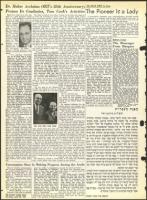
Mt. AND MRS. TOM COOK
She Built ORT in Iran
The Pioneer Is a Lady
A raven-haired, statuesque wom-
an dressed in a superbly tailored
brown suit paid a recent visit to
the national headquarters of Wom-
en's American ORT in New York.
The distinguished and attractive
visitor was Mme. Solayman Senehi,
president of Women's Iranian ORT
and member of the Women's Com-
mittee of Princess Ashraf, twin sis-
ter of Iran's shah, Mohammed Reza
Pahlevi.
Mine. Senehi described herself
as a "pioneer" in building ORT in
Iran. The program, which began
in 1949, ran into "great difficulties"
at first. Many families were hesi-
tant about sending children to a
vocational school. There was also
great resistance to sending girls,
"but," said Mine. Senehi, who has
served as president of the Wom-
en's ORT group in Iran for 16
years, "the enormous value of vo-
cational education soon proved its
worth. I sent my own daughter to
ORT Iran."
Mme. Senehi said that it was not
easy to establish a woman's group
in her land, where women were,
up until recent times, still consid-
ered second-class citizens. She ob-
served that ORT members had many
obstacles to overcome, but that
they organized theater evenings,
made speeches, and "knocked on
doors" to gain support.
At first, ORT Iran had only
make-shift buildings erected on
the grounds of the Jewish cem-
etery, located in Teheren's out-
skirts. "Since then," said Mm.
Senehi, "amazing changes have
taken place. ,ORT is out of the
cemetery for many years and
has become the most modern
school of its kind in Iran to-
day!"
ORT Iran has attracted not only
the attention of, but receives some
financial support from the Iranian
government, which considers the
program a kind of "pilot project."
ORT in Iran, a nation engaged in
a sweeping and constant drive for
industrialization, presently enrolls
some 2,000 students each year. It
has been honored by visits from the
shah and his sisters.
Mine. Senehi, whose family is in
the import-export business, serves
as ORT's delegate to a committee
which supervises women's groups
throughout the country. This com-
mittee is headed by Princess Ash-
raf, who has championed equal
rights for women in Iran for many
years.
Hebrew Corner
The Messenger
From Hungary
In 1944 Joel Brand, one of the lead-
ers of the Jewish community in Hun-
gary, was summonded to the office
of Adolph Eichmann, who was at that
time responsible for the extermination
of Hungarian Jewry. Eichmann then
made him the well-known offer to
exchange "goods for blood," namely,
that the Jews provide trucks and other
essential supplies to the German army
and that, in return, the Nazis would
save one minion Jews from the ex-
termination camps. Eichmann told him
that he was beginning to send twelve
thousand Jews daily to the extermina-
tion camps. If the goods arrived, he
was prepared to reprieve the Hungar-
ian Jews from the death sentence im-
posed upon them. Brand left for
Istanbul in order to meet the leaders
of the Jewish Community in Israel and
ask for their assistance in carrying out
the transaction. The representatives
of the Jewish Agency who met him on
Turkish soil requested him to accom-
pany them to Eretz-Yisarel. On reach-
ing the border, he was detained by the
British. Only after he had been held
in custody for several days was he per-
mitted to meet with Mr. Moshe Sher-
tok (now Moshe Sharett), the Head of
the Political Department of the Jewish
Agency. Brand conveyed Eichmann's
proposal to him, and asked for im-
mediate action in the execution of the
transaction. -
Since then, Brand never returned to
Hungary. The British transferred him
to Cairo. A few months later he met
Lord Moyne, the British High Commis-
sioner for the Middle East (later killed
by two Jewish members of the Under-
ground), and requested permission to
return to Hungary to save the lives of
the Jews there. Lord Moyne said to
hiin, "Your plan is known to me, but
what would I do with a million Jews?"
A few months ago Joel Brand died
in Germany, twenty years after the
Germans murdered a million of his
fellow-Jews in Auschwitz.
Translation of Hebrew Column
Published by the Brit Ivrit
Olamit, Jerusalem.
1111;P:7 mi4173
pn:113)riz?
IN117 1944 rini;
yriyrrt rOmprr Trjr4 ;14-14
irl,t;i'? 1 7;
ncritz 71:;;Itg ,izp ,7tt
rnp:r i to,r)itq
,- pr' z7V ri-vtgrin nte.?7?
117 PIbPri (ri:r.orP) nr,PW:i N.; Tit
ririn
rvi,kqn uro trryrri
117 4 r
k.t;417
nxt n173111
.n .r?.trrri -nianwp rr
thin,n)
ni,4NFT,
ri•L7tg74 7, ,r3r,n wrn
"IVI - W3tg
.rry?tgriri - ryirrY7
N171 — nininpri
1.17z
new? raw; ntirr. nx 1-11-itz7
mr# nrp
14-1
L71m3up,ke?
st,r.='?1 nirrn nzi71
511 3 ;3 tirnis?
inlx ILM). tg n-i17rn - P14jOrl 'Tit!)
nvix 2712,
nr)kt inp ?riL? 1374
nlnsrn 77 .ttriri 1 '217 n3373 - nktrj '71=3z1 17 447'itg7
irj4 ,n'-R7ti - )417n ,n!
s)
ritpb : ni,m) 7innty ritpb
riT 7iV (rn.tri
.n'-rirrr i rn4lon L7tg rr4,17pn n'erpn
Communism Show Is Making Progress Among the Arabs 1:7p t753p'7 13z4 2,-)T 17.4, )x z 7tt? insir rq.3 npp - , 141;
Hans E. Tuetsch, correspondent
for a Zurich newspaper in Paris,
a visiting history professor at
Wayne State University, is the
author of "Facets of Arab Na-
tionalism," a paperback issued by
WSU Press.
He is not optimistic about Arab-
Israel relations and he describes
how under certain conditions the
tensions of the Middle East "are
channeled into the Communist
mold" and under other conditions
"into a national form."
"Where ideology has not yet
fastened a firm grip on agitated
THE DETROIT JEWISH NEWS
40—Friday, April 30, 1965
•77P17r i .! rq.; 1,7 =L?
mnarrit?
1.7,7 te7 Tt;t. 7
rrtriln
'1.pqr,1 n'337riz7 ns7 np4
risI4) roTn
7T4t0"1
'tg;x l'Atg "7.4
rrumn
nnan-07 ntri'7 rontriDx nr,', inn cr,7n1
'7,4r0?
On II* .nitirrgi
11:111471, ":1'7
ntpgt.i rp? Ix ;0? 74711:
ri rontR - n:47r).t /3`) L7t3i' luP4 n'Irit; n'tri,r! 'AO
tzITTI 111 4 -.),tg"upt
tro*v n,` ?v
nts4i7q)