
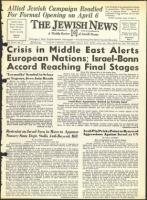

Allied Jewish Campaign Readied
For Formal Opening on April 6
Middle East's
Joan Fontaine to be presented in drama-
tic presentation, "The Children of Is-
rael," at opening dinner , . . Women's
traditional G - Day activities set for next
Wednesday.
Detailed campaign stories on Page 5
JEWISH NEWS
Boiling Cauldron
Marks Renewed
Threats to
-
Israel's Security
"r"FQ
"T"
I G des. NJ
A Weekly Review
Editorial
Page 4
Farouk as an Ally
of Hitler and Mufti
of Jewish Events
Michigan's Only English-Jewish Newspaper —Incorporating The Detroit Jewish Chronicle
XLVI I, No. 5
Printed in a
100% Union Shop
Quentin Reynolds'
Role as Fighter
Agaitsst Nazism
Here and Abroad
Commentary
Page 2
17100 W. 7 Mile Rd.—VE 8-9364—Detroit, Mich. 48235—March 26, 1965—$6.00 Per Year; This Issue 20c
Crisis in Middle East Alerts
European Nations; Israel-Bonn
Accord Reaching Final Stages
Direct JTA Teletype Wire to The Jewish News
`Yarmulke' Symbol in. Selina
as Negroes, Jews Join Hands
SELMA, Ala. (JTA) — Hundreds of Negro freedom
marchers wore yarmulkes (skullcaps), in respectful emulation
of rabbis who participated in demonstrations in Alabama as
Jewish participation in the march from Selma to Montgomery
The Alabama Negroes called the yarmulkes "freedom caps."
The demand for yarmulkes was so great that an order was wired
for delivery of 1,000 when the marchers arrived in Montgomery
Thursday for a great demonstration at the state capitol.
The adoption of the yarmulke as a symbol began some time
ago when rabbis joining prayer services in a Negro church were
asked the meaning of the yarmulke. An explanation was given
by a rabbi that one's head must be covered in the presence of
the Lord. The Negro response was that "wherever the freedom
movement is, God is to be found there."
• While not assuming the Jewish faith, many Negroes adopted
the yarmulke as a symbol of their movement.
Dr. Abraham Heschel, of. the Jewish Theological Seminary,
was asked by the Rev. Martin Luther King to take a position of
honor at the head of the marchers. He walked with Dr. Ralph
Bunche, undersecretary of the United Nations, and the 82-
year-old grandfather of a Negro youth slain recently by Ala-
bama police. The rabbi completed the day's march despite the
distance.
Rabbis jailed by Selma police last weekend, for participat-
ing in demonstrations, conducted Friday evening services in
the Selma jail, it was learned. Five rabbis recited Hebrew
prayers behind prison bars. They have since been released
Continued on Page 7
Reports from the capitals of European nations indicated this week that statesmen in
many areas are showing concern over the crisis that has developed in the Middle East as
a result of Israel-Bonn negotiations for diplomatic exchanges and that official quarters are
being alerted against further breakdowns in efforts to assure peace in the area.
JTA reported on Tuesday from Rome that Prime Minister Aldo Moro told the Italian
Senate that his government has been in touch with all parties concerned in the current Middle
East crisis, stressing Italy's concern for the "safeguarding of the balance of forces and
the peace in that area."
In a lengthy discussion of the Middle East situation, the premier said that his gov
ernment is "fully aware of the situation that has emerged in the Mediterranean zone and of
Italy's important function" in the zone.
The Italian government, he said, "had hoped that the sense of responsibility of all
governments in the area would lead to the permanent clear- up of the delicate situation.
We were therefore surprised by recent manifestations which certainly do not contribute to
establishment of that climate of tolerance necessary to ensure peace in that region."
Israel-Bonn Agreements Marked by Friendly Spirit
BONN Dr. Kurt Birrenbach, Chancellor Ludwig Erhard's personal emissary, returned
Tuesday from Israel after completing a second round of talks with Israeli government leaders
on West German Israeli diplomatic relations and met with the chancellor to report on his
mission.
It was assumed that he would receive fresh instructions on various aspects of the
talks and then return to Israel for a third time.
Rudolf Werner, a member of the Bundestag, the lower house of parliament, was due
back in Bonn Tuesday from Cairo. While nothing was reported officially about his mission,
reports from Cairo said that Werner declared that to ensure some success for his efforts
the starting point for talks with Egyptian authorities would have to be "security guarantees"
from West Germany to Egypt.
It was believed that another Bundestag member whose name was not disclosed had
flown to Syria on a similar effort to patch up Bonn-Arab relations in the wake of West
—
Restraint on Israel Seen in Move to Appease
Nasser; State Dept. Stalls Anti-Boycott Bill
Arab Pin Pricks Point to Renewed
Aggressions Against Israel at UN
By MILTON FRIEDMAN
JTA Correspondent at the United Nations
(Copyright, 1965, Jewish Telegraphic Agency, Inc,)
WASHINGTON — Despite American military blows against the sources of aggression in
North Viet Nam, the Administration is trying to restrain Israel from following similar defensive
strategy on the water diversion issue.
The main foreign policy objective of the United States in the Middle East is the improve-
ment of American-Arab relations. It is now clear that the State Department is trying to silence
L Congressional criticism of the Arab blockade, to organize new channels of aid to Egypt, and
•---'Ththerwise appease President Nasser. To avoid offending Arab sensitivity, the State Department •
eclined comment on the historic establishment of diplomatic relations between Israel and West
dermany. Although aware of the new shipments of Soviet arms to Egypt, the department sought
to evade responsibility for selling balancing arms to Israel.
President Johnson is said to feel that his assurances to Israel of his devotion to Israeli
security and regional peace should be adequate. Accordingly, Secretary of State Dean Rusk
recently discussed the Arab-Israel issue with a delegation of American Jewish leaders to the
State Department in - an effort to sell them the Administration line. The group was headed by
Rabbi Joachim Prinz, chairman of the Conference of Presidents of Major American Jewish Or-
ganizations. It included such veteran pro-Israel leaders as Rabbi Philip Bernstein, of Rochester,
N.Y., and Mrs. Rose Halprin, of New York. •
Mr. Rusk sought subtly to influence the delegation to restrain Israel from defensive meas-
ures on the water issue. The Arabs are preparing to divert water flowing into Israel. The
Israelis may use military measures to prevent this. There are rising criticisms of efforts to ap-
pease Egyptian President Nasser. Mr. Rusk tried to explain that it was in Israel's best interests
for the United States to maintain an "effective presence" in Cairo. Otherwise, he warned, a
situation hazardous to Israel might develop.
But the delegation felt that enough hazards already confronted Israel. They cited the lack
of a clean, firm, and up-to-date statement of Middle Eastern policy by the United States. Also
needed were actions consistent with justice and the realities of Nasser's aggression and blackmail
tactics. The delegation told Mr. Rusk of American evasion of responsibility for maintaining a
regional arms balance to deter aggression. • Mr. Rusk is fully aware of new Soviet munitions
shipments arriving in Egypt. But he does not want America linked with Israel's military needs.
The climax came when the delegation voiced concern over State Department opposition
to a pending Senate anti-boycott amendment. This exposed the raw truth of the Administration's
actual policy. Mr. Rusk at first maintained that he did not know the department was lobbying
against the pending Williams-Javits Bill. Participating in the meeting was Phillips Talbot, assist-
(Continued on Page 3)
:
-
Continued on Page 40
By SAUL CARSON
(Copyright, 1965, Jewish Telegraphic Agency, Inc.)
UNITED NATIONS, N.Y.—There is grave trouble brewing in the
Middle East. There will be Arab aggressions against Israel, and the issue
will come to the Security Council—where the Arabs will try to pin the
blame on Israel.
All of the recent pin pricks by the Arabs have been preliminaries to
the main goal. These efforts have included sabotage attempts coming from
the Fatah terrorists infiltrating Israel from Jordan, Syria and Lebanon;
Jordanian complaints to the Security Council about Israel's planned sym-
bolic military parade to be held in Jerusalem, in connection with the
Independence Day celebration, on May 6; Jordan's complaint about "ag-
gressions" by Israel in the Latrun area, where both Jordan and Israel
have been, for years, cultivating agricultural lands in the demilitarized
zone, without a kick by either side; Jordan's gratuitous attack against
Israel in the Security Council during a formalized session, when Jordan
was welcomed to membership on the Council; and at least a dozen Syrian
attacks against Israel.
What the Arabs hope is that Israel, listening to some of its own
proponents of preventive warfare, may start something to prevent the
Arabs from diverting the headwaters of the Jordan River. But if Israel
is stubborn enough to refuse to pick up that bait, the Arabs will start
the ruckus, making it big enough to force Israel to retaliate. Then the
issue will be taken by the Arabs to the Security Council.
The Arabs want to put the United States on the spot. They want to
blackmail the U.S.A.—as they recently tried, not with total success, to
blackmail West Germany. In the Council, their big guns will be aimed
at the United States policies vis-a-vis Israel, hoping they will scare
Washington into a tough anti-Israeli line.
Abdel Monem Rifai, Jordan's permanent representative at the United
Nations, lost no time attacking Israel on his very first day in the Council,
and followed up with two letters of very thin complaints the next day.
The last Arab member of the Council was Morocco. The Nasserite Arabs
did not like Morocco's relative moderation, and finally forced the Moroccan
to denounce Israel severely. Rifai is waiting for no such reminder.