
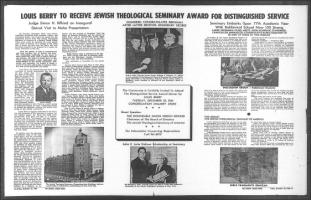

LOUIS BERRY TO RECEIVE JEWISH THEOLOGICAL SEMINARY AWARD FOR DISTINGUISHED SERVICE
GOLDBERG CONGRATULATES BRENNAN
AFTER LATTER RECEIVES HONORARY DEGREE
Judge Simon H. Rifkind on Inaugural
Detroit Visit to Make Presentation
On Tuesday, December 22nd, Louis Berry,
nationally prominent hotel magnate, realtor, and
communal leader, will receive an award for dis-
tinguished service from The Jewish Theological
Seminary of America at a Shaarey Zedek dinner
which must surely be regarded as a most signifi-
cant event in Detroit. It is unique in the sense
that it marks the first time Mr. Berry has ever
permitted himself to be honored by a major. na-
tional institution in this city.
That the tribute to him is well-deserved
and long overdue, few in Detroit can deny.
The outstanding leadership he has given to
many causes for many years is known through-
out America. The name of Louis Berry is one
which understandably evokes admiration and
commendation in the Jewish community, both
locally and nationally, for behind it stands a
record of devotion and loyalty to Judaism which
few men of his generation can match.
Louis Berry has labored long and hard in the
vineyards of Jewish institutional life, but there
are few causes that
are closer to his heart
than the Jewish Theo-
logical Seminary of
of America. He serves
on its Board of Over-
seers, its Committee
on National Campaign
and Regions, and its
National Cabinet, and
along with Abraham
Borman, S o 1 Eisen-
berg, and Hy Safran,
shares the distinction
••f being one of four
iietroiters ever to
have received the
Seminary's Louis Mar-
LOUIS BERRY
shall Memorial Medal,
awarded annually in New York to a select group
of communal leaders for their "continuing efforts
to further the spiritual, cultural, and ethical well-
being of the Jewish community."
Louis Berry's singular dedication to the activi-
ties and programs of the Seminary is unique. but
not without reason. Mr. Berry has made many
investments, both good and bad, in a lifetime.
For him the term "investment" not only applies
to the world of business and finance, but also to
learning and scholarship. His keen understanding
and realization of the eminence and stature that
the Seminary has achieved in these domains has
often prompted him to declare
it one of the best investments he
has ever made.
16—Friday, December 18, 1964
LARGE FRESHMAN CLASS MEETS HIGH ACADEMIC STANDARDS:
CHANCELLOR EMPHASIZES CONSERVATIVE RABBIS REQUIRED TO
BE MEN 'AT HOME IN TWO WORLDS'
deavor. On the evening of December 22nd the
legacy of Solomon Schechter and the odyssey of
Louis Berry will be dramatically joined. High-
lighting the occasion will be a visit to Detroit—
the first for any major Jewish institution—by
Judge Simon Hirsch Rifkind. The new chairman
of The Jewish. Theological Seminary's Board of
Directors and one of the nation's most eloquent
spokesmen for Judasim will deliver the main ad-
dress of the dinner and formally present to Louis
Berry, in behalf of the Seminary, an award for dis-
tinguished service.
Rabbi Morris Adler is chairman of the din-
ner, while serving with him as associate chair-
men are Sol Eisenberg, Joseph Gendelman,
Stephen Lanyi and Jack Shenkman.
The committee in formation for the dinner
includes:
On October 19, The Jewish Theological Seminary of
America reopened for its 77th academic year with a stu-
dent body of 150 strong enrolled in its rabbinical depart-
ment. Welcoming the 30 new students admitted to the
freshman class this year, Dr. Louis Finkelstein, the Chan-
cellor, commented that this increased intake was made
possible by the gratifying response of the American com-
munity to the Seminary's ideal and aims: the Seminary
was exerting. the most vigoroUs efforts to recruit talented
young people for leadership of the growing communities in
this country. The youngest of the three Jewish denomina-
tions, the Conservative Movement, now has the largest
body of adherents: there are now some 2 million members
affiliated with the 788 congregations throughout the United
States and Canada.
Rabbinical Candidates — 'Intellectual Elite'
Emphasizing the general high standard of academic
attainment that is required of candidates to this training
school for the Conservative rabbinate, Dr. Finkelstein
pointed out that the young men selected by the Seminary
represented some of the most gifted intellectuals of their
generation, steeped in the secular scholarship and culture
of the age. "The Seminary." the Chancellor declared, "is
aware that the spiritual leaders of the community, in order
to face the dynamic challenges of the day, and the even
more perplexing problems that the future might hold,
.
Bernard Albert. Norman Allan. Henry S. Alper, Maur-
ice Aronsson, Samuel Berger, Mandell L. Berman, Harold
Berry, Max Biber, Morris II. Blumberg, Abraham Borman,
Tom Borman,- Arthur Boschan, Richard Burton, Charles
II. Charlip, Irwin L Cohn, Norman Cottler. Theodore M.
Curtis, Alfred L. Deutsch, Reubin Dubrinsky, Jonas
Dworin, Joseph Efram, Nathan R. Epstein, Arthur Faber,
I. Irving Feldman. Joseph D. Feldman. Dr. Manuel Feld-
man, Mitchell Feldman, Morris Fenkell, Walter L. Field,
Max M. Fisher, Meyer M. Fishman, Nathan Fishman,
Arthur Fleischman. Samuel Frank. Samuel Frankel,
Nathan Freedland, Sam Freedman, Joseph Frenkel, Abe
Friedman, Ben Goldberg, David Goldberg, Harry Goldberg,
Nathan I. Goldin, David Goldsmith, Max H. Goldsmith,
Edward Gordon, Rabbi Benjamin Gorrelick, Abe Green,
Irwin Green, Samuel R. Greenbaum, Rabbi Irwin Groner,
Charles Grosberg, Harry Gunsberg, Rabbi Mordecai S.
Halpern, Louis Hamburger, Samuel Hamburger, Samuel
Hechtman,
Joseph Holtzman. John Isaacs. Harold Kaplan. Law-
rence Kaplan, Morris Karbal, Abe Kasle, Sam Katkin,
Judge Ira G. Kaufman, Samuel A. Kayne, Judge George D.
Kent, Jerome M. Keywell, Harry B. Korman, Samuel C.
Kovan, Jule Kraft, Allen B. Kramer, Ben Krugel, Harold
B. Kukes, Alex Kushner, Charles S. Lapides, Manny Lax,
Jack 0. Lefton, Rabbi Moses Lehrman, Benjamin Levin-
son, Edward C. Levy, William I. Liberson, Dr. Max L.
Lichter, Sam Loberman, Louis H. Luckoff„
John E. Lurie, Sidney II. Marwil, Meyer E. Millman,
David M. Miro, Max Nosanchuk, Rabbi Seymour Panitz,
Alexander Pollak, Albert Posen, Charles Rubiner, David
Safran, Hyman Safran, Abraham Satovsky, Rabbi A. Irving
Schnipper, Rabbi Jacob E. Segal, George D. Seyburn,
Nathan Sharon, Max M. Shaye, Rudolph Shulman, David
Silver, Max Silverman, Nathan Silverman, Samuel S. Sim-
mer, Rabbi Pesach Sobel, Samuel B. Solomon, George
Spoon, Robert A. Steinberg, Irving Strickstein, Morris
Sukenic, Jack Sylvan, Asher N. Tilchin, Allan L. Waller,
Benjamin Weiss, Eugene Weiss, Melvin Weisz, Abner A.
Wolf, and Paul Zuckerman.
In certain ways the phenome-
nal personal saga of the man,
Louis Berry, and the institution
with which his name has come to
be synonymous in Detroit, are
linked by common denominators:
both rose from humble origins
to positions of high attainment
on the American scene. It was a
fellow countryman of Mr. Berry
who built the Seminary into a
citadel of scholastic pre-emi-
nance which is today unsurpass-
ed among Jewish institutions of
learning. Solomon Schechter
came to America in 1902 from
Cambridge, England, to take
over the presidency of the Semi-
nary and to leave it with a legacy
that is priceless in the annals of
Jewish history. Louis Berry ar-
rived in Detroit from Liverpool
21 years later, challenged the
marketplace, turned adversity
into fortune, and never forget-
ting the land which gave him his
opportunity nor the Jewish heri-
tage he brought with him, be-
came a pillar of strength for the
American Jewish community.
Each man had his own vision of
America and each saw the vision
fulfilled in a lifetime of en-
Seminary Embarks Upon 77th Academic Year
With Rabbinical School Now 150 Strong
Left to right: Supreme Court Justice William J. Brennan, Jr.; Albert
A. List, member of the Seminary's Board of Directors; Dr. Louis Finkel-
stein, Chancellor of the Seminary, Supreme Court Justice Arthur J.
Goldberg, newly installed as chairman of the Seminary's Board of
Overseers'
The Community Is Cordially Invited To Attend
The Distinguished Service Award Dinner for
LOUIS BERRY
TUESDAY, DECEMBER 22, 1964
CONGREGATION SHAAREY ZEDEK
* * *
Guest Speaker:
THE HONORABLE SIMON HIRSCH RIFKIND
Chairman of The Board of Directors
The Jewish Theological Seminary of America
* * *
For Information Concerning Reservations
Call 961-6970
John E. Lurie Endows
cholarship at Seminary
DISCUSSION GROUP — Rabbinical Students
need to be men at home in two worlds. Our rabbis must
be equipped with the widest contemporary knowledge as
well as the wisdom of our ancient traditions."
Outstanding Academic Records
The 30 selected students entering the Seminary this
year to embark upon a program of study extending from
four to seven years, have not only satisfied the demanding
standards in Jewish religious knowledge which are a pre-
requisite for admission to the School of Judaica: every one
of these students has presented, in addition, evidence of
outstanding academic achievement in the area of secular
scholarship. They have majored in subjects as diverse as
English and economics. biology and business management,
history and sociology, psychology and Semitics. One third
•
of the new students hold. beyond the minimum bachelor
degree requirements, degrees in more than one field.
Several students have earned three or even four degrees
each.
Students from All Corners of the Globe
This year's freshmen have graduated from some 40
universities and institutions of learning as diverse as
Harvard and the Hebrew University, Toronto and Tulane,
Lehigh and London. For the 1964 semester the Rabbinical
Department will have a total student enrollment of 150.
Carefully selected on the basis of character and academic
achievement, they come to the Seminary from almost
every corner of the United States, and from seven foreign
countries.
THE LIBRARY
THE JEWISH THEOLOGICAL SEMINARY OF AMERICA
A great educational institution may have its test tubes
and microscopes, its cyclotron and computer. It may have
the pick of the nation's youth. Its professors may be much
sought out wherever men seek wisdom and learning.
But without books—those great repositories of man's
wisdom and follies—it would not qualify as a great educa-
tional center.
If the institution happens to be a great religious insti-
tution, books assume an even greater importance than in a
secular university. For such a school concerns itself with
great questions of good and evil, right and wrong, life and
death. And the tools it uses are, primarily, books.
The library of The Jewish Theological Seminary of
America is admirably equipped with these tools. In fact,
it has the world"s largest collection of books on Jewish
subjects. Never before in the long history of the Jews
has there been such an extensive library.
Today, the Seminary library boasts 200,000 printed
volumes and 10,000 manuscripts. And while it turns down
nine out of every ten works offered to it, because in most
cases the library already has all nine of them, there are
still conspicuous gaps in the collection.
World History Reflected
Nearly every area of learning, whether history or
philosophy or early science or mathematics, must resort to
early manuscripts. And more often than not, some of those
manuscripts are available at the library of the Jewish
Theological Seminary. For example, the library haS a
superb collection of works in the history of medieval
science and medicine.
A priest from the University of Barcelona came to in-
spect some Aramaic Bibles and remained for two years.
ar
The Jewish Theological Seminary, Comprising three Buildings, built on
a quadrangle at 122nd Street and Broadway in New York City.
THE DETROIT JEWISH NEWS
Sol Eisenberg (left) presents plaque to John E. Lurie who endowed a
scholarship at the Jewish Theological Seminary in New York.
BIBLE FRAGMENTS GENIZAH
THE DETROIT JEWISH NEWS
Friday, December 18, 1964-17