
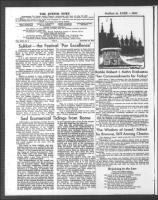

Sukkot in USSR - 1964
THE JEWISH NEWS
Incorporating The Detroit Jewish Chronicle commencing with issue of July 20, 1951
Member American Association of English—Jewish Newspapers, Michigan Press Association, National Editorial
Association.
Published every Friday by The Jewish News Publishing Co., 17100 West Seven Mile Road, Detroit 48235 Mich.,
VE 8-9364. Subscription $6 a year. Foreign $7.
, Second Class Postage Paid at Detroit, Michigan
PHILIP SLOMOVITZ
Editor and Publisher
SIDNEY SHMARAK
CARMI M. SLOMOVITZ
Advertising Manager
Business Manager
CHARLOTTE KYAMS
City Editor
Sabbath Scriptural Selections
This Sabbath, the thirteenth day of Tishri, 5725. the following scriptural selections
will be read in our synagogues:
Pentateuchal portion: Deut. 42:1-52; Prophetical portion: II Samuel 22:1-51.
Licht Benshen, Friday, Sept. 18, 5:36 p.m.
Sukkot Scriptural Selections
Pentateuchal portions: First Day of Sukkot, Monday. Levit. 22:26-23:44, Num.
29:12-16; Second Day of Sukkot, Tuesday, Levit. 22:26-23:44, Num. 29:12-16.
Prophetical portions: Monday, Zechariah 14:1-21; Tuesday, I Kings, 8:2-21.
VOL. XLVI, No. 4
Page '4
September 18, 1964
Sukkot the Festival 'Par Excellence'
A glorious title was given to the Festival
of Tabernacles—Sukkot—by the late Chief
Rabbi of the British Empire, Dr. Joseph
Hertz. He called it "the Festival par ex-
cellence."
It is a well deserved term for a joyous
occasion on our calendar. It is the holiday of
the ingathering of the fruits, and while such
gathering of the results of man's labors
stems from the ancient Land of Israel, it
speaks gloriously in support of creative
effort.
Indeed, Sukkot is the festival of joy. It
provides happiness in Jewish life. It adds zest
to the observance of Jewish traditions by the
youth.
Sukkot is steeped ilk many traditions. It
is during Sukkot that we observe the Draw-
ing of the Water—a custom that was a daily
event during the entire Sukkot festival and
since the dispersion has become an event for
one day during the festival. It is the Simhat
Beth Hashoeva, and the water libation, which
was intended as a temperance lesson, stems
from the traditional admonition "with joy
shall ye draw water out of the wells of salva-
tion." In a sense the water festival signifies
the petition for rain, since on Sukkot we
have the Tefillat Geshem—the appeal for
moisture for a parched land.
The late Chief Rabbi Hermann Adler of
the British Empire (1839-1911) thus evalu-
ated all the aspects of Sukkot:
"Joyful worship has always been the key-
note of the Festival of Tabernacles. In,temple
days, the priests, with Lulav and Ethrog,
went round the Altar in procession to the,.
sound of the Shofar, chanting, 'Save now, I
beseech Thee. 0 Lord: 0 Lord, I beseech
Thee, send now prosperity' (Ps cxvii, 25).
The ceremony which appears to have aroused
the greatest enthusiasm was the Drawing of
Water. The Mishnah tells us, 'He that hath
not beheld the joy of the Drawing of Water
hath never seen joy in his life.' There were
torch dances by men of piety and renown,
and songs and hymns by Levites and people
to the accompaniment of flutes, harps and
cymbals.
"The latest feature of the development of
the Festival is the festive character given to
the last day—Simhat Torah—as marking
the occasion of the completion and recom-
mencement of the reading of the Law. In the
Middle Ages, it became customary to take
all the Scrolls from the Ark and to bear them
in procession round the synagogue. Anxious
as Jewish parents have always been to stimu-
Rabbi Robert I. Kahn of Houston, Tex., has developed a series of
late their children's love and interest in their
religion, they made it essentially a children's guideposts out of the Decalogue in "The Ten Commandments for Today,"
festival. In some synagogues, children were published by Doubleday.
His total theme is composed of a variety of approaches to the basic
called to the reading of the Law. Fruits and
laws contained in the Ten Words. He covers a variety of problems in
sweets were distributed amongst them.
his application of the principles contained in the Commandments as
"And thus, in ever-changing surround- they are applied to the issues of our time, and he reviews their status
ings, the note of joy in the Festival of Taber- among differing faiths.
nacles can be heard through all the cen
At the outset, he poses the question "why the negativism?" and
turies; now as the rejoicing over the harvest, he proves the validity of the "thou shalt not" by pointing out that
now as the joy of temple-worship, and now the Bill of Rights also is composed of a number of negatives—"thou
again in triumphant homage to the Law,' shall make NO law" . . . "certain rights shall NOT be construed"
soldier shall be quartered" ... etc.
Israel's inalienable birthright, 'whence with ... "NO
The Texas rabbi proceeds to show that while the listing of the
joy he draws water out of the wells of salva-' Commandments differs in Jewish and Christian (Catholic) scriptures,
tion.' "
the ideals are alike.
Rabbi Robert I. Kahn Evaluates
'Ten Commandments for Today'
- This, in a sense, is an elementary defini-
tion. But it evaluates Sukkot completely. It
explains the holiday as it has influenced the
young as well as the old.
It is a most spirited event on our calen-
dar. May it continue to bring much joy into
every Jewish household.
Sad Ecumenical T idings from Rome
Affirmations and denials marked the fre-
quent reports about the Vatican Ecumenical
plans. Many suspected from the very begin-
ning that the intentions of the Catholic
prelates were in the main in line with a
continuing policy of the Catholic church to
aspire for Jewish converts.
Towards the end of last year. when it be- -
came apparent that the first Vatican council
would adjourn without action on the deicide
question, the eminent theologian, Dr. Rein-
hold Niebuhr, expressed the view that noth-
ing would happen on the issue, and his
contention was:
The hopes of both Catholic and non-
Catholic observers were excited by the fact
that, when the issue was joined between the
"fathers" of the Council and the conserva-
tive Curia (or Vatican bureaucracy), Pope
John XXIII sided with innovating major-
ity in every critical instance. • The second
session under a new Pope, however; was
conducted in a different spirit.
The disappointment of the second ses-
sion reached its pitch with toe shelving of
the two proposed actions. Both amended
and challenged traditional Catholic atti-
tudes and dogmas. The action on the Jews
intended as a refutation of primitive reli-
gious anti-Semitism with its charge that the
Jews were "Christ-killers," was particular-
ly dear to Cardinal- Bea, a German-born
Jesuit and the late Pope's alter ego. Car-
dinal Bea, who was very influential during
the first session and was perhaps also instru-
mental in the original decision to convene
the Ecumenical Council, is reported to have
an uneasy conscience about the Nazi era in
German history, and to have the ambition
to establish more charitable relations with
Jewish religious organizations. He is said
to have queried some of his Jewish friends
on how this might best be achieved.
But, alas, any constructive pronounce-
ment would offend the traditionalists in
the Church. It would probably offend them
not because they seriously believe in the
age-old slogans of Christian anti-Semitism,
but because it is difficult to offer an official
olive branch to a great and historic religion
which has stubbornly refused to accept the
tenets of the "only true religion." Pro-
posals for making the pronouncement less
offensive to traditional Christians were re-
ported sub rosa, such -as the affirmation
that "only a few Jews were guilty of the
death of Christ." But the wiser members
of the Council knew that such a statement
would be worse than no statement at all.
Postponement may have been the most
prudent policy once the Pandora's box of
religious prejudice was opened.
There was hope against hope that this
would not be the accepted view, but in spite
of conflicting declarations it is daily becom-
ing more apparent that it is not merely
postponement we are dealing with but an
ancient enmity, a refusal to accept Judaism
as other that a "mother religion" that has
outlived its usefulness and must submit to
the tenets of the daughter-faith.
Some Jewish leaders had foreseen the
final outcome of the "uneasy conscience."
The major orthodox elements refused to be-
come . parties to the Ecumenical debates and
speculations. Others, and some leaders of
major Jewish organizations, fell victims to
the delusions. It would have been better
if we had let the Catholic prelates debate
the issue among themselves. It is their prob-
lem, just as the deicide charge is the guilt
of their church. Let them solve it.
He then proceeds to emphasize how much the 20th Century needs
the Ten Commandments.
Resorting tb parables, quoting from the sages and from great world
figures, Rabbi Kahn shows how important it is to have and to retain
faith in God and in God's Law.
Every conceivable element in life is taken into account in Rabbi
Kahn's study—philosophy, psychology, psychiatry, sex, morality, the
quality of mercy.
. He emphasizes the rejection of suicidal tendencies in Jewish tra•
dition, the opposition to capital punishment, the repudiation of vett.
geance, the emphasis on the sacredness of life.
Summing up his theme's conclusions, Rabbi Kahn asserts that even
in the space age "the family will still be the primary unit of human life."
He declares that the Ten Commandments "although formulated
long ago, are as up-to-date as tomorrow's newspaper." He emphasizes:
"We do not need a new morality but a rededication of the old."
'The Wisdom of Israel,' Edited
by Browne, Still Among Classics
"The Wisdom of Israel" edited by the late Lewis Browne remains
a classic to this day.
Republished as an attractive Modern Library GiaM by Random
Press, this volume contains "the essence of the Hebraic contribution to
the world's moral culture, from the prophetic utterances of the Bible
to the wit and wisdom of living writers."
Browne, one of American Jewry's most brilliant writers during his
lifetime, has left an indelible mark on Jewish literature with this work
and others that continue to serve as reference and textbooks as well
as valuable and informative reading material for those seeking Jewish
knowledge.
In "The Wisdom of Israel," the interpretive and explanatory notes
by the editor serve the reader well and assist him in gathering Jewish
information.
Selections from Biblical and Prophetic works and also from the
New Testament, words "between the Testaments" such as the aphorisms
of Ben Sirach, Tobit's admonitions, selections from Hillel, Philo,
Esdrasi and others; gems from the Talmudic period, from medieval and
modern writers, make this work stand out among the best for the
Jewish book shelves.
•
Rejoicing in the Law
From the Sukkot Liturgy
Translated by Israel Zangwill
This Feast of the Law all your gladness display,
Today all your homages render.
What profit can lead one so pleasant away,
What jewels can vie with its splendor?
Then exult in the Law on its festival day,
The Law is Our Light and Defender.
My God I will praise in a jubliant lay,
My hope in Him never surrender,
His glory proclaim where His chosen sons pray,
My Rock all my trust shall engender.