
Allied Campaign Idatuntehed; $1,674,310
Initial Gifts Marked by 10% Increases
Detroit's Allied Jewish Campaign opened
Tuesday night unofficially, at a Pace Setters'
meeting at the home of Mr. and Mrs. Louis Ham-
burger, 27881 Lakehills Drive, Franklin, Mich.,
with a record sum that nearly matched the best
campaign year in the community's history—and
the result encouraged leaders in the drive to be-
lieve that 1964 will exceed by far the $5,000,000
minimum goal envisioned for the current year's
income.
Approximately 75 contributors on Tuesday
evening pledged a total of $1,674,310. The same
group last year gave close to .$1,500,000 and their
current gifts therefore represented a 10 per cent
increase over 1963.
The gathered guests at the Hamburger home
were inspired by the address of Louis A. Pincus
of Israel, treasurer of the Jewish Agency, who
described the current needs in Israel and indicated
the shortcomings in aid extended the Jewish State
in its efforts to retain an open door for the tens
of thousands of new settlers who must find homes
there yearly.
The local needs were emphasized by Charles
Gershenson, chairman of the drive, who presided
at the meeting, and Al
. Borman, his co-chairman.
Borman made an especially urgent plea for sup-
port of Detroit's educational and recreational
agencies and pointed out that 52 per cent of cam-
paign income goes to Israel and the balance of 48
per cent for upkeep of local and national causes.
Admonishing the participants to strengthen
the major fund-raising cause with increased
gifts, Max M. Fisher, Hyman Safran and Isidore
Sobeloff told of the role of the United Jewish
Appeal—the major overseas beneficiary of the
campaign—and of allied movements, as well as
the local agencies, in the over-all communal
picture.
Referring to "the reality of Israel's progress,"
Pincus declared that "this doesn't spell the end
of the story." He said that there is still a big job
to be done, that Israel still has many problems to
solve still being "the only country that will accept
Jews." He then showed how pressing is the need
to rescue more and more Jews from many lands
where conditions have become unbearable for them.
"The freedom and independence of Israel has
Continued on Page 3
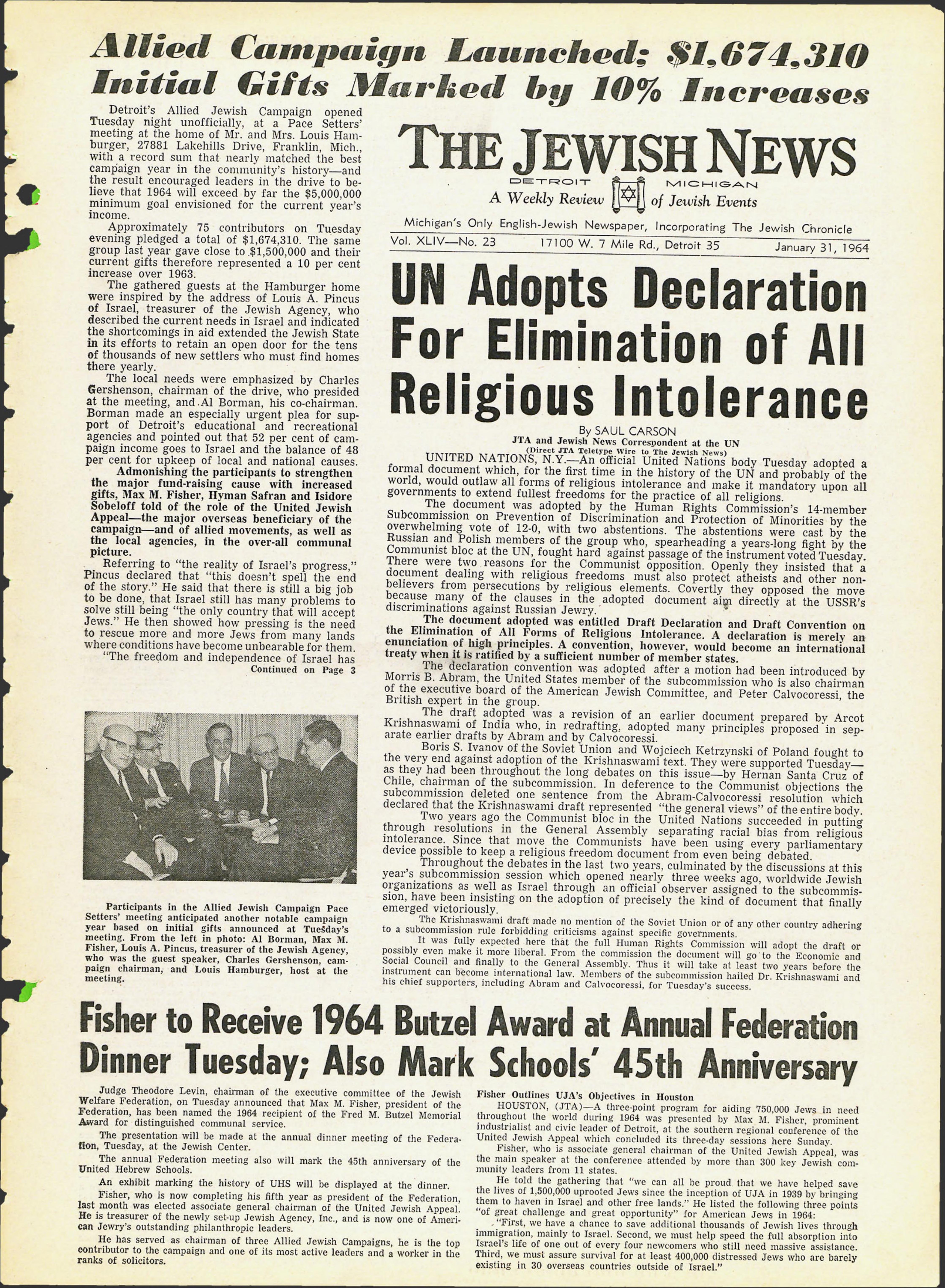
Participants in the Allied Jewish Campaign Pace
Setters' meeting anticipated another notable campaign
year based on initial gifts announced at Tue4day's
meeting. From the left in photo: Al Borman, Max M.
Fisher, Louis A. Pincus, treasurer of the Jewish Agency,
who was the guest speaker, Charles Gershenson, cam-
paign chairman, and Louis Hamburger, host at the
meeting.
THE JEWISH NEWS
c:3-7-1=R
"r"
A Weekly Review
I
MI'ZI—I IGAN
of Jewish Events
Michigan's Only English-Jewish Newspaper, Incorporating The Jewish Chronicle
Vol. XLIV—No. 23
17100 W.
7 Mile Rd., Detroit 35
January 31, 1964
UN Adopts Declaration
For Elimination of All
Religious Intolerance
By SAUL CARSON
JTA and Jewish News Correspondent at the UN
(Direct JTA Teletype Wire to The Jewish News)
UNITED NATIONS, N.Y.—An official United Nations body Tuesday adopted a
formal document which, for the first time in the history of the UN and probably of the
world, would outlaw all forms of religious intolerance and make it mandatory upon all
governments to extend fullest freedoms for the practice of all religions.
The document was adopted by the Human Rights Commission's 14-member
Subcommission on Prevention of Discrimination and Protection of Minorities by the
overwhelming vote of 12-0, with two abstentions. The abstentions were cast by the
Russian and Polish members of the group who, spearheading a years-long fight by the
Communist bloc at the UN, fought hard against passage of the instrument voted Tuesday.
There were two reasons for the Communist opposition. Openly they insisted that a
document dealing with religious freedoms must also protect atheists and other non-
believers from persecutions by religious elements. Covertly they opposed the move
because many of the clauses in the adopted document airy directly at the USSR's
discriminations against Russian Jewry.'
The document adopted was entitled Draft Declaration and Draft Convention on
the Elimination of All Forms of Religious Intolerance. A declaration is merely an
enunciation of high principles. A convention, however, would become an international
treaty when it is ratified by a sufficient number of member states.
The declaration convention was adopted after a motion had been introduced by
Morris B. Abram, the United States member of the subcommission who is also chairman
of the executive board of the American Jewish Committee, and Peter Calvocoressi, the
British expert in the group.
The draft adopted was a revision of an earlier document prepared by Arcot
Krishnaswami of India who, in redrafting, adopted many principles proposed in sep-
arate earlier drafts by Abram and by Calvocoressi_
Boris S. Ivanov of the Soviet Union and Wojciech Ketrzynski of Poland fought to
the very end against adoption of the Krishnaswami text. They were supported Tuesday—
as they had been throughout the long debates on this issue—by Hernan Santa Cruz of
Chile, chairman of the subcommission. In deference to the Communist objections the
subcommission deleted one sentence from the Abram-Calvocoressi resolution which
declared that the Krishnaswami draft represented "the general views" of the entire body.
Two years ago the Communist bloc in the United Nations succeeded in putting
through resolutions in the General Assembly separating racial bias from religious
intolerance. Since that move the Communists have been using every parliamentary
device possible to keep a religious freedom document from even being debated.
Throughout the debates in the last two years, culminated by the discussions at this
year's subcommission session which opened nearly three weeks ago, worldwide Jewish
organizations as well as Israel through an official observer assigned to the subcommis-
sion, have been insisting on the adoption of precisely the kind of document that finally
emerged victoriously.
The Krishnaswami draft made no mention of the Soviet Union or of any other country adhering
to a subcommission rule forbidding criticisms against specific governments.
It was fully expected here that the full Human Rights Commission will adopt the draft or
possibly even make it more liberal. From the commission the document will go 'to the Economic and
Social Council and finally to the General Assembly. Thus it will take at least two years before the
instrument can become international law. Members of the subcommission hailed Dr. Krishnaswami and
his chief supporters, including Abram and Calvocoressi, for Tuesday's success.
Fisher to Receive 1964 Butzel Award at Annual Federation
Dinner Tuesday; Also Mark Schools' 45th Anniversary
Judge Theodore Levin, chairman of the executive committee of the Jewish
Welfare Federation, on Tuesday announced that Max M. Fisher, president of the
Federation, has been named the 1964 recipient of the Fred M. Butzel Memorial
Award for distinguished communal service.
The presentation will be made at the annual dinner meeting of the Federa-
tion, Tuesday, at the Jewish Center.
The annual Federation meeting also will mark the 45th anniversary of the
United Hebrew Schools.
An exhibit marking the history of UHS will be displayed at the dinner.
Fisher, who is now completing his fifth year as president of the Federation,
last month was elected associate general chairman of the United Jewish Appeal.
He is treasurer of the newly set-up Jewish Agency, Inc., and is now one of Ameri-
can Jewry's outstanding philanthropic leaders.
He has served as chairman of three Allied Jewish Campaigns, he is the top
contributor to the campaign and one of its most active leaders and a worker in the
ranks of solicitors.
Fisher Outlines UJA's Objectives in Houston
HOUSTON, (JTA)—A three-point program for aiding 750,000 Jews in need
throughout the world during 1964 was presented by Max M. Fisher, prominent
industrialist and civic leader of Detroit, at the southern regional conference of the
United Jewish Appeal which concluded its three-day sessions here Sunday.
Fisher, who is associate general chairman of the United Jewish Appeal, was
the main speaker at the conference attended by more than 300 key Jewish com-
munity leaders from 11 states.
He told the gathering that "we can all be proud. that we have helped save
the lives of 1,500,000 uprooted Jews since the inception of UJA in 1939 by bringing
them to haven in Israel and other free lands." He listed the following three points
"of great challenge and great opportunity" for American Jews in 1964:
"First, we have a chance to save additional thousands of Jewish lives through
immigration, mainly to Israel. Second, we must help speed the full absorption into
Israel's life of one out of every four newcomers who still need massive assistance.
Third, we must assure survival for at least 400,000 distressed Jews who are barely
existing in 30 overseas countries outside of Israel."