

Purel
Commentary
Hanukah Theme
y th Interpretatio n
in Mgno
By Philip
Eternal Youth
By Justice Louis D. Bfandeis
The Jewish calendar has many
The mere sound of the name, which he now pronounced every
sorrowful
Holy Days. Hanukah—
erz!
and
Stefan
Zweig
on
'The
Menorah'
Theodor H _
evening to his children, gave him great pleasure. There was
Stefan Zweig, the great German-Jewish writer, the con-
a lovable ring to the word when it came from the lips of little the Feast of Maccabees—is one
temporary of .Theodor Herzl, might have been aliVe today, had
children.
of the few joyous red letter days.
Israel's rebirth taken place just a few years earlier. He was
On the first night the candle was lit and the origin of the
frustrated by tlie sufferings that were brought ,upon mankind
holiday explained. The wonderful incident of the lights that It celebrates a victory—not a
by Hitlerism and he took his own life. Yet, he -Was not without
strangely remained burning so long, the story of the return military victory only; but a vic-
from the Babylonian exile, the second Temple, the Maccabees— tory also of the spirit over things
faith, In a poWerful story he had written several years before
his death entitled "The Buried Candelabrum," he stated:
our friend told his children all he knew. It was not very much,
material. Not a victory only over
"Hidden in its secret tomb, there still 'Watches and waits
to be sure, but it served. When the second candle was lit, they
the everlasting Menorah, unrecognized and unimpaired. Over
repeated what he had told them, and though it had all been external enemies—the Saddu-
it have raged the storms of time. Century after century the
learned from him, it seemed to him quite new and beautiful. cees; a victory of the many over
nations have disputed one with another for possession of the
In the days that followed he waited keenly for the evenings, the ease-loving, safety-playing,
Land of Promise. Generation after generation has awakened
which became even brighter. Candle after candle stood in the
and then has slept; but no robber could seize the sacred
Menorah, and the father mused on the little candles with his privileged, powerful few, who in
emblem, nor could greed destroy it. Often • enough a hasty
children, till at length his reflections became too deep to be their pliancy would have be-
foot passes over the ground beneath which it lies; often
uttered before them.
trayed the best interests of the
enough a weary traveler sleeps for an hour or two by the
When he had resolved to return to his people and to make
wayside close to which the Lampstand slumbers; but no one
open acknowledgment of his return, he had only thought he 'people, a victory of democracy
has the slightest inkling of its presence, nor have the curious
would be doing the honorable and rational thing. But he had over aristocracy.
ever dug down into the depths where it lies entombed. Like
never dreamed that he would find in it a gratification of his
As part of the eternal world-
all God's mysteries, it rests in the darkness through the ages.
yearning for the beautiful. Yet nothing less was his good
Nor can anyone tell whether it will remain thus for ever
fortune. The Menorah with its many lights became a thing of wide struggle for democracy, the
and for ever, hidden away and lost to its people, who stilt
beauty to inspire lofty thoughts. So, with his practical hand, struggle of the. Maccabees is o
know no peace in their wanderings through the lands of the
he drew a plan for a Menorah to present to his children the
up
the
eternal world-wide interest. It is
Gentiles; or whether, at length, someone will dig
Menorah on that day when the Jews come once more into following year. He made free use of the motif of the nine
and left in one plane from the struggle of the Jews of today
branching
arms
projecting
right
their own, and that then the Seven-Branched Lampstand will
the central stem. He did not hold himself bound by the rigid as well as those of two thousand
diffuse its gentle light in the Temple of Peace."
traditional form, but created directly from nature, unconcerned years ago. It is a struggle in
Nearly a half century earlier, Dr. Herzl, the founder of the
by other symbolisms also seeking expression. He was on the
modern political Zionist movement, also wrote about the candle-
search for living beauty. Yet, though he gave the withered which all Americans, non-Jews as
In
an
essay
entitled
"The
Menorah,"
he
envisioned
the
abrum.
branch new life, he conformed to the law, to the gentle dignity well as Jews, should be vitall
eternal Jewish light as symbolizing the enkindling of the spirit
of its being. It was a tree with slender branches; its ends interested because they are -vi
of Jewish faith and the Jewish will to live.
were moulded into flower calyxes which would hold the lights. tally affected.
The week passed with this absorbing labor. Then came
For the Zionists, the day has
So many references are frequently made to Herzl's "Menorah"
the eighth day, when the whole row burns, even the faithful
special
significance. The Macca-
that it is time t _ o record it anew. The Herzl essay "The Menorah"
ninth, the servant, which on other nights is used only for the
follows, in its full text:
the others. A great splendor streamed from the bees' victory proved that the
lighting
of
Deep in his soul he began to feel the need of being a
Menorah,: The children's eyes glistened. But for our friend Jews — then already an old peo-
JeW. His circumstances were not unsatisfactory; he enjoyed
all this was the symbol of the enkindling of a nation. When ple — possessed the secret of eter
an ample income and a profession that permitted him to do
there is but one light, all is still dark, and the solitary light nal youth: the ability to rejuve-
whatever his heart desired, for he was an artist. His Jewish
looks melancholy. Soon it finds one company,. then another, nate itself through c o u r a g e ,
origin and the faith of his fathers had long since ceased - and another. The darkness must retreat. The light comes first
u- ne e nthusiasms, devotion and
to trouble, him. Then suddenly the old hatred came to the
to the young and the poor—then others join them who love nu.- ,
elf - sacr i fice of the plain people.
self
surface again in a new mob-cry. With many others he be-
Justice Truth, Liberty, Progress, Humanity, and Beauty. When s
lieved that this flood would shortly subside, But there was
Then
they achieved a rebirth.
all the candles burn, then we must all stand and rejoice over
no change for the better; in fact, things went` from bad to
the achievements. And no office can be more blessed than They will bring again a Jewish
worse; and every blow, even though not aimed directly at
Renaissance.
that of Servant of the Light.
him, struck him with fresh pain, till little by little his soul
became one bleeding wound. These sorrows, buried deep in
his heart and silenced there, evoked thoughts of his origin
and of his Judaism, and now he did something he could not
perhaps have done in the old days because he was then so
alien to it—he began to love this Judaism with an intense
fervor. Although in his own eyes he could not, at first, clearly
justify this new yearning, it became so powerful at length
.
a
that it crystallized from vague emotions into a definitee
which he must needs express. It was the conviction that there
was only one solution—the return to Judaism.
When this came to the knowledge of his closest friends,
similarly situated though they were, they shook their heads
gravely and even feared for his reason. For how could that
be a remedy which merely sharpened and intensified the evil?
It seemed to him, on the other hand, that their moral distress
was so acute because the Jew of today had lost the poise which
was his father's very being. They ridiculed him for this when
his back was turned—many even laughed openly in his face;
yet he did not allow himself to be misled by the banalities of
these people whose acuteness of judgment had never before
inspired his respect, and he bore their witticisms and their
sneers with equal indifference. And since, in all other respects,
he acted like a man in his senses, they suffered him gradually
to indulge in his infatuation which a number of them began to
call by a harsher term than idee fixe.
He continued, however, with characteristic persistence, to
develop one idea after another from his fundamental conviction.
At this time he was profoundly moved by several instances of
apostasy, though his pride would not permit him to betray it.
As a man and as an artist of the modern school, he had, of
course, acquired many non-Jewish habits and his study of the
cultures of successive civilizations had left an indelible impress
upon him. How was this to be reconciled with his return to
Judaism? Often doubts assailed him as to the soundness of his
guiding thought, his idee maitresse, as a French thinker calls
it. Perhaps this generation, having grown up under the influence
of an alien culture, was no longer capable of that return which
he had perceived to be their redemption. But the new genera:
tion would be canable of it, if it were only given the right di-
rection early enough. He resolved, therefore, that his , own
children, at least, should be shown the proper path. They should
be trained as Jews in their own home.
Hitherto he had permitted to pass by unobserved the holiday
which the wonderful apparition of the Maccabees had illumined,
for thousands- of years with the glow of miniature lights. Now,
however, he. made this holiday an opportunity to prepare some-
thing beautiful which should be forever commemorated in the
minds of his children. In their young souls should be implanted
early a steadfast devotion to their ancient people. He bought
a Menorah, and when he held this nine-branched candlestick
in his hands for the first time, a strange mood came over him.
In his father's house also, the lights had once burned in his
youth, now far away, and the recollection gave him a sad and
tender feeling for home. The tradition was neither cold nor
dead—thus it had passed through the ages, one light kindling
another. Moreover, the ancient form of the Menorah had excited
his interest. When was the primitive structure of this candle:.
stick fashioned? Clearly the design was suggested by the tree—
in the center the sturdy trunk, on right and left four branches,
one below the other, in one plane, and all of equal height.
A later symbolism brought with it the ninth branch, which pro-
jects in front and functions as a servant. What mystery had
the generations which followed one another read into this form
of art, at once so simple and natural? And our artist wondered
to himself if it were not possible to animate again the withered
form of the Menorah, to water its roots, as one would a tree.
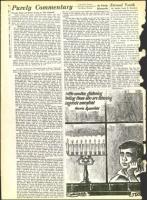
SIOMOVit1
Lifik andles
Telling Maw who are
Legendg man id
MOPPis