

Cleveland's Suburbia, Ghost-
Status Is Applicable to Detroit
-commentary,
Validity of
Single Zionist
Movement
'Beginning
of Wisdom':
End to
'Drifting'
Page 2
Editorials _
—See Editorial, Page 4
JEWISH E WS
DETROIT
A
Religious Schools' Status Defined
in UN's International Declaration
_
Vol. XLI, No. 17
Weekly Review
Evaluated
by Non-Jewess
of Jewish Events
Michigan's Only English-Jewish NeWspaper — Incorporating The Detroi
P rinted in
100 Union Shop
Splendidly
MICHI GAN
Page 4
.
Tehillim
—the Psalms—
t Jewish Chronicle
Comments and
Reviews,
Pages 2, 4 .
17100 W. 7 Mile Rd. — VE 8-9364 — Detroit 35, June 22, 1962.
--
$500 Per Year; Single Copy•15c
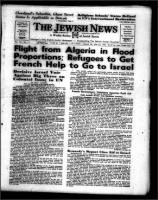
Flight from• Algeria in Flood
Proportions; Refugees
: to Get
„
French -Help to Go to Israel
Decisive Israel Vote
Against Big Three on
Colonial Issis. Q. in UN
By SAUL CARSON
JTA Correspondent at the United Nations
(Copyright. 1962. Jewish Telegraphic Agency, Inc.)
UNITED NATIONS, N.Y.—When Israel
votes on an important reso-
lution
at the United Nations with the_ _Soviet and Arab blocs — and
against France, the United States and Britain—it is news.
- What happened needs some
explanation. The 16th session of the
General Assembly, which ended late last year, voted to hold what is
called a "resumed" session this month, for one
purpose and- one only.
The sole item on the agenda of the resumed
session dealt with Ruanda-
ljruadioui African area which
is trying hard to liberate itself from the
old Colonial yoke, and
where disputes between the two sections, Ruanda
and Urundi, have complicated
a situation already complex. After the
session got going,
a number of African members demanded that another
_item be added to the agenda, to deal with the situation in Southern
Rhodesia, another Central African territory where about
300,000 white
men are trying hard to curb the
liberation movement involving freedom
from colonialism for about 3.000,000
Negroes.
There were hot debates in the Assembly's steering committee
about
the adding of the Rhodesian item to the agenda.
The Africans carried
the vote in the committee. Here, however, Israel was not involved for
the simple reason that it is not a member of the steering committee
and never has been
(another instance of Israel's second-class citizenship).
-Then the issue came to the full Assembly at a plenary meeting.
A fresh debate broke
out in the Assembly at this point. Once again,
Mongi Slim, the Tunisian who is president of the Assembly, showed that
he is more of an Arab than a fair presiding officer of the international
body. His rulings were all in favor of the African bloc.
Before the resolution to add the Rhodesian item could be put to
the vote, the Assembly had to decide a procedural question—should the
ballot require only a majority vote or would it need a two-thirds vote to
pass? Leading the forces for majority versus two-thirds were Ghana,
Bulgaria, the USSR. India and the African republic of Dahomay. The
forces favoring majority won, Israel voting with the West.
Finally, the main question was put to the vote. Now. all of Israel's
'closest Western friends voted against the inclusion of the Rhodesian
item on the agenda. The Arab and Soviet blocs joined the Africans
and a number of Latin Americans in the affirmative vote. Israel 'took
her place—against France, the United States and Britain—for the
African demand, alongside its sworn Arab and Soviet enemies.
When Israel voted against South Africa's apartheid policy, it risked
—and received—stark criticism—not only from South Africa's govern-
ment, which had always been friendly to Israel, but from large segments
of South Africa's Jewish community as well. This time, however, Israel's
snub of its Big Three Western friends was outright .
Observers here noted that there were two excellent reasons
for
Israel's course. First, of course, is the fact that both Israel's government
and its people are committed by tradition and by personal involvement
to oppose, always, anything that smacks of racial persecution and dis-
crimination—and certainly colonialism is the prime example of such
unfairness on a world-wide level. Secondly, Israel has to take into
account purely practical considerations.
of There has been a steady parade, in the last year and a half or two,
African leaders visiting Israel and of Israeli leaders visiting the
African states. Israel is proud of its , good relations with virtually all
of Africa's non-Arab states, especially with the African states which
were formerly colonies of France.
It
is recalled that it was the Africans of the French community
who, last year, sparked the move for that 16-power resolution demanding
peace talks between
the Arab states and Israel (a move killed, in part,
by the United States).
Israeli-African relaiions, it is noted,
must rest on a two-way basis:
If Israel
expects its new African friends to stay friendly, it cannot oppose
.the deepest sentiments of the Africans fighting hard to help fellow-
_Africans
another to gain independence and freedom from colonialism. It was
case where Israel had to take a stand. It did so.
Ideologically, it was agreed, Israel was certainly on the side of
justice. Whether practically Israel chose the right side—history will tell.
Israel risked the displeasure of its Big Three
friends in the West on
behalf
of the oppressed and the rising peoples of the world. That alone
took
courage.
TEL
AVIV, (JTA)--An agreement under which France will help
Algerian
Jews
settle in Israel
France and Israel.
if they so desire is about to be signed between
.
The projected agreement will
cover in those
Algerian
rently eligible for assistance in settling
France.
The Jews who are cur-
give them the same
would
French aid if they decided to settle in agreement
Housing Ministry
Israel.
officials announced here that a major effort would
have to be made to boost construction of housing for new
meet
that objective and to cope
immigrants. To
with a shortage of builders and construc-
tion workers, they said, all
officials offered a projection non-essential construction will be. halted. The
during this year by 150,000. that the Israeli population would increase
French Government, Voluntary Agencies Rush Aid
By
IRVING R. DICKMAN
Public Relations Director, Joint Distribution Committee
MARSE/LLr,---Wednesday morning, June 5, Lucien M. left
his apartment in the
Bab-el-Oued
quarter of Algiers at 6:30 a.m. as though he were going to
work as usual.
Around
the corner,
however,
hailed a cab, first making certain that the driver
was not an OAS (French secret he
army)
man .
m a friend's store wh ere he
them, he loaded two suitcases into the
had
cab A
Fro few minutes later his wife and left
children came around the corner and got
four
into the cab without a word.
All the way to the dock, the M. family kept looking
nervously behind them and
to each side. The two younger children crouched on the floor of the cab. When they
got they
to the
they found it guarded by two lines of polic with guns.
But
did dock
not begin
e
submachine
to relax—even a little—until they were
actually aboard the ship.
Lucien M., 51, his wife and four children, were among the 6,000 Algerian refugees
who reached Marseille June 6. Some 3,000 came aboard three ships. the rest by plane.
Among the 6,000 there were an estimated 500 or 600 Jewish refugees.
For Lucien, this was his
second trip to France in six
November,
he had seen the shadow of coming events. At months. As far back as last
spend four days
with
that time he had come to
antique furniture_ He his cousin, a French army non-com. He is a skilled restorer of
spent the entire four days looking for work in
the surrounding area. When he could not
Marseille and
After the French government—FLN find, any. he returned to Algeria.
ment, the M.'s were forced to move for (Algerian independence movement) agree-
safety into the Bab-el-Oued quarter, which
was now completely European. As
work as a scrubwoman in a hospital.
life became more difficult, Mrs. M. had to go to
It took extreme courage for the M.'s to leave. Aside from the dangers, they did not
dare to sell anything they owned. Refrigerator, furniture—anything that would not
fit into one of their two suitcases—was simply left in the apartment.
'In Marseille, Lucien's cousin met them. There were also representatives of the
Fonds Social Juif Unifie, the French Jewish welfare organization, which is subsidized
by the Joint Distribution Committee, with United Jewish Appeal funds.
Among the 5,000 to 6,000 refu es arriving in Marseille daily. there are many
instances of mother with three or ur small children traveling without husband and
father. The father has stayed b d, either from fear or from a desperate hope that
he can sell
enough
of his b iness or household goods to give him a new start in
France.
These
fatherless
f
groups financial
often need
French government, whic is ily
making
.. . immediate financial help — the
h Alerian
g
or te
"repatriates,"
does not yet pay the allOwance unless the head of the family
is also in FranCe.
(Continued on Page 32)
Kennedy's Report Cites Aid to Israel
WASHINGTON. (JTA)—United States development fund loans to Israel for fiscal
1961 totaled
$16,000,000--an
increase of $1.000,000 over the previous year--President
Kennedy
reported
to Congress.
But the President reported that U.S. technical assistance to Israel was reduced
in
fiscal 1961 to $1,000,000 as compared with $1,400,000 the previous year. The reduc-
tion
tion in technical assistance, the President said, was the result of "the growth of
competence in Israel."
President Kennedy's references to Israel were contained in his annual report to
Congress on the 'U.S. Mutual Security Program. The lawmakers were also told that in
addition toU.S. agricultural commodities for Israel totaling $25,900,000 during the
last fiscal year, U.S. advisers and technicians continue to serve in Israel on highway
and railway projects, as well as on programs for mineral and industrial development.
The report showed no U.S. military aid was p
Israel
fi ca l 1961,
although four of her Arab neighbors--Saudi Arabia, rovided
q—did
Jordan,to
in
Lebanon
and Ira
receive such aid. Lebanon received $172,000 worth of military aid from the
U.S.A.
in fiscal 1961, and was allocated $10'7,000 in that category for fiscal 1962. Jordan got
military
valued at $3,470.000 for fiscal 1961, and $1,511,000 for fiscal 1962. Ira
share
was aid
$32,000 in fiscal 1961, and $40,000 for fiscal 1962.
's
No figure for military aid to Saudi Arabia was mentioned
report.
in the President's
Defense Department circles said they did not know why such
a figure was
omitted,
but of thought it was possible that Saudi Arabia's military aid share
in
the form
had been
purchases,
rather
than
in
grants
as
applied
to
the
other
Arab
of Israel.
neighbor' -
.