
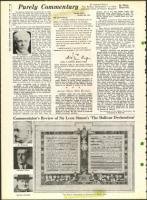

Sir Leonard Stein's
`The Balfour Declaration'—a Most
.W suable Work of Historic Research
Purely Commentar
,
The Balfour Declaration was dated Nov. 2, 1917.
40reign Offibe,
Many essays and books have been written on and
November tad, 1917.
about it and the events that led to its issuance by.
Arthur James Balfour in behalf of the British gov- " ifiSr •LOrd Rothschild,
•
ernment. An untold number of speeches have been
I have much pleasure In conveying to you. on
delivered about the Declaration, and it may gen-
erally be believed that everything that is to he
behalf of His Majesty's Government. the following
known about it has either been written or verbally
declaration of sympathy with Jewish Zionist aspirations
told. -
which has been submitted to. and approved by, the Cabinet.
That, of course, is far from being totally factual.
So many things have happened behind the scenes, in
His Majesty's Government view with favour the
England, in this country, in France, in Germany
establisivnent
in Palestine of a national home for the
and in the Middle East,
Jewish people, and will use their best endeaVours to
to affect both the final
text of the Balfour De-
facilitate the achievement of this object. it being
claration and the policies
clearly understood that nothing shall be done which
of the British govern-
may prejudice the civil and religious rights of
ment, that it remained to
the present time, more
existing non-Jewish communities in Palestine. or the
than 43 years after the
rights and political status enjoyed by Jews' in any
issuance of the Declara-
tion, for the total com-
other country"
pilation of facts to be
I should be grateful if you would bring this
made public.
In "The Balfour Decla-
deOlarition to the knowledge of the Zionist PederatiOn.
ration," a highly scholarly
680-page historical work,
Lord Balfour
published by Simon and
Schuster (630 5th, N. Y. 20), Leonard Stein presents
the complete story of the document. Stein is espe-
cially well qualified to delineate the history of the
Declaration. A native of London, educated at
ArthUr J. Balfour's Historic Letter
Oxford, Stein then studied law. He served in the
British army during - World War I, held appoint-
Chaim Weizmann began to urge British leaders to
take an interest in Zionism and formally to support
ments, • first in the military administration of
Palestine and later as a political officer, 1918-19,
the ideal.
It is an objective study, and the author does
and from 1920 - to 1929 was political secretary of
not hesitate to indicate how Zionists often differed
the World Zionist Organization. He returned to
in their approaches, how the Jewish communities
active law practice in 1932, was an adviser to the
Jewish Agency for Palestine in the presentation of
were divided, how a number of Christians dedicated
themselves in support of Jewry's aspiration for
its case before the Palestine Royal Commission in
1936 and again before the Woodland Commission
national rebirth
in 1938. He was president of the Anglo-Jewish
It was an era of behind-the-scenes battles, of
public debates, of strong Jewish opposition to
Association, 1939-49. He has written a number of
Zionism, but of equally valiant support from non-
books on revenue law, on Zionism and on Syria.
Jews. It was not expected that Herbert Samuel
Stein's remarkable work of research, his
would be as adamant in support of the Zionist
knowledge of the personalities involved,' his
thorough awareness of the conditions that created
much controversy over the Declaration, enabled
him to produce a truly great work—one that will
occupy a most important place in the compilation
LONDON, (JTA)—Sir Leon Simon, author
of Jewish historical data.
and educator, celebrated his eightieth birthday
In "The Balfour Declaration," Stein- traced the
June 17. A deputation of the Zionist Federation
events relating. to the Balfour letter from the very
called on him to convey the Federation's good
beginnings of related history through the London
wishes. The delegation, headed by Levi Gertner
and San Remo conferences. In order fully to accom-
presented an address ni Hebrew expressing the
plish his task, he went back into the history of
Federation's tribute to "our leader and teacher."
the great powers' aspirations, in the Middle. East,
Sir Leon Simon, who is currently chairman
as well as Jewry's hopes for national redemption,
of the Hebrew University Press, is well known for
arid he deals with these in the opening "back-.
his English translations of hte works of Ahad-
ground" chapter concerned with the years 1839-1914.
Ha'am and his translations into Hebrew of the
Then come the reviews of British and French aims
Dialogues of Plato. He also served in numerous
in that area, as well as the history of the Zionist
British government positions.
movement, especially the year 1914, when Dr.
* *
-Author Marks 80th Birthday
By Philip
Slomovitz
position, but it was this Jewish leader who
encouraged David Lloyd-George to back the
Zionist idea. Lord Milner supported Zionism. So
did Sir Edward Grey. General Smuts was espe-
cially helpful.
The details reviewed by Stein cause his book
to read like a romance. It is romantic history, and
it is /splendidly embellished by the author's analyses
of the personalities who were involved in the great
drama. '
Thus, there are remarkable fine evaluations of
the Jewish leaders, the non-Jewish supporters, and
of Balfour. His biographer, his niece, Mrs. Blanche
Dugdale, is quoted as testifying "to his lifelong
interest in the Jews and their history, ascribing
this to the early Scottish training which had woven
the Old Testament story into the . texture of his
mind." She recollected that from childhood she
was "imbibing from him the idea that Christian
religion and civilization owed to Judaism an
immeasurable debt, shamefully ill repaid."
Stein evaluates Balfour's thinking and the
attitudes toward him, on the Jewish question, by
eminent leaders, as follows:
"Balfour's inquisitive and speculative mind
ranged widely over matters remote from politics.
In his interest in Zionism there may well have
been an element of sheer intellectual curiosity,
but there was also a tinge of emotion out of
keeping with the generally accepted view of his
character and temperament. `Behind all this
glitter lay a hardness,' says one historian, quoting _
Neville Chamberlain's verdict: 'He always seemed
- to me to have a heart like a stone.' Another
writer has spoken of him as 'never allowing
enthusiasm to color his innate and detached
cynicism.' This is not the Balfour who was moved
to the point of tears by Weizmann's exposition of
the Zionist case at their interview in 1914, nor
the Balfour who, in 1917, in conversation with
Harold Nicolson, explained his approach to the
Jewish question in words like these: "The Jews
are the most gifted race that mankind has seen
since the Greeks of the fifth century. They have
been exiled, scattered and oppressed . .. If we
can find them an asylum, a safe home, in their
native land, then the full flowering of their genius
will burst forth and propagate . . . The submerged
Jews of the ghettoes of Eastern Europe will in
Palestine find a new life and develop a new and
powerful identity. And the educated Jew from
all over the world will render the University of
Jerusalem a center of intellectual life and a
radiant nurse of science and the arts: `Such,
More or less,' Nicolson recalls, 'were the exact
words he used.' 'I never knew A. J. B.', Lord
Vansittart writes, `to care for anything but Zion-
ism.' The cynic with a 'a heart like stone' was cap-
able of a sensitive understanding of the Jewish
predicament and threw himself into the Zionist
cause with an ardor in which there was plainly
an element of emotion."
The architects of the Balfour Declaration, the
(Continued on Page 32)
Comment,ator's Review of Sir Leon Simon's 'The Balfour Declaration'
•••.‘
Dr. Weizmann
...........
• • .....
•
Winston Churchill
.. .... .
•
:,....
The Balfour Declaration as Depicted by Arthur Szyk
srj