

Noteworthy
JNF
Achievements
Source of
Revived Bigotr),
Top 1959
Jewish Story
Editorials
Page 4
THE JEWISH 71‘,:EWS
A Weekly Review J
of
(\ ‘0 -
le*
VOLUME XXXVI — No. 18 Nor ljentr!n Sgop 17100 W. 7 Mile Rd.—VF
Neo-Nazism Major Menace in Trout
Greetings
to Jewish
Communities
*4
Everywhere
b-
Michigan's Only English-Jewish Newspaper—'
Hanukah
.
Detroit Jewish Chronicle
, January 1, 1960
.$5.00 Per Year; Single Copy 15c
orld
Anti-Semitism Threatens denauer
Position as West Germany's Leader
The resurgence of anti-Semitism in Germany, on the
eve of Christmas, suddenly catapulted the rebirth of
Nazism into one of the major stories of 1959.
A gradually developing neo-Nazism, and its attendant
rebirth of hatred of the remaining 35,000 Jews in Ger-
many, has created a serious problem for Chancellor
Konrad Adenauer of the West German Federal Republic.
Germany's leaders have condemned the new out-
breaks against the small number of Jews that remains in
Germany out of the pre-World War II population of
600,000.
The new incidents at Cologne have attracted world-
wide notice, and the problem of a re-emerging German
anti-Semitism is being discussed in many countries as one
of the new menaces in a troubled world.
While Adenauer's position as West •German
has become endangered as a result of the new Nazi acts,
there are warnings that the situation will worsen when
Adenauer no longer is in power.
.
Political Crisis Faced by Adenauer
Direct JTA Teletype Wire to The Jewish News
LONDON.—Chancellor Konrad Adenauer,
who has
staked his political life on the proposition that Nazism and
anti-Semitism are dead in West Germany, is facing a
political crisis because of the Christmas Eve deSecration
of the Cologne synagogue, the Daily Express correspond-
ent reported from Bonn.
He reported that the Socialist opposition party issued
Photo by Meirowitch, Jerusalem
a call to the German people demanding whether "the
(03=1 U17s)
•17 rutn nn13725 rn n- 15D"y31:
roots of Nazi criminality have really been torn up." The
Chancellor's Christian Democratic Party has promised
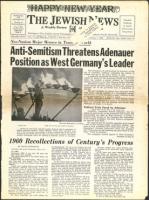
During the long Exile. Hanukah candles flickered only in synagogues or
that "Nazis who are still smearing the good name of Ger-
behind shuttered windows. Today, Hanukah torches blaze wherever Jews
many" would be punished.
live in free democratic communities. In Israel, menorahs are lit on roofs of
houses and are visible from the hills—on towers and in homes. The accom-
The synagogue scandal figured in West Germany's
panying
photograph shows the lighting of Hanukah torches in Jerusalem.
Continued on Page 24
1960 Recollections of Century's Progress
BY DAVID SCHWARTZ
(Copyright, 1960, Jewish Telegraphic Agency, Inc.)
-It's 1960!
'Remember 1860? It was only 100 years ago.
How things have changed!
-The entire population of the United States was
only 30,000,000.
Pebple didn't use tooth brushes. When they got
sick, Jews took "zum molten." For a fever, you
took quinine. If you were hoarse, rock candy with
whiskey.
People were reading Dickens and George Eliot
and Emerson. Whitman had written a book but
it took time before it caught on. Heinrich Heine
was well known. He had died four years before
1860, but he had left a strong impression. At first,
he had abandoned Judaism but later retraced his
steps and became a very good Jew.
His friend Karl Marx wcote . a book about Capital.
He told his mother about it. She said, "Karl, it
would have been better if you had some capital
instead of writing about it." The only money Karl
Marx made was the little he received from the
New York Tribune for serving as European
correspondent for it.
In England, Benjamin Disraeli was coming to
the fore. In 1860, he had not yet become Prime
Minister but Carlyle had already called him "a
superlative Hebrew conjurer."
Sir Moses Montefiore was world, famous for
his philanthropy. He was a very religious Jew and
traveled about Europe asking the crowned heads of
such countries as Turkey, Russia and Romania to
be merciful to Jews. In 1860, Romania was a
particularly troublesome spot for Jews. In many
parts of the world, "the blood accusation" was
raised against Jews. It was charged that Jews
killed non-Jews to get blood which they mixed
with matzot.
In the United States in 1860, the slavery issue
had precipitated a crisis which seemed about to rend
the Union in two, at a time when, with the develop-
ment of the West and the building of railroads, the
country was making greater progress than ever.
There was a lot of talk at the time about railroads,
which were a comparatively new thing. Everywhere
it was supplanting the horse, and the first name of
the railroad was the iron horse.
A new party called the Republicans had been
organized, and it was anti=slavery. Louis N.
Dembitz, a Jew who had been elected one of the
delegates to the national Republican convention
meeting in Chicago in 1860, was asked who he
thought would be nominated. "Well," said Mr.
Dembitz, "there is a great deal of hullabaloo
for Seward, but there is a growing sentiment
for that fellow from Illinois, Abe Lincoln. The
country doesn't know much about Lincoln yet,
but I think he would make a strong candidate.
I am for him."
However, another Jew, August Belmont, who
was a leader in the Democratic party, supported
Douglas.
In all, there were about 200,000 Jews in the
United States. In Louisiana, a Jew, Judah P.
Benjamin, had been elected United States Senator.
A young and beautiful Jewish actress from New
Orleans, Ada Isaacs Menken, was a sensation appear-
ing in tights. Mark Twain, then an unknown in
Nevada, was fascinated by her. She also wrote
p.*ems about the rebirth of the Jewish State.
But the first person to take the idea of a
Jewish State seriously was a Christian, Warder
Cresson. He had been a Quaker and had gone to
Palestine to establish the first Jewish agricultural
colony. He died in 1860.
In that same year, a child was born in Buda-
pest to a Jewish merchant. The father said to his
wife: "You know, Jeannette, he has your beautiful
eyes and features." "But look, Jacob," she
answered, "what a big fellow he is. He will grow
up to be a man of tall stature like you."
The grandfather of the child stod by: "He has
inherited the beautiful face of his mother, the
stature of his father. Where do I come in?
Doesn't he inherit something from me? Maybe he
will inherit my ideas." The grandfather, Simon
Loeb Herzl, had frequently spoken of the re-
establishment of the Jewish State.
So they named the boy Theodor.
It was in 1860—just 100 years ago.