

Tradition of
BET DIN
•versus
the Secular
Courts
THEIEWISy NEWS
Editorial
Page 4
Vol. XXXV, No. 17
A
Michigan's Only English-Jewish Newspaper—Incorporating The Detroit Jewish Chronicle
Printed in a
100% Union Shop
Classic by
Justice
Cheshin:
"Tears and
Laughter in
Israel Court"
Commentary
Page 2
17100 W. 7 Mile Rd.—VE 8 - 9364 — Detroit 35, June 26, 1959 $5.00 Per Year; Single Copy 15c
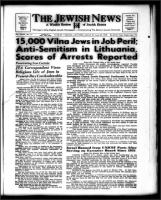
15,000 Vilna Jews in Job Peril;
Anti-Semitism in Lithuania,
Scores of Arrests Reported
Penetrating Iron Curtain
JTA Correspondent Views
Religious Life of • Jews in
.
Present-Day Czechoslovakui
Editor's Note: For the first time in more than a decade.
a direct report is available of conditions in countries behind
the Iron Curtain. This is one of a series of articles by a JTA
correspondent who has visited all of the USSR satellites.
By DAVID MILLER
(Special Correspondent of The Jewish Telegraphic Agency)
PRAGUE—For the first time in 18 years the once-proud
synagogues of Communist Czechoslovakia are echoing to the
' ancient prayers of a bar mitzvah service.
"All the babies were killed during the war. Until
January there was not a Jewish boy of 13 in the country.
We have had to wait for a second generation to grow up."
These words from Dr. Gustave Sieber, 79-year-old Chief
Rabbi of Prague, summed up the paradox of present-day life
for the bare 18.000 Czech Jews who remain from a pre-war
population of 380.000.
"We had 14 bar mitzvahs in the first five months of the
year, an important landmark in our rebirth," he said. "From
1941 to 1945, when the Germans were in power. until a few
months ago we did not know what it was to have a young
Jew in Czechoslovakia."
Czech Jews have struggled painfully to regain a share
of their pre-war life when they were prominent in the
political, economic and academic life of the country, western-
most of the Soviet-bloc satellites.
The outlook continues grim despite the outlawing of
anti-Semitism and the Czech government's subsidies for the
operations of the Jewish community and its agencies.
Official claims to the contrary, life in present-day Prague
and other centers of Jewish life in Slovakia, Moravia and
Bohemia is as difficult as ever.
The mood is one of resignation and acceptance of life
as it is. The Jewish populace, generally elderly, tends to
avoid unpopular causes. But without question, the position of
the Jews has continued to deteriorate.
On the surface. matters look much improved. The coun-
try's seven rabbis. 14 cantors and other religious official's are
under salary to the Ministry of Education and Culture.
Interviews with key Jewish figures are easily obtained.
At one time, no responsible Jewish leader would meet a
Western newsman without government permission or an
official witness. Now. a request to Czech officials to interview
the Chief Rabbi was dismissed with a "no permission is
required."
Kosher wine and brandy are bottled by the government.
Religions instruction is available upon the written request of
both parents each semester. Occasional anti-Semites are
publicly chastised.
Two Czech teenage boys were fined earlier this month
for throwing stones in a Jewish cemetery. Rabbi Sicher,
informed of the matter by the local police chief, said other
cases were "isolated."
Gray-bearded, Vienna-trained Dr. Sicher, Chief Rabbi since
1947, and Dr. Rudolf 'His. general secretary of the Council
of Jewish Religious Communities in Prague, gave official
answers to questions on the religious community but shied
away from political matters. •
Both stressed the critical shortage of rabbis and the prob-
lem of building for the future. They proclaimed the im-
portance of identifying the Jewish community with the Czech
nation as a whole.
But the predominant fact of life for Jews here is the
shadow of Rudolf Slansky. Once the most important Jewish
figure in the Czech government, Slansky, then secretary general
of the Czech Communist Party, was hanged seven years ago
in the last of the big Stalinist purge trials.
He and 10 others. including seven Jews, were denounced
for treason and accused of plotting against the state, collabo-
rating with Tito, conspiring to help Czech' Jews immigrate to
Israel and attempting to seize the government.
Rabbi Sieber denied that the trial was anti-Semitic.
"Slansky himself was not a practicing Jew. The trial did,
(Continued on Page 3)
Direct JTA Teletype Wire to The Jewish News
NEW YORK—Newsweek, the weekly newsmagazine, reported Tuesday
from Stockholm that the focus on anti-Semitism in the Soviet Union has been
aimed at Lithuania and that large numbers of the 15,000 Jews in Vilna have
been fired from their jobs.
Newsweek reported that the Communists have -banned a projected Jewish
dramatic group in Vilna and that a sports stadium has been built on the site of
Vilna's oldest Jewish cemetery.
Synagogues Closed, Scrolls Reported Confiscated in Russia
UNITED NATIONS. N.Y. (JTA)--New details were disclosed here of the
continuing campaign by the Soviet Union to suppress the practice of Judaism
by Russian Jews.
The synagogue in Chernigov, in the Ukraine, was closed last month and
its Scrolls confiscated. This action followed the arrest last fall of several Jews
in C-hernowitz and the Ukraine, on charges of participation in "Zionist propa-
ganda."
According to the report. the charge was based on the participation of the
defendants, who included synagogue officials, in the traditional Passover toast:
"Next year in Jerusalem."
The reports suggest that the oppressive measures are motivated by the
belief of Soviet Union leaders that Russian Jews are involved in "bourgeois Jew-
ish nationalism" and thus retain ties with outside Jewry.
The possibility that the pressures were politically motivated rAther than
aimed at crushing the Jewish religion. although Marxist ideology is fiercely and
unreservedly anti-religious and atheistic, also were raised by the reports.
The current measures are centered in the Ukraine but not restricted to it.
In Minsk, eight Jewish students were jailed last December on charges that they
organized "a Zionist cell." Several Jews were arrested in Kishinev for baking mat-
zos in violation of a government decree last Passover.
The reports also disclosed that the Jewish cemetery in Kishinev was re-
cently divided. Authorities are building a market place on one of the halves.
The dismantling of Jewish cemeteries and the sales of tombstones for commercial
purposes was reported to be one of the principal elements of the current anti-
Jewish campaign.
In another official action. the synagogue in Voronezh was confiscated for
use as a grain warehouse. The Jewish community has been unable to raise the
funds needed for its release as a svnagogue.
ASide from anti-Jewish actions by authorities. there also have been reports
of anti-Semitic activities which have not been punished. -
The Jewish cemetery in Kiev was wrecked and ;48 of its finest tombstones
smashed on Yom Kippur night. The- Mayor of Kiev said that the cemetery would
be restored but later it was announced that the cemetery would be converted
into a park.
'
A ravine outside of Kiev Babi Yar. where 80.000 Jews were slaughtered by the
Nazis during the occupation, also will be made into a park. despite a promise by Premier
Khrushchev, made when he was secretary of the Ukrainian Communist party, that a memorial
for the murdered Jews would be built there.
Soviet authorities did arrest several persons in an attack on a synagogue in Plungian,
Lithuania, on Rosh Hashanah eve last year. They also intervened two months later when
peasants attacked Jews.
Israel Banned from UNICEF Posts After
Serving on Executive Board Since 1951
Direct JTA Teletype Wire to The Jewish News
-UNITED NATIONS. N.Y.—Israel, which has held membership on the
executive board of the United Nations Children's Fund since 1951 and w hi ch
was in line for the chairmanship of the • UNICEF executive board, has been
eliminated from UNICEF leadership for the first time in eight years.
This fact became known here Tuesday from perusal of the minutes of the
last meeting of the United Nations Economic and Social Council preparatory to
ECOSOC's next meeting which will convene in Geneva next week. ECOSOC is
e UN organ which elects members to the board of various subsidiary UN
bodies, including UNICEF.
ECOSOC's last session was held in April in Mexico City. At that time,
Israel again was a candidate for the UNICEF executive board. The minutes show
that Israel was not elected.
Israel first became a member of UNICEF executive board in 1951. held the chairman-
ship of the UNICEF program committee in 1955 and 1956 and held the vice chairmanship
of the executive board for 1957 and 1958. The new board without Israel will take office
Jan. 1. 1960.
In addition to voting against Israel for the UNICEF post, ECOSOC also eliminated
Israel's candidacies for the Commission on Human Rights and the Population Commission.
The high posts on the UNICEF executive board and on the program committee—the
latter being the group that formulates the programs of UNICEF activities throughout the
world—have been filled on Israel's behalf for the last few years by Mrs. Zena Harman,
wife of Israel's new Ambassador-designate to Washington._