
Israel Eliminated from Grant-in-Aid:
Economic Progress Given as the Reason
THE DETRMT JEWISH NEWS—Friday, April 3,
Direct JTA Teletype Wire to The Jewish News
WASHINGTON — Israel has been eliminated from the list of countries to receive
grant-in-aid special assistance from the U. S. Foreign Aid Program.
Aid to Israel will now be confined to development loans and sale of surplus agricultural
commodities at reduced prices.
The fact of Israel's omission for the fiscal year 1960 emerged during hearings on the
administration's proposed new program. It was confirmed Tuesday by the International
Cooperation Administration.
This development marks the first time since the grant program for Israel began in 1951
that Israel was eliminated.
The omission of Israel emerged during a hearing of the House Foreign Affairs Committee,
the transcript of which became available Tuesday.
Acting I.C.A. Director Leonard J. Saccio told the committee the grant program benefiting
Israel was terminated. He attributed the termination to Israel's economic progress. He said
that future aid to Israel would consist of permitting Israel to buy surplus food at low
prices and to obtain loans through the development Loan Fund.
Questions were raised by a number of committee members. Rep. James G. Fulton,
Pennsylvania Republican, told Saccio that Israel was being sorely pressed militarily and
economically and with "the upsets that have been in that area recently, it is a little hard for
me to understand why they, as a people so loyal to us, are being left out of these programs."
Rep. Fulton said he was considering an amendment to restore Israel to the list of nations
to receive grant aid. But Saccio said that, in his views, no such amendment was necessary
because "if a country reaches a situation where it is really in distress, it can be helped by
the contingency fund."
Other questions that sought to determine why Israel was eliminated by the administration
were asked by Rep. Wayne Hays, Ohio Democrat; Rep. Leonard Farbstein, New York Demo-
crat, and Rep. Edna F. Kelly, New York Democrat.
Grant assistance to Israel reached a high of $70,000,000 in 1953. It dropped to a low
of $7,500,000 in the fiscal year 1958-59.
The administration has sought gradually to transform its aid program to Israel from one
of grants to loans through the Development Loan Fund and other Federally-approved loans.
Also, a substantial amount of surplus foodstuffs were sold to Israel through the Department
of Agriculture at bargain prices.
The grant in aid question was totally in the economic program. Israel has never re-
ceived military grants in aid from the United States. The Arab states, however, have received
military grants in aid — some from the United States and other from the Soviet Union.
Israel has stressed that it is dependent on United States economic assistance because of
the burden imposed on its economy by the need to divert its own funds for the purchase of
military equipment for defense.
Congress voted the first grant to Israel in 1951 to assist in the settlement of displaced
persons and other immigrants.
A number of Arab states continue on the new list for the fiscal 1960, from which Israel
has been dropped, and will again receive eco nomic aid grants. The total special assistance
program for 1960 calls for the expenditure of $271,800,000.
Souslov Dodges Questions on Romanian Emigration;
Tells British MP Soviet Has No 'Jewish Problem'
• Continued from Page 1 •
the Foreign Minister held, that Israel is only a secondary problem among .the
great issues of the Middle East.
Whereas the world previously considered the Middle East a homogeneous
region, with the Arabs disturbed only by Israel, said Mrs. Meir, it is now being
conceded that the Arabs are only half of the Middle East population.
Discussing at length Israel's relations with the United States, Mrs. Meir
stressed the fact that there was a rapid re-establishment of a friendly atmos-
phere after the Sinai campaign of 1956. At present, she said, there is a more
complete identity of views concerning Middle East problems.
American public opinion, she said, "now approaches Israel's evaluation of
Nasserism and its subversive tendencies." The Foreign Minister recalled the
wide scope of American assistance to Israel—from Jewish, non-Jewish and gov-
ernmental sources—and voiced particular appreciation for expressions of warm
friendship by America during Israel's tenth anniversary celebration. -
Reviewing relations between Israel and France, Mrs. Meir said they are as
friendly as ever. She recalled her recent meetings with President Charles de
Gaulle and French Premier
Michel Debre which, she said,
were "conducted with the same
good feelingswhich have been
characteristic of all Israeli-
French contacts." Economic re-
lations with France were seen
by the Foreign Minister as ex-
panding, and trade between the
two countries is growing.
Relations with Britain, she
reported, have "become closer."
Britain, she stated, remains Is-
rael's most important customer,
and the further development of
economic ties is hoped for, espe-
cially in the fields of aviation.
communications and invest-
ments. The Foreign Minister
reiterated Prime Minister David
Ben-Gurion's previously ex-
pressed satisfaction with the
recent agreement made among
Britain, Turkey and Greece re-
garding Cyprus.
Soviet Leader Ignores
Queries ,on Russia's Jews
LONDON (JTA) — Mikhail
Souslov, chairman of the For-
eign Affairs Committee of the
Supreme Soviet, demonstrated
in London a readiness to talk
with his British hosts on every
imaginable topic except Jews,
Pc was reported here.
Souslov, the top Soviet Com-
munist theoretician, is now in
Britain for a two-week stay.
He proceeded at various occa-
sions to duck all questions
about Jews even under the most
intensive questioning. This stand
was in marked contrast to his
steady flow of opinions on all
other political issues, including
the delicate Berlin problem and
the current Geneva talks .on
control of nuclear testing.
At a private dinner, he was
pressed by Sir Leslie Plummer,
British Labor MP, for an assur-
ance, confidentially if neces-
sary, that the Soviet .0 n i on
would intervene with the Ro-
manian authorities - to assure
continuation of Jewish emigra-
tion and reunification with fam-
ilies in Israel on humanitarian
grounds. Another issue raised
by the non-Jewish MP was the
future of Russian Jews and their
chances for emigration.
Refusing to be drawn into any
discussion on either topic, Sous-
lov referred to the stereotyped
Moscow announcements t h at
there was no Jewish problem in
the Soviet Union, that Russian
Jews did not want to emigrate
and that "it is for the Romanian
authorities to reach their own
decisions." He implied that he
had never heard about a Jewish
emigration from Romania.
Other Labor MPs, including
Jewish Socialists known to be
strong protagonists of peaceful
co-existence between the East
and West, were equally unsuc-
cessful, though the Jewish ques-
tions were raised repeatedly at
the dinner. A similar failure
was registered at a luncheon
tendered the Soviet official by
the Foreign Press Association.
The interest displayed by
British political leaders in the
fate of East Europe's Jews -is
linked with a renewal of inter-
est in the nine Jews imprisoned
in Czechoslovakia for "Zionist
activities." Jewish and non-
Jewish Socialist leaders were
understood to have asked Mr.
Souslov to intervene to obtain
release of the nine prisoners
and permission for them to
leave for Israel.
The answer of the S o vie t
leader was reported to be non-
committal, but a number of top
West European personalities
were reported to have pledged
themselves to continue working
for their release. It is believed
that many personal interven-
tions will be made to Czech
envoys in Western Europe and
possibly directly to the Czecho-
slovak authorities in Prague
soon.
Chile Invites Mrs. Meir
SANTIAGO DE CHILE (JTA)
—The government of Chile ex-
tended a formal invitation to
Mrs. Golda Meir, Foreign Min-
ister of Israel, asking her to
visit here. The date for the
formal visit has been fixed as
June 3. It is known that, early
this summer, Mrs. Meir is plan-
ning to visit a number of Latin
American countries. She is ex-
pected to be accompanied by
Dr. Moshe Toy, Israel's Am-
bassador to Mexico.
Goitein to Speak on Arab-Jewish
Relations at Field Lecture Tuesday
Dr. Shelomo D. Goitein,
noted Arabist and founder of
the Israel Oriental Society,
will speak on "Jews and Arabs:
Their Contacts Through the
Ages," on Wednesday, at
Wayne State University.
His lecture, one in the cur-
rent Walter and Lea Field
Semitic Lecture Series, will be
presented at 8 p.m. in Room
101, State Hall. He will de-
scribe the exchange and in-
fluence between the Jewish and
Arab cultures, according to Dr.
Abram Spiro, lecture com-
mittee director and chairman
of the WSU Semetics Depart-
ment.
Dr. Goitein is visiting pro-
fessor of Arabic at the Univer-
sity of Pennsylvania. Born in
Germany, he was taught at the
Reali School in Haifa, Israel,
and the Hebrew University in
Jerusalem, where he was dean
of the School of Oriental
Studies. He is currently on
leave from the Hebrew Univer-
sity, where he has been pro-
fessor of Islam and Muslim
peoples.
He is an authority on the
Hebrew Corner.
Water for Jerusalem
colun
(Translation of
published by Brit; Iv rit Olamit.)
That day was a day of rejoicing
for the inhabitants of Jerusalem,
for on it the construction of the
great water reservoir for the city
had been completed.
Jerusalem is located among the
mountains, very high above sea
level. In its immediate vicinity there
are no—or virtually no—springs of
water.
In ancient days already the prob-
lem of water was a difficult one
for Jerusalem, and the people of
Jerusalem always drank rainwater
which they collected in cisterns in
the courtyards of their houses. It
was only in the modern period that
pipes were laid, in which water was
brought from afar.
At the time of the War of Liber-
ation the Arabs cut the water pipe
and the one hundred thousand Jew•
ish inhabitants of the city (at that
time) suffered thirst, receiving small
quantities of water which were dis-
tributed to them every day.
After the War the water pipeline
was reopened but the problem of
water was still not solved. In the
course of the past ten years the
city has doubled and many indus-
trial projects have been established
in it. This development brought in
its wake an increased demand for
water and in recent years a new,
wider pipe has been laid.
Following the completion of the
large reservoir the inhabitants of
Jerusalem hope that they will no
longer suffer from a shortage of
water. Even if something should
happen to the pipe that brings the
water from afar they will be able
to use the water in the reservoir.
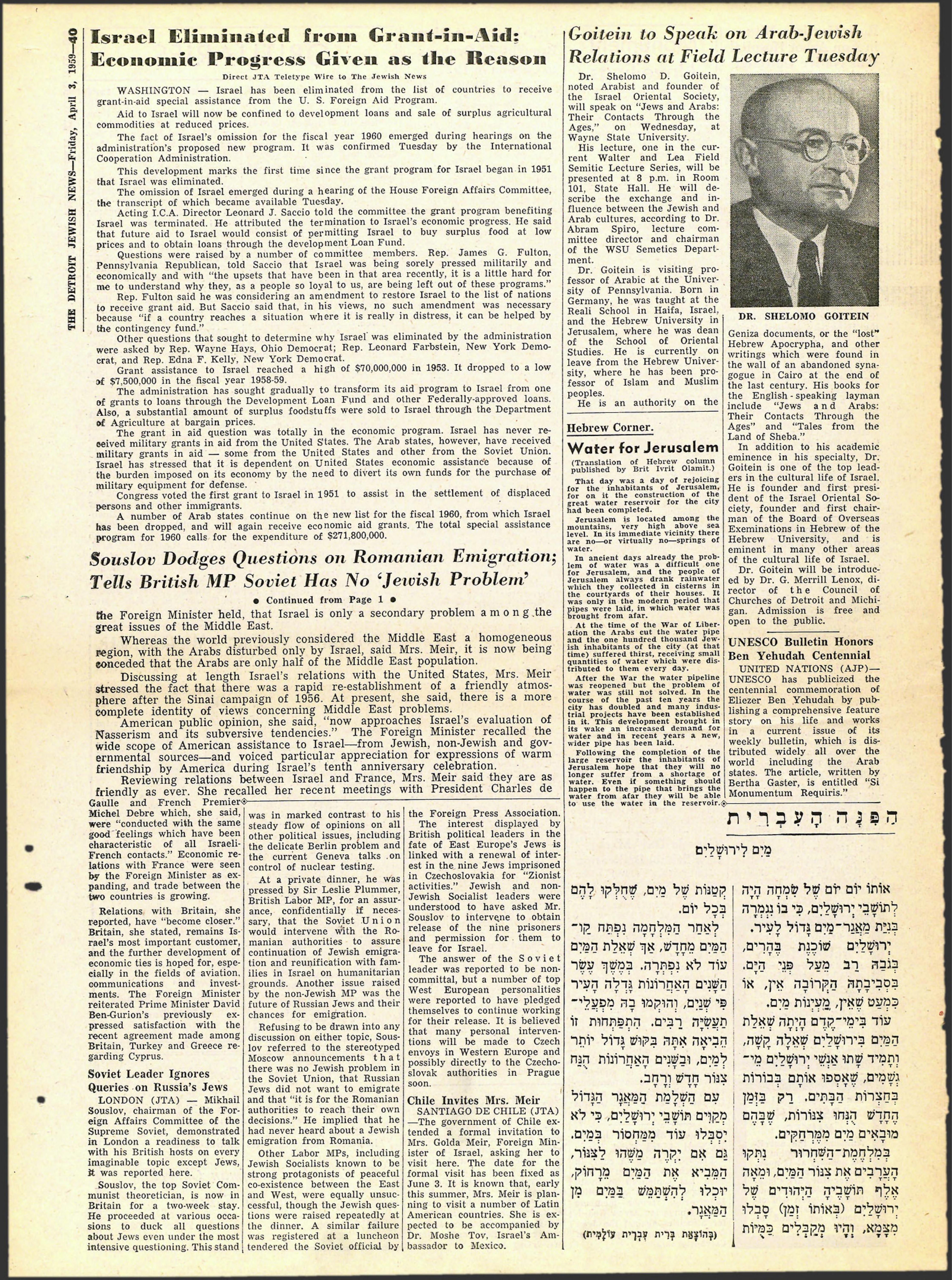
DR. SHELOMO GOITEIN
Geniza documents, or the "lost"
Hebrew Apocrypha, and other
writings which were found in
the wall of an abandoned syna-
gogue in Cairo at the end of
the last century. His books for-
the English - speaking layman
include "Jews a n d Arabs:
Their Contacts Through the
Ages" and "Tales from the
Land of Sheba."
In addition to his academic
eminence in his specialty, Dr.
Goitein is one of the top lead-
ers in the cultural life of Israel.
He is founder and first presi-
dent of the Israel Oriental So-
ciety, founder and first chair-
man of the Board of Overseas
Exeminations in Hebrew of the
Hebrew University, and is
eminent in many other areas
of the cultural life of Israel.
Dr. Goitein will be introduc-
ed by Dr. G. Merrill Lenox, di-
rector of t h e Council of
Churches of Detroit and Michi-
gan. Admission is free and
open to the public.
UNESCO Bulletin Honors
Ben Yehudah Centennial
UNITED NATIONS (AJP)—
UNESCO has publicized the
centennial commemoration of
Eliezer Ben Yehudah by pub-
lishing a comprehensive feature
story on his life and works
in a current issue of its
weekly bulletin, which is dis-
tributed widely all over the
world including the Arab
states. The article, written by
Bertha Gaster, is entitled "Si
Monumentum Requiris."
"1;•Pr.:1 rl;Pr7
trt?trirr'? trIz
irrix
rrn nnnt
irin)44
L77-T4 tryp - inin 1114
,r371.4 r14it ra , .ty:rr:
1 74. 77p 11
.n:7
rrinpri iiIr14'4p
nir.17q ,Tvg tov:4
nt,k0 nrI;;( t112"P'4,
rP.t7ttir-1 ,
,nrtipT
- 47? n! ' 7ttp-o. ,tg4t.t
,rrntria
nit= nnix
TT
T : •
•••
►
T T:
TT
•