

THE DETROIT JEWISH NEWS—Friday, January 9, 1959-32
German Claims Conference Opens
'59 Jewish Scholarship -Program
Dr. St. -mime' Views Paul as
Hellenistic Jew: Shows now
Philo 'Reversed His Process'
Prof. Samuel Sandmel, Pro-
vost of Hebrew Union College-
Jewish Institute of Religion and
an authority on literary activi-
ties of Jews in the pediods of
Jesus and Paul, already has es-
tablished his position as a
Jewish expert in matters in-
volving the New Testament,
with his book, "A Jewish Under-
standing of the New Testa-
ment." His latest work, "The
Genius of Paul," just published
by Farrar, Straus and Cudahy,
is another outstanding contribu-
tion to New Testament studies
and throws much light on Paul
in relation to Christianity.
Dr. Samuel describes Paul—
who bore the Hebrew name
Saul before changing it to the
Apostolic Paul—as "A Hellenis-
tic Jew" whose thinking was
shaped by his environment, who
"gave Christianity a new direc-
tion which resulted in his de-
tachment from Judaism."
* *
There were more Jews living
in the Greek world than in
Palestine in Paul's time, Dr.
Sandmel points out. The Five
Books of Moses had already
been rendered into Greek and
"there was already a Graeco-
Jewish tradition" that "over-
lapped with Palestinian Judaism
in many ways" and "made it
adaptable to the Greek world."
"Although Paul called him-
self a Pharisee, one cannot say
that he was closely identified
with Palestinian Judaism be-
fore his conversion," the author
of this important -book declares.
"To call Paul a Hellenistic Jew
is not to put a value on the
nature of his Jewish fidelity,
but is only to state a fact." He
adds:
"Paul was in some ways a
universalist, but his Jewish par-
ticularism never disappeared
completely. . . Paul advocated a
particularism, 'Christi a nit y.'
Paul did not use that term; for
us to use it in connection with
it is anachronistic, . . . not only
because it arose after Paul's
time, but also because Paul had
no sense of his being something
other than a Jew. He was fully
aware that convictions sepa-
rated him from his erstwhile
coreligionists, but he had no
sense that he was abandoning
J u d a is m. Rather, from his
standpoint, his fellow-Jews had
failed to come along with him
on the final step which he felt
that they, as true Jews, should
have taken."
* * *
Interesting comparisons are
made by Prof Sandmel of the
writings and trends of thinking
of Paul with that of the great
Jewish philosopher who lived in
the same period, Paul's Graeco-
Jewish contempory, Philo of
Alexandria (20 BCE-40CE).
Strikingly common elements are
seen in Philo and Paul, and we
are told how they "tend to re-
verse each other's process:"
"To Philo, the Law of Moses
is the formula whereby the in-
dividual enables his higher
mind to achieve domination
over his body, lets his soul rise
out of his body, and achieves
immortality. The observance of
the Law of Moses, according to
Philo, can bring a transforma-
tion of man from a bodily crea-
ture into a spiritual creature—
and it is likely that Philo means
an actual transformation . . .
But for Paul, by contrast, there
was a personal problem: he
could not do those things which
the Law and Philo would have
said he must do. Paul needed
beforehand the peace of mind
to do that which Philo asserted
would bring peace of mind to
a person. To Paul the Law of
Moses was a revelation which
came at one particular time in
history. . . and it could there-
fore be supplanted by a revela-
tion more recent in history. . ."
In his description of Paul the
Man. Dr. Sandmel states: "A
few short years after the move-
ment later known as Christian-
ity came into being, it spread
into the Greek world. A certain
Greek Jew named Paul first op-
posed this version of Judaism
and later joined the movement.
He opposed the movement be-
cause it differed from his view
of Judaism. When he joined it,
he was convinced, rather, that
it was a true version of Judaism.
When Paul joined the move-
ment, it received no ordinary
man, but a highly individualistic
genius. Almost half of the writ-
ings in the New Testament
come from his hand. Even when
we subtract the Epistles attri-
buted to him, which are now
not regarded as from his hand,
his writings are more numerous
in the New Testament than
those of any one else."
In his evaluation of Paul the
Jew, Dr. Sandmel shows how
"Paul saw the ancient revela-
tion to Moses not as a crucial,
decisive event, but as a single
milestone in a long road of re-
velations," a d din g: "For the
rabbis, the climax was in Moses,
and Sinai to them was the high-
est mountain; for Paul, Sinai
was only a hill, which had now
sunk below the horizon." Dr.
S an dm el also explains that
while Christianity took over
many of the holy days from the
Jewish calendar, "Pauline Chris-
tianity and rabbinic Judaism
share little more than a com-
mon point of departure, the
Bible. . . In the sense that to
Judaism the Law remains con-
ceived of as throughly divine in
origin and eternal, and in Paul
as limitedly divine and can-
cellable, one can almost set
Pauline Christianity and rab-
binic Judaism down as anti-
theses to each other."
Discussions of Paul the Con-
vert and Paul the Apostle add
to the value of Dr. Sandmel's
work. "A 'convert,' in Paul's
view, is one who has undergone
`spiritual rebirth' " In this con-
nection there is reference to
prophets and prophecy. In Prof.
Sandmel's judgement, "no term
better serves initially to classify
the convert Paul than the word
`prophet.' Paul had the sense
of a call from God, of com-
munion with him." But Paul
"described himself as an
`apostle,' the basic meaning of
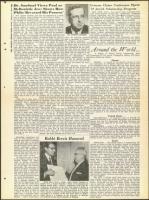
DR. SAMUEL SANDMEL
which the HUC-JIR professor
says is equivelent to "messen-
ger, emissary, missionary."
Paul did not meet Jesus, but
his claims were to having seen
the Risen Christ and to having
been predestined for his spiri-
tual role. Paul saw himself as
the minister of a new spirit, "as
Moses was the minister of the
old," and his intent was "to
M o s e s' disadvantage." "The
leading characteristic of Paul
was that he regarded himself
as an apostle, indeed the
Apostle, the prophet par excel-
lence."
Dr. Sandmel's analyses of
Paul and the Acts of the Apos-
tles adds to the scholarly con-
tributions he has made in this
field. He shows how Christianity
"a long with its tremendous
legacy from Paul inherited some
minor debits" and shows how
Paul "confused his preachment
of liberty from the Law with
his hearers' disposition towards
license."
We learn much in this book
about the Palestinian Jewish
Christianity, the rise of the dia-
spora Church, the conflicts be-
tween the two as indicated in
other New Testament writings
and the fact that: "Except for
Revelation, every writing in the
New Testament is by Paul, or
attributed to Paul, or deals with
issues and problems created for
the church by reason of Paul's
tremendous contribution."
"A modern Jew can certainly
not follow Paul. But he can try
to assess him more justly than
Paul assessed Judaism," is the
tolerant way in which Prof.
Sandmel concludes his study.
"It was the genius of Paul," he
states that "cut a road from
Palestinian Jewish Christianity
that went almost all the way to
the Dispersion Gentile church."
The book is a most interesting
study that adds to the stature of
the author who has emerged as
an authority on New Testament
literature from the Jewish point
of view.—P.S.
Rabbi Brevis Honored
NEW YORK (JTA) — T h e
sixth annual program of Inter-
national Scholarship and Fel-
lowship Grants for the academic
year 1959-60 will be offered by
the Conference on Jewish Ma-
terial Claims Against Germany,
Dr. Nahum Goldmann, Confer-
ence president, announced.
The grants will be awarded to
Jewish victims of Nazi persecu-
tion who qualify for Jewish
teacher training scholarships,
scholarships in Jewish. studies,
and research fellowships for in-
dependent projects in Jewish
arts, letters and social sciences.
Last year, 163 successful can-
didates in Austria, Denmark,
France, Germany, Great Britain,
Greece, Italy, Luxemburg, Swe-
den, Switzerland, Yugoslavia,
United States, Argentina, Brazil,
Peru and Australia received
scholarship and fellowship
grants, totaling $135,000.
Applications for grants must
be submitted on special forms
which may be obtained from
the offices of the Claims Con-
ference in New York. Scholar-
ship and fellowship applications
must be submitted to the Claims
Conference not later than
March 31.
The scholarship and fellow-
ship grants are part of a greater
program for Jewish cultural and
educational reconstruction car-
ried on by the Conference.
Around the World...
A Digest of World Jewish Happenings, from
Dispatches of the Jewish Telegraphic Agency and Other
News-Gathering Media.
Europe
MUNICH — A request by the Bavarian Council of Jews
for confiscation of anti-Semitic literature being printed here
and distributed from a Munich office has been turned down
by the Prosecutor pending further inquiries into the Council's
complaints against the periodicals "Cel" and "Hidverok," pub-
lished here by a Hungarian refugee group whose members
formerly belonged to the anti-Semitic "Arrow Cross." The Jew-
ish group demanded confiscation of a book by Lajos Mars-
chalko, "The World Conquerors," written in the style of the
notorious anti-Semitic forgery, "The Protocols of Zion."
KIEL — The Ministry of Culture was requested by the
Social Democratic Party in the Schleswig-Holsterin Parliament
to suspend a high school teacher, Lothar Stielau, district
leader of the neo-Nazi Deutsche Reichspartie in Luebeck, who
is accused of making racist remarks against Jews and -Negroes
.. . Reinfried Freuneck, a male nurse in a Munich sanitarium,
has been indicted on a complaint by the Weiden Jewish com-
munity of violating the state law prohibiting the spreading of
national and racial hatred . . . East Germany may permit the
Frankfurt prosecutor to inspect the personal records of Otto
Schweinsberger, suspended public prosecutor in the Hesse
Ministry of Justice, who is accused of having quashed court
proceedings against an army official charged with murdering
75 Jews in the Caucuses during World War II.
PARIS — The French government was asked by Andre
Blumel, president of the Zionist Federation of France, to move
its Embassy in Israel from Tel Aviv to Jerusalem, Blumel
having stressed that such a move would serve as an example
for the other Great Powers, pointing out that it could draw
no objections from the United Nations since Israel has given
every assurance of the protection of the Holy Places in the
city..
United States
PHILADELPHIA — A three-year grant of $117,345 for
Sheltered Workshop of the Jewish Employment and Vocational
Service from the U.S. Department of Health, Education and
Welfare has been approved by the State Office of Vocational
Rehabilitation.
BALTIMORE — Louis J. Fox, retiring president of the
Jewish Welfare Fund of Batlimore, who has been active nation-
ally in the Council of Jewish Federations and Welfare Funds,
announced the establishment of the "Harry Greenstein Leader-
ship Award" to encourage • the development of new leaders,
and to provid recognition for young men who have outstanding
leadership qualities, the award being named in honor of the
Welfare Fund's executive director, Harry Greenstein.
Israel
JERUSALEM — The Jewish Agency is implementing the
decision to reduce its staff for economy reasons by dismissing
• 500 members of the Agency staffs, 400 members of the admin-
istrative - staff having been dismissed, with 100 more to be
dismissed in the next three months . . . The Jewish Agency
executive approved the dates Feb. 26-March 6 as the period for
the next session of the Zionist Actions Committtee. Dr. Nahum
Goldmann, world president of the agency, is expected to arrive
here Feb. 8 . . . The parliamentary correspondents who have
been boycotting Parliament for a week returned to their assign-
ments after a compromise was worked out, calling for a
month's trial of new regulations to which the correspondents
had objected . . . Of a total of 26,000 new Jewish immigrants
who arrived in this country in 1958, more than 11,000 came
here in the last three months, according to figures disclosed
by the Jewish Agency which show that about half of the
total of the new arrivals came from Eastern Europe . • Israel
and Liberia concluded a treaty of friendship and a commerce
and navigation agreement, Israel having pledged to provide
Liberia with experts, know-how and capital in industry, agricul-
ture and irrigation.
TEL AVIV — Fifteen young Arab citizens of Israel have
been awarded government prizes for literary works including
poetry, novels, short stories and drama, among the winners
Rabbi Harry Brevis (right), blind Jewish Chaplain of being a 13-year-old boy from a Northern Galilee village who
Buffalo, N.Y., a former Detroiter, "father of the International won an award for a lengthy ode in classic Arabic, commemor-
Hebrew Braille Code," receives a testimonial scroll from the ating Israel's tenth anniversary . . . Due to American financial
Chaplaincy Commission of the New York Board of Rabbis in and technical aid, there is a new highway link between Haifa
recognition of his 25 years of service on behalf of the Jewish and this city, saving 15 minutes in the motor run between
blind and in the Chaplaincy. The presentation by Dr. Jacob these two important centers, the new link, a section of modern
Freid, executive director, Jewish Braille Institute of America, roadway between Nathanya and Hederah, having opened last
was made at a meeting of the New York Board of Rabbis. week-end, built under the supervision of an American, Harold
Rabbi Bervis is a graduate of the University of Michigan Monson, who was brought to Israel by the United States Oper-
and ordained by the Jewish Institute of Religion.
ations Mission.