

Friday, April 4, 1958—THE DETROIT JEWISH NEWS-54
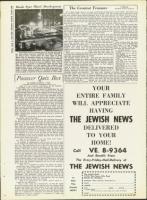
Bonds Spur Mines' Development
Israel Bond funds are helping Israel to develop and exploit
her vital natural resources, including the copper deposits of
the. Timna mines, located about ten miles north of Elath.
Shown here in operation during an evening shift is the sul-
phuric acid plant at Timna, which was completed in February
with the aid of Israel Bond dollars. The plant, which currently
produces between 50 and 60 tons of sulphuric acid a day in
three shifts, is expected to manufacture about 90 tons daily
when at full capacity in a few months. The sulphuric acid
produced here will be combined with crushed ore in a nearby
copper recovery plant, now being built with Israel Bond pro-
ceeds, to make purified copper for industrial purposes. The
recovery plant is expected to begin operations in a few weeks.
Passover utz Box
By RABBI SAMUEL J. FOX
I
A Midrash
The Greatest Treasure
The rabbis taught that if a
man was living with a wife for
10 years without being blessed
with a child, he should divorce
her and give her the prescribed
marriage portion as he may not
be deemed worthy to have chil-
dren by her.
The following story from the
Midrash Shir Hashurim (Yalkut,
chapter 17) is told by Rabbi
Simeon Ben Jochai who lived in
the middle of the second cen-
tury C.E. He is the reputed
author of the Zohar ("Book of
Splendor") and of many Midra-
shic tales:
A Jew of Sidon, having lived
many years with his wife with-
out being blessed with off-
spring, decided to divorce her.
Together they went to Rabbi
Simeon ben Jochai that he
might pronounce their legal sep-
aration.
When they entered, the Rab-
bi's sharp eyes immediately had
spied the tear-stained cheeks of
the unhappy woman and so he
addressed the couple in a mild,
fatherly tone: "My dear chil-
dren", he began, "your divorce
must not take place in pettiness
or anger, lest people should sur-
mise a guilty or disgraceful
motive in your action. Let your
parting, therefore, be like your
meeting, friendly and cheerful.
Go home, make a feast, and in-
vite your friends to share it
with you. Come back to me to-
morrow, and I will then rectify
the divorce you ask for."
So they went home, prepared
(Standard Feature Syndicate)
a feast, invited their friends and
made merry together. And the
husband said to his wife with
trembling voice: "We have lived
happily together for many years
and now that we are about to be
separated, it is only because we
are not blessed with a family.
To prove you that my love is
unchanged and that I wish you
only well, I give thee permis-
sion to choose whatever thou
likest best in the house and car-
ry it away with thee".
Lifting her tearful eyes, the
wife smiled sadly and replied
softly: "I will do so, my dear
husband". Her voice broke and
she turned her head away, so
that he should not see her tears.
The evening came and went
by joyfully. The cups filled to
the brim with wine, made their
joyful rounds and all passed off
well until one guest after an-
other and then the master of
the house himself, fell soundly
asleep.
The good wife who had only
waited for this, summoned her
confidential handmaids and had
her sleeping husband gently
borne away to her father's
house.
Late the following morning,
the husband awoke and cried in
astonishment: "Where am I?"
"Be easy, dear husband of
mine" replied his wife softly,
tenderly stroking his hot fore-
head, "I have acted only accord-
ing to your wish. Did you not
permit me last night to take
away from our house whatever
I loved best? And there was
nothing that I cared for so much
as for thyself. For thou art all
to me, my greatest treasure,
and so I brought you here with
me. Where I am, there shalt
thou be. And let nothing but
death part us".
They returned to Rabbi Sim-
eon and reported their change
of mind. And the good rabbi's
heart was filled with joy and
gladness and he prayed to the
Lord and spoke a blessing over
the wife. His prayer was grant-
ed. The wife became henceforth
"as a fruitful vine and honored
her husband with many chil-
dren".
This touching story has been
used in a poem by Sabine Bar-
ing Gould ( in the Standard
Book of Jewish Verse, p.768)
and these are the last lines:
. . . At peep of day
He started up and said "Woman
I pray,
Tell me where am I?" She bo
him replied:
"You promised me that nought
should be denied
To me of what I valued. I could
find,
In all thy house thee only to
my mind.
And I have borne thee hither:
now I • trow
That thou art mine; I will not
let thee go.
When I was thine, thou wouldet
be rid of me
Now thou art mine and I will
treasure see".
This story has inspired the
famous composer Carl Orff to
the libretto "The Clever Worn-
an"—a two-act folk-opera that
has been played here with great
success. In the Midrash and in
the opera the couple "lived hap-
pily ever after".
(Copyright, 1958, Jewish Telegraphic Agency, Inc-)
'D
Why is it that chometz (leavening) on the Passover
is forbidden even in the minutest quantity?
The rabbis were especially severe in prohibiting the con-
sumption of chometz on Passover, even going as far as outlaw-
ing the smallest amount of it. Two reasons are advanced for this
in rabbinic literature. One is that chometz is an item which is
permissible the rest of the year and is only forbidden on Pass-
over. Thus, it is possible, that without the severest of restric-
tions people may not avoid it, being used to it the year round.
Another reason advanced is the fact that since the chometz
or the mixture in which it is involved will become permissible
for consumption after Passover (provided it does not belong
to a Jew on Passover), the rabbis preferred to prohibit it to the
limit as such a prohibition is not a total loss. Later opinions
claim that chometz was prohibited in the slightest amount since
it is the activity of the ingredient which is prohibited (i.e., its
active function as a fermentation agent) and this activity can
affect a much larger quantity of food, being that it involves an
active organism.
Why is it prohibited to drink more wine after finishing
the fourth cup at the Seder?
Some claim that this restriction was instituted because of
the poor who were only able to get the wine from charitable
sources. They thus had wine enough for eight glasses, i.e., four
each night. If they drank more than four cups the first night,
they would not have had enough for the second night. Others
claim that this prohibition was instituted so that „people would
not get drunk on Passover eve since the evening was to be spent
in discussing the events of the Exodus. Some claim that this
was imposed so as not to lose the taste of the Matzoh which
was supposed to last in one's mouth for the rest of the night,
as a reminder of the taste of Matzoh that the Jews had in the
Exodus from Egypt that night.
Why is it customary to eat the bitter herb before
the meal at the Passover eve Seder?
A number of commentaries note the fact that in the days
of the Temple the bitter herb was eaten after the meal on Pass-
over eve. The explanation given is that the bitter herb repre-
sents the bitterness of exile or diaspora., In the days of the
Temple, when Jews lived in their homeland, the bitter herb
was eaten at the end of the meal to indicate that the people
of Israel would yet taste the bitterness of diaspora after having
lived in the homeland. Now, the Diaspora, the bitter herb, is
eaten before the meal, in the expectation that just as the bitter-
ness of the bitter herb is followed by the good tasting delicacies
of the Passover meal, so will the present bitterness of exile be
followed by redemption and salvation some day when we shall
again enjoy our complete homeland and eat of the sacrifices,
as we once used -to.
Why is it customary to place ten pieces of bread
around the house before starting the search far leavening
on the night before Passover?
Basically, it was required to place bits of leavening around
the house, to impress one that as clean as one might think
himself to be, there are always small particles of sin that are
overlooked. The Kabbalists claim that placing ten bits of
leavening around the house corresponds to the ten kinds of sin
which human beings indulge in, and signifies that we should
try to rid ourselves of every one of them.
Why is it particularly the middle matzoh which is
broken for the alikoman?
This is done, claim the commentaries, so that the upper
piece will remain intact for the blessing over the matzoh which
is made just before the meal begins. If the top matzoh were
broken, one would have to pass it by and make the blessing
b
over the second or middle one, and this is not considered proper
since it is prohibited to embarrass even food by passing over
one item in favor of a second. It is necessary to make the
blessing over a whole matzoh.
YOUR
ENTIRE FAMILY
WILL APPRECIATE
HAVING
THE JEWISH NEWS
DELIVERED
TO YOUR
HOME!
VE. 8-9364
Call
And Benefit From
The Every-Friday-Mail-Delivery of
THE JEWISH NEWS
r
or
I
I
MN
.
1•1 NM ISM RI 1•11 MN
Mail
I Gentlemen: Please send The Jewish News to:
This
I
I
Coupon
NOW
IMM
The Jewish News
17100 West Seven Mile Road
Detroit 35, Michigan
WM
I
I
I
NAME
ADDRESS
CITY
ZONE
STATE
I enclose $5.00
(If to be
. sent as a gift. please give name of sender)
I
I NAME
AI MN MN MI MN NM
I
imum
MN NM= NM In MB MN MN MN