

411111111•1k
most picturesque.
They come from
the Kurdistan
mountain area of
Iran and Southeast-
ern Turkey.
Saturday, c ∎ctober 12, 1957—THE DETROIT FREE PRESS-
6
Speaking a sort of
Aramaic, which was
spoken by Jesus,
they are perhaps
the only group in
the world now using
this dialect of 2,000
years ago.
THE BAGGY
trousers of the Kur-
distani elders; the
women sitting cross-
legged cleaning
cooking pots; their
gaily colored dresses
with hair dyed red
which is considered
a mark of beauty,
all offer interesting
sidelights on the
types of civilization
abounding in Israel.
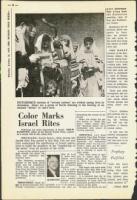
PICTURESQUE customs of "seventy nations" are evident among Jews in
Jerusalem. Above are a group of Kurds listening to the blowing of an
unsuaul "shofar" or ram's horn.
Color Marks
Israel Rites
Following are some impressions of Israel. PHILIP
SLOMOVITZ, editor of the Detroit Jewish News, reports
on a recent visit to the young state.
JERUSALEM—Israel Sector—Only during the
Jewish Holy Day period in this Holy City can one
fully understand the significance of Israeli aspira-
tions to fulfill the prophecy of the "ingathering of
the exiles" from all corners of the world.
A tour of the colorful syna4
gogs reveals the many cul-
blies of t e n
tures and traditions that
or more wor-
function here.
shipers, m e n
• The Jeshurun synagog,
and women
nearest to the King David
are separated
Hotel and the magnificent
at religious
YMCA built with contribu-
services.
tions from the United States,
This tradi-
is more like Shaarey Zedek
tion of separa-
Synagog in Detroit, except
t i o n between
that mixing of the sexes is
men and wom-
prohibited.
e n's congre-
* * *
gational s e c-
tions will
THROUGHOUT Israel ex-
cept in several privately func- probably s u r v iv e longest.
tioning "minyanim,"—assem- Traditionalists are firm in
demanding the custom be en-
forced.
When one enters the sec-
tion known as "Meah She-
arim," which means liter-
ally "Hundred Gates," he is
confronted with scores of
varying practices.
* *
ORIENTALS, a n d those
stemming from East Europe,
Bakharan and Turkish Jews,
Sephardic and Ashkenazic
elements from German y,
Turkey, India and 60 other
lands chant prayers accord-
ing to customs in lands of
their origin. •
They often come to serv-
ices in native garb. The
shofar, the ram's horn used
on Holy Days becomes a
matter of special choice for
them.
The longer and more twist-
ed the more they like it al-
though it may be more diffi-
cult to blow.
It is believed that the Is-
raelis are composed of repre-
sentatives of more than 70
nationality groups from every
portion of the globe.
Of these the Kurds are the
These and other
immigrants add col-
or and zest to this
new nation where
diverse groups are
being fused into
one.
Their children
give promise that in
Israel, as in Amer-
ica, the 'melting
pot' will one day
produce a homog-
eneous nation.
In that case the
colorful atmosphere
prevailing today
will lose most of its
picturesque aspect.
Prophecy
Fulfilled
"And the Lord
thy God will
bring thee into
the land which
thy fathers pos-
sessed, and thou
shalt possess it."
—Deut. 30:5