
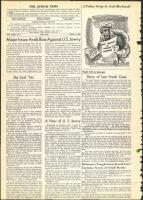

A Yellow Stripe in Arab Blackmail
THE JEWISH NEWS
Incorporating the Detroit Jewish Chronicle commencing with issue of July 20, 1951
Member American Association of English-Jewish Newspapers, Michigan Press Association. National Editorial
Association.
Published every Friday by The Jewish News Publishing Co., 17100 West Seven Mile Road, Detroit 35. Mich.,
VE. 8-9364. Subscription $5 a year Foreign $5.
Entered as second class matter Aug. 6, 1942, at Post Office, Detroit, Mich., under Act of March 3, 1879
PHILIP SLOMOVITZ
SIDNEY SHMARAK
FRANK SIMONS
Editor and Publisher
Advertising Manager
City Editor
Sabbath Scriptural Selections
This Sabbath, the twenty-seventh day of Adar, 5716, the following Scriptural selections
will be read in our synagogues:
Pentateuchal portions, Vayakhei, Pckude Hahodesh, Ex. 35:1-38:20, .38:21-28, 12:1-20.
Prophetical portion, Ezekiel 45:18-46:18.
Rosh Hodesh Nisan reading of the Torah, Tuesday, Num. 28:1-15.
Licht Benshen, Friday, March 9, 6:13 p.m.
VOL. XXIX. No. 1
Page Four
March 9, 1956
Maior Issue:Arab Bias Against U.S. Jewry
The major issue erupting from the un-
fortunate Arab-Israel conflict and the en-
couragement given to the Arab states by
anti-Israelis in this country is the discrimi-
nation practiced in Arab lands against
American Jews.
Our State Department unfortunately has
yielded to pressure to condone such dis-
crimination. Instead of pursuing the poli-
cies that were set down by President Taft,
when he broke trade relations with Tzarist
Russia as an answer to Russia's refusal
to recognize passports of Americans of the
Jewish faith, our State Department has
Ike Said 'Yes'
President Eisenhower's affirmative reply
to the country's anxiety to know whether
he had decided to be a candidate for re-
election carried with it very happy tidings.
His "Yes" meant that our President had
recovered from his illness, that he is pre-
pared to continue to serve our country,
that he is confident that he is restored
to full strength.
To President Eisenhower's "Yes" now
will be added many political speculations
and the opinions of opponents as well as
friends. In a sense, his declaration of Feb.
29 signalized the opening of the 1956 Presi-
dential campaign.
We are certain to have a few exciting,
months, until the American electorate de-
cides who is to occupy the White House
for another four years.
In the course of the campaign, many
vital issues will be discussed. That of
segregation or desegregation will affect
the thinking of many voters.
Similarly, the Middle Eastern situation
will figure in political debates. It is an
inevitable issue because upon it may hinge
the peace of the world.
The late Hilaire Belloc had chosen to
title one of his books with the challenging
assertion: "Palestine, the Battleground of
the World." That area threatens to assume
the position of the Balkans of World War
I, and the elimination of tensions that may
lead to another world war must be eradi-
cated in that area. Elimination of strife
can not be accomplished by way of "secret
diplomacy." We may as well recognize the
issue and face it. The Middle East will
figure in political debates.
We have only one warning on that score:
whether it is the Arab or the Israel view-
point, it is not a one-sided, one-party mat-
ter. It is of concern to all Americans, to
all the peoples of the .world, and we must
view with suspicion any attempt to stifle
discussion of it.
Israel happens to be on the defensive.
If Israel is enabled to hold her ground and
to defend her people, a world conflict may
be averted. But if our prayers for peace
and the help we give Israel should fail,
then the worst conflagration may result,
especially in view of Soviet Russia's de-
termination to gain a foothold there.
, It: is our earnest hope and prayer that
President Eisenhower will recognize the
need for frank discussion of the issue, and
that he and his associates will strive to
render justice in a trying situation. The
cry for fair play for Israel must not come
froni Democrats alone or from Republi-
cans alone: it must come from the entire
American people. Perhaps it will develop
fully out of the free discussion that dis-
timliiishes American politics.
yielded to Saudi Arabian demands not to
send Jews as members of its diplomatic
corps in that country; and not to use boats
owned or manned by Jews or destined for
Israel in making shipments to Egypt.
This country's Jewish citizens are not
the only sufferers from such discrimina-
tion. Last week, Lord Rea, leader of the
Liberal peers, asked in the British House
of Lords what his government had done
about the Arab states' refusal to grant
transit visas to British Jews and the re-
fusal of the Arab states to recognize the
validity of a power of attorney held in
behalf of any British firm in which a Jew
had a proprietary interest.
According to a JTA report, Lord Read-
ing, Minister of State in the Foreign Of-
fice, replying for the British government,
said that these discriminatory measures
were an outgrowth of the Arab League
boycott against Israel. He added that the
British- government considers this a viola-
tion of international law and has protested
on numerous occasions.
Secretary of State John Foster Dulles,
in reply to a similar question at his press
conference, expressed the hope for a grad-
ual development of tolerance but declared
that it was a difficult problem to cope
with and is comparable to certain prob-
lems in the United States.
In either case, insufficient effort has
been exerted to remove the injustice of
the Arab boycott. When will the great
powers act to avert violation of interna-
tional law and human rights?
A View of U. S. Jewry
Returning to London from a visit in
this country, R. N. Carvalho, president of
the 'Anglo-Jewish Association, gave this
opinion of American Jewry:
"From our point of view, it (the Ameri-
can Jewish community) is unorganized or
over-organized, whichever you will," he
said. "There is no coordination and intense
competition . . . leaders are well informed,
but I thought the rank and file surpris-
ingly ignorant of conditions in other coun-
tries. The outstanding characteristic of
them all is an intense wish to do good and
a real desire to be advised how good
should be done. There is a tremendous
potentiality in the American community
and I believe it is being harnessed."
We read this opinion of us, as reported
in a Jewish Telegraphic Agency cable
from London, with a sense of gratitude.
It is well that we should see ourselves as
others see us. It is important that we
should understand ourselves, in order that
we should better be able to improve our
status as a cultural entity.
Recently, however, we have been study-
ing the opinions of British Jews about
themselves, and we come to the conclu-
sion that the ills that are ours also are
those of British Jewry; that Mr. Carvalho's
community is affected by the same short-
comings as ours.
Which proved to us that we are not
alone in our ignorance; that all the Eng-
lish-speaking communities need bolstering
in their cultural aspirations. Perhaps all
of us—in this country, in England, in
Africa, in Canada, in Australia—should
work together for a common program of
self-improvement. If we could work that
out, we would feel doubly .grateful to Mr.
Carvalho.
'Night Fell on Georgia'
Story of Leo Frank Case
"The only celebrated American murder case of the 20th cen-
tury in which religious prejudice Played a dominant role, the
sensational case of teen-age Mary Phagan and her employer Leo
Frank," is described in all its details in a new 25-cent First
Edition by Charles and Louise Samuels, published by Dell Books
(200 5th, N. Y. 19), under the title "Night Fell on Georgia."
A documented story, containing lengthy excerpts from the
record, the title itself reveals the authors' view of the case. "And
Night Fell on Georgia" is the title of the sixth and final chapter
in the book. It is the chapter. dealing with the lynching, with
the brutality of crazed people.
The authors believe that if Frank- had not been a Jew, the-
conspiracy against him would not have developed. It is evident
from all the happenings recorded in this new book that mass
hysteria dominated the scene, that the influence exerted by the
crowds in and out of the courtroom was the deciding factor in
the jury's verdict, in the appeals to passion and to hatred, in
the threats that- regardless of the verdict Frank would be
murdered.
In "Night Fell on Georgia" the compilers of the data in the
Frank case derive comfort from the fact that "millions of men
and women who had never before heard the names and would
never see the faces of the victims, or be thanked by them, gave
of their time, their money, and their hearts to help" Leo Frank
and defendants in other similar cases (Mooney-Billings, Sacco-
Vanzetti, Scottsboro boy) ; and that "these millions of Americans
were of all races, religions, ages, and political parties."
It is little comfort—except that the judge_in the - Frank
case asserted his doubts (too late! . . . they were revealed in a
posthumous letter!), and Governor John M. Slaton sacrificed
his political career to commute Frank's death sentence to life
imprisonment. -
But the mob succeeded! It lynched! It caused Night to Fail
on Georgia!
There still are some who are not convinced that Frank was
innocent—among them so noted a liberal as Ralph McGill, editor
of the Atlanta Constitution. But the actions of Tom Watson, the
works of the mob, the attacks on the Jews,, the acceptance of
evidence from Jim Conley whom many believed to be the true
killer and who was described as a "black demon," will continue
to cause consternation and create sorrow among those who read
the Samuels' story that revives interest in the shocking Frank
case.
The entire country was stirred by the case. The .late Louis
Marshall joined the corps of lawyers who assisted in exposing
the horrible injustice against an innocent Jew. But the con-
spirators were too strong, the defense often too • weak.
It is well that the facts again are made known. All genera-
tions must be kept aware of what can happen in an American
community, in order to strive that it should not happen again.
Richman's `Laughs from jetvish Lore'
Contains Scores of Good Stories
Many scores of Jewish stories, applicable to all occasions, are
incorporated in Jacob Richman's "Laughs From Jewish Lore,"
issued, by Hebrew Publishing Co. (79 Delancey. N. Y.).
Richman is an excellent story-teller, and his - art is reflected
in the tales recorded in his book.
The numerous chapter titles offer a clue to the topics touched
upon. Feasts and Fasts, Jewish Leaders, Guests and Hotels,
Preachers, Philanthropists, Traders and Tradesmen, Matchmaking
and Marriage, Parents and Children, Medicine and Law, Thieves
and Sinners, Buffoons, etc.
There are hundreds of stories in this book, and while many
of them have been told and retold, they have a place in a com-
pilation of Jewish humor in order that every generation may
be treated to them.
Some of Richman's stories are too long, but all of them are
well told. Many of them—being commonplace—cannot be digni-
fied with the title "Jawish Lore," but they nevertheless are part
of good Jewish humor.