
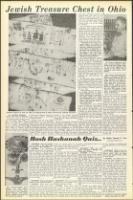

Jewish Treasure Chest in Ohio
tion grew, through purchases or
private gifts, but since it was
hidden in cellars and vaults, it
was like gold slumbering in the
veins of a mountain and waiting
for the day the miner's tools
would bring it up to the bright
of daylight.
For the Hebrew Union College
collection, this blessed day of
liberation came in 1948. The year
before, a Jewish Museum on New
York's Fifth Avenue had opened
its gates to the public, after the
heads of the Jewish Theological
Seminary had decided that it
was absurd to store thousands of
items without giving the public a
chance to see and enjoy them.
Prompted by the same com-
munal spirit, the trustees of
Hebrew Union College had the
one-story building of the Bern-
heim Library in Cincinnati, re-
decorated and assigned half of
the space to the museum-in-
the-making, while the other
half would be occupied by the
American Jewish Archives.
Dr. Franz Landsberger, a grey-
haired, kindly Silesian, with his
wife, has been taking loving care
of the museum. Landsberger,
now 72, has been active as an his-
torian of art for several decades.
Ousted from the University of
Breslau in 1933 by the Nazi re-
gime, he found a new niche when
the post of director of the Jue-
disches Museum was vacated that
year by the departure of its
founder, Dr. Karl Schwarz, to
Tel Aviv:
In November 1938, Landsber-
ger escaped to England, and from
there migrated to America where
Hebrew Union College, by offer-
ing -him a position as lecturer on
Jewish art, enabled him to build
for himself a renewed career in
the new land.
The museum, of which he is
in charge, consists of three
small galleries: one for alter-
nating exhibitions of paintings
and prints, another for prints
and photographs, and a third
room devoted chiefly to ritual
objects. The Museum boasts of
some 10,000 items.
Chronologically, t h e objects
can be divided into three groups:
relics of antiquity, acquired by
the famous archaeologist and
president of the Hebrew Union
College, Dr. Nelson Glueck; Jew-
SHOWN ABOVE IS ONE OF THE 110 KETUB OTH IN THE CINCINNATI JEWISH MUSEUM
ish ceremonial art from the pre-
emancipation era; and paintings,
By ALFRED WERNER
. is the famous Hebrew Union Col- friends of the college acquired drawings and prints by Jewish
lege which recently celebrated for it the famous art collection
Noted Critic and Art Historian
artists of the 19th and 20th cen-
its 80th birthday.
of Berlin's Mr. Sally Kirchstein
Cincinnati, Ohio's second larg-
turies.
(1869-1934).
Visitors must not miss seeing
In its 110 ketuboth, the Mu-
est community, like Rome, is
He had acquired the collection seum boasts of the world's largest
built on seven hills. Today's Cincinnati's Jewish Museum,
tourist will agree it is possesser small in size, but endowed with of Heinrich Frauberger, a Ger- collection of illuminated marriage
an almost Mediterranean many precious things, and fitting- man Gentile who, astonishingly, contracts. These documents were
of
charm and loveliness. There a• ly located in one of the Hebrew was the founder of a - "Society often lavishly decorated with
many sights to delight, many Union College buildings. Its short for the Investigation of Jewish flowers, birds and even human
places to welcome the stranger, history goes back to 1925 when, Art Treasures," and, until his figures in the most fanciful man-
and one of the most interesting at the suggestion of the late Dr. death in 1920, devoted all his ner. Some Italian ketuboth are
Adolph S. Oko, head of the Col- energies to making it successful. unmistakably influenced by Re-
From year to year the collet- naissance painting.
lege library, several wealthy
®s Hashanah Quiza.
QUESTION: Why is it custom-
ary to listen to 100 notes from
the Shofar on Rosh Hashanah?
T w o interesting
ANSWER:
reasons are offered for requiring
one to listen to the 100 blasts
from the Shofar on Rosh Hasha-
nah. One of these traces the num-
ber of the 100 sobs which the
mother of Sisera gave upon learn-
ing of her son's tragedy. The other
traces the number to the Tal-
mudic statement that a mother
issues 100 groans upon the birth
of a new baby. The first of these
reasons would associate the Sho-
far with cries • of repentance and
remind us to repent fully lest we
be faced with the sobs of bear-
ing punishment. The second of
these reasons associates the Sho-
far with the creation and birth
of the universe.
* * *
This sunflower-shaped silver
spicebox from 19th century.
Poland is one of many treas-
ures housed in the Cincinnati
Jewish Museum. The gentle
aroma consoled the pious for
the end of the sabbath.
QUESTION: Why is the Shofar
blown at four different times?
ANSWER: Some claim that
originally the notes were blown
during the early morning service
but that a tyrannical decree from
a hostile government prohibited
this practice, which was then
delayed until the later pkayers.,`
Others claim that some of the
notes are blown later in the
service for the benefit of women
and children who come later to
the synagogue and miss the ear-
lier notes.
Still others say that these notes
are sounded at four different
times because we seek atonement
for four different types of sins:
The first set of notes is blown
to have us repent for the sins
which come under the category
of idol worship; the second is
blown to have us repent for the
sins which come under the cate-
gory of forbidden sexual acts;
the third set is blown to have
us repent for the sins which
come under the category of blood-
shed; the folirth set of notes are
blown to have us repent for the
sins which come under the cate-
gory of the evil tongue.
* * *
QUESTION: Why is the Shofar
sounded from the platform upon
which the Torah is read?
'ANSWER: Some claim that
this is done to remind us that
the Shofar was blown at Sinai
when the Torah was given to the
Jews. Others claim that it is done
'there to attach kteat "im`partahce
to the Shofar and to have the
entire congregation look up to
its calling.
* * *
QUESTION: What are "Te-
kiah, "Shevorim," "Teruah" and
"Shevorim Teruah?"
ANSWER: A "Tekiah" is the
plain deep sound of the Shofar
which* ends abruptly. It is some-
times called "Peshuta" because of
its "straightness" or "plainness."
Before and after every other
sound of the Shofar this note is
blown. One of the reasons given
for this is that man is reminded
that the world was created in
a plain and even pattern. The
breaks and difficulties that come
in life are not the original plan
of the world and will all be
straightened out in the end.
A "Shevorim" is a combination
of three broken notes. These are
said to sound like a moan or a
sign. This description is said to
remind us of the moaning of the
sinful soul for an act of repent-
ance.
A "Teruah" is a quick succes-
sion of nine short notes which
are said to sound like the wailing
or a person in grief.
A "Shevorim-Teruah" is a
combination of the sobbing "She-
vorim" 'and -the -wailing "Teruah" -
which is used as a combination
Dr. Franz Landsberger, Mu-
seum Curator, displays Torah
crown from 19th century Rus-
sia, The crown emphasizes the
royalty of the Torah, and is
sometimes used instead of Ri-
monim.
The famous Cincinnati Hag-
gadah, a precious product of
15th century Germany, with its
many vignettes of Jewish do-
mestic life,. is in the college li-
brary next door, but the Mu-
seum displays a no less inter-
esting, if less widely known,
German haggadah, this one of
the early 18th century, whose
scenes are reminiscent of the
seder descriptions in Heine's
Rabbi of Bacharach."
Well worth seeing also are the
pictures that came from Europe
only last year. They belonged
originally to the Juedisches Mu-
seum, Berlin. After the last war,
whatever treasures of the mu-
seum had survived in cellars and
shacks, were through the efforts
of the Jewish Restitution Succes-
sor Committee, shipped to Jeru-
salem's Bezalel National Museum,
with the exception of 15 paint-
ings apportioned to the Hebrew
Union College.
They are excellently displayed,
and they include "Sabbath After-
noon" by Moritz Oppenheim, that
celebrated illustrator of Ortho-
dox Jewish family life in Ger-
many; Max Liebermann's charm-
ing study of his wife and grand-
daughter, and a self-portrait of
Lesser Ury, that great and enig-
matic master who has yet to be
rediscovered by those interested
in art and, in this instance, in
Jewish art.
,
By Rabbi SamuelT. Fox
(Copyright, 1955,JTA, Inc.)
of the emotions of sobbing and
wailing expressed by the troubled
soul.
* * *
QUESTION: What is the rea-
son for these different types of
Shofar notes? Why are these
notes each sounded three times
at each series?
ANSWER: The Bible asks us
to declare Rosh Hashanah as a
"Yom Teruah" which is often
translated as a "day of blowing."
The Talmud isn't sure whether
the required sounds should be
those of sobbing, which would
be done by the "Shevorim," those
of the wailing which would be
accomplished by the "Teruah" or
both of these together. Thus all
three possibilities are exhausted.
The word "Teruah" (blowing)
is mentioned three times in the
Bible in connection with the fes-
tival of -the seventh month. Do-
ing it thrice makes it emphatic.
Also, the liturgy of the holiday
is split into three themes: Mal-
chiyos, Zichronos and Shofros,
which represent the royalty of
the Almighty, memorials and His
Divine Relations.
8--DETROIT JEWISH .-NEWS
Friday, September 16, 1955