

ignimpogempplmompinunimplpempumuimpw.F.•••••••••••••••••••••
Purely Commentary
(Continued from Page 2)
and tillable land cultivated according to the most modern prac-
tices; roads were being built and kept in repair; sanitary villages
were being built on the barren hilltops while the land below bore
crops; schools, when permanent buildings were not yet available,
Were held in tents. Everywhere was evidence of industry and a
determination to better conditions of labor and living.
"The same things needed to be done in Jordan, yet no Arabs
seized the opportunity. The loitering men could have raised
eucalyptus seedlings and then transplanted them to the barren
hillsides behind their camps. The hills of Jordan, as of Israel,
must be the classic example of soil erosion. Never have I seen
such destruction, but the Jews alone saw that there was some-
thing to be done and bent their energies to the task. The trees
they are planting in Israel will hold the water and whatever soil
forms until Palestine may again be a wooded and fertile land. But
the Arabs do aothing but complain to a sympathetic world.
"Their fellows, the Palestinian Arabs who were fortunate or
wise enough to remain in Israel during its conflict with Arab
countries, live now contentedly in their ancient villages. Many of
them are employed by the Jews at a good wage, and all are
accepted as equal citizens of the country. Some are even given
special privileges. For instance, Nazareth is an Arab town and the
only persons authorized to serve as guides are Arabs, who meet
the tourists and guide them to the holy places. I was taken to
-Nazareth by a Jewish guide but as soon as we arrived he turned
me over, as a matter of course, to an Arab.
"It is easy to see that the relation between individual Jews
and Arabs is one of friendliness, which is not surprising since
both are Semites. Religion seems to be the main deterrent to
completely happy relations. One suspects that the attack of the
Arab countries on Israel was at least partly inspired by the Mo-
hammendan priestly hierarchy as a preliminary to a Holy War.
That war seems very unlikely today as Israel is too well armed
and too alert to the threat of danger to make it safe to attack her.
And she herself is too busy developing her country to attack in
turn. Another factor making for peace in that troubled land is the
jealousy and hatred the Arab countries entertain for each other.
"Defenders of the Arab countries say that their people are too
impoverished and too restricted in territory to be able to place
their fellow refugees in any region where they could make a
living. So far not one of the countries has made much of an effort
to help. Judging by what I saw of the indolent attitude of the
refugees any land offered would have to be pretty rich and pro-
ductive to be acceptable. Probably the refugees would have to be
taken to it by force, so unwilling are they to give up the idea of
ultimately returning to Palestine. There is none of the pioneer
spirit among them.
"The land between the Euphrates and the Tigris once sup-
ported large populations, but its irrigation system has fallen to
ruin and waits for men with energy to restore it. I tried to picture
a million Americans sitting in the dust at Jericho while that rich
neighboring region waited only for hard work to restore it and to
provide food for thousands. The Americans would surely see that
prospect as a challenge and accept it. But not so the refugees.
They lack the energy and determination to tackle a hard task and
master it.
"One recalls the miracle the Mormons performed on the rocks
and barren wastes of Utah and becomes impatient of the Arabs
and their complaints. The United Nations committee is not helping
them in character development. Instead of saying "Work or
starve," they say, "Rest and eat," and the Arabs acquiesce.
"Should the world, because these people seem unable to help
themselves, force Israel to take them back and give them the care
and opportunity which their own kin refuse them? Would we be
so stupid as to ask the Jews to burden the magnificient work they
are doing for the Jewish refugees of the centuries in order to
provide for dependent Arabs whom their own brothers reject?
"I kept asking myself which people had most to offer to
human society, the Jews with the Weizmann. Institute, a scientific
organization which would have reflected credit on any country, or
the pronouncements of the priestly schools in the mosques. In
spite of the personal charm of the Arab individuals' one could not
deny the fact that the Arabs had long since made their contribu-
tion to the wisdom of the ages and future offerings seemed far in
the future. Meanwhile the Jew, here and now, is bestowing gifts
with promise of more to come.
"And even the most sentimental of the Arab refugees must
recognize the magnitude of the righting of the great wrong to the
Jews through the centuries which is taking place on that narrow
strip of land along the eastern Mediterranean. Is it fair to ask
them to assume a responsibility to the Arabs which their own
people might assume? One all too easily forgets that large areas
of Israel were originally bought by the Jewish immigrants from
the Arab peasants who sold the land of their own free will. Of
course those who fled and whose land has been since occupied by
the Israelis should be recompensed as Israel is beginning to ac-
knowledge. But the Arabs insist that the land be returned to them.
They refuse to accept an accomplished fact and harbour a futile
resentment. If only the Mohamrnendan leaders, devotees of a
religion of fatalism, would help their followers to turn from
rebellion at what is past to a determination to build a good life in
the present, how much happier they would all be!
"The United Nations must help the refugees, not with pallia-
tives but with construction. The slogan of Point Four pro-
gram is, 'Help people to help themselves.' No better one could
be employed in the work with the refugees. The present is not
important. ' The future is the only time to be considered. What
can we do today to make the future of the refugees a time of
hope and betterment?"
It is this Commentator's feeling that this statement is worth all
the space it consumes. The truth must be made known. The truth,
especially when suppressed, sprouts forth from the earth, forces
itself to the fore, and reclaims justice for the right causes. Let the
truth be known—and we are confident that fair-minded Americans
will listen to facts and differentiate, them from misrepresentations.
An Old Historical. Episode—Brilliantly Evaluated
Halasz's 'Captain Dreyfus': Mass Hysteria Story
The Alfred Dreyfus story is
more than half a century old.
Many books have been written on
the subject. Anything else that
may be written about it now
stands in danger of being called
a "rehash." Not so, however, with
"Captain Dreyfus: The Story of a
Mass Hysteria," by Nichols Hal-
asz, a native Hungarian, who
was educated in Czechoslovakia
and who has lived in the United
States since 1941. This book, just
published by Simon and Schuster
(630 5th, NY 20), is certain to
hold the attention of its readers
and to revive interest in the
major issue that shocked the
world at the end of the last cen-.
tury: an issue that was carried
over into the 20th century and the
effects of which continue to be
felt.
L'Affaire Dreyfus itself is so
well told in less than 300 pages
in this brilliant evaluation that
even those who, like this review-
er, have read nearly everything
that has been written on the sub-
ject, will remain glued to its
pages. The major interests, how-
ever, will be found in two
themes: in the mass hysteria—
the major concern of the able
author—and in the personality of
Dreyfus.
* * *
Dreyfus himself was a color-
less figure. He was so passion-
ately devoted to the French army,
he was so deeply devoted to his
career as a military man, that
nothing else mattered to him. The
army came first. It was generally
believed that if he were among
the judges, he would have ad-
judged the accused as guilty.
It certainly was not a Jewish
case, insofar as Dreyfus was con-
cerned. He became the symbol of
a fight against anti-Semitism, and
the battle was conducted mainly
by non-Jews. Jews in France
steered clear of the issue. Many
believed him guilty, and some
said so.
Captain Dreyfus had suffered
so much But he could not un-
derstand the great principle
that was involved. He only
knew that he was an honorable
soldier, and wanted to be treat-
ed as such. (But when his son,
Pierre, was in this country sev-
eral years ago, he denied em-
phatically that his father' had
shunned Jewish interests. He
: said that while he was not a
Zionist, he nevertheless adher-
ed to his Jewish-faith and re-
tained Jewish loyalties).
Mr. Halasz has these interesting
things to say on the subject, in
his review of Dreyfus' attitude at
the Rennes re-trial in June of
1899:
"Military discipline and re-
spect for his superiors were
deeply ingrained in Dreyfus.
Many of his sympathizers saw
with astonishment that he took
great pride in being noticed by
a general. He listened with pro-
found respect when General
Boisdeffre spoke of him at
great length to the judges —
even when Boisdeffre, asserted
that he was convinced of Drey-
fus' guilt,. Yet when Picquart,
a mere lieutenant colonel,
Jesuit Organ Lauds
U.S. Jews for Seeking
Liberal Immigration -
dared belie the generals and as-
sert his belief in Dreyfus' in-
nocence, Dreyfus' eyes took on
the stricken and tormented ex-
pression of a trapped animal.
It is quite possible, in the light
of what he did later, that if
Dreyfus had been sitting on the
court he would. have convicted
himself.
"Clemenceau, asked by his
private secretary just how
much Dreyfus had understood
of the case, replied: 'Nothing.
He is the only one who has not
understood it at all. He stands
abysmally below the Dreyfus
Affair.' A younger Dreyfusard,
Leon Blum, wrote that Dreyfus,
had he not been Dreyfus but
someone else, would not even
have been a Dreyfusard.
Georges Sorel, the revolu-
tionary syndicalist, remarked
that Dreyfus had been a servile
socialist, a chauvinist whose
heart beat as one with that of
the General Staff which was
bent on his destruction. Much
later, when the president of the
League of Rights of Man spoke
to Dreyfus about his historic
part, Dreyfus protested, crying,
`No, no, I was only an Artillery
officer prevented by a tragic
error from following my _ca-
reer. Dreyfus, the figurehead of
justice, was not I. He was
created by you.'"
There is much more about
Dreyfus' servility in Mr. Halasz's
book. Suffice it to say that the
real heroes in that historic battle
were Major Marie-Georges Pic-
quart, the courageous soldier who
sacrificed his career and his free-
dom for truth, who disliked Prey-
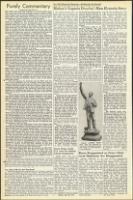
Captain ALFRED DREY-
MS, from the statuette by.
Caccia. The inscription is Drey-
fus' outcry, "je suis innocent—
I am innocent."
his (he later snubbed him), who
was not at all pro-Jewish, but
who defended the truth; Emile
Zola, whose "J'Accuse" and
whose trial brought the case to
the forefront; Dreyfus' brother,
Mathieu, who did not leave a
stone unturned to bring the case
to public notice and to help free
the innocently-accused Alfred;
the Clemenceau brothers and
others whose courage saved the
honor of France.
* * *
Mr. Halasz's description of
France's mass hysteria, generated
by the Dreyfus case, is the major
subject of interest in his illumi-
nating book. We read:
"The crowd was a mob. It
was in a lynching mood. 'Death
to the Jew' was heard from all
sides."
While Dreyfus kept shouting
"I am innocent," the mob was
thirsting for blood. They later
thirsted for Zola's blood and. for
the lives of all Dreyfusards. It
was the mob, inspired by the
army's generals who were deter-
mined—even when they knew
that Dreyfus was innocent—to
give themselves a clean bill of
health, that turned every hearing
into a farce and a travesty on
justice.
Interestingly enough, as ,Mr.
Halasz points out, even after
Dreyfus was cleared there were
many who believed him guilty.
It was not until the publication
of the memoirs of Colonel Max
von Schwarzkoppen, the Ger-
man attache in Paris who
bought military documents
from the real traitor, Esterhazy,
were published that the truth
was definitely established.
Von Schwarzkoppen had re-
mained loyal to his own — the
German — army and his own
government, both of which pre-
vented him from speaking out in
Dreyfus' defense. To quote Mr.
Halasz:
"In 191'7 Von Schwarzkoppen,
then a general, was in a Berlin
hospital on the brink of death.
He began talking French in a
delirium. 'Frenchmen,' his wife
heard him cry out in the lan-
guage of the enemy, 'listen to
me. - Dreyfus is innocent. It was
all jUst forgery and intrigue.
There is nothing whatever
against him V.He died the same
year.
"His memoirs, which com-
pletely exonerate Dreyfus and
incriminate Esterhazy with re-
spect to the bordereau, were
not published until 1930. Von
Schwarzkoppen had remained
loyal to his army although it
had made him commit a crime."
Thus ended an historic case—a
case which still raises many
questions, especially one: is domi-
nation by an army and by cleri-
cals, who played a mean role in
the Dreyfus Case, possible in
other democratic countries? The
Dreyfus Affaire emphasizes an
important point: that no one who
values his own freedom dares to
refuse to speak for justice and
liberty for all, lest his own secur-
ity should be endangered. The
Dreyfus case has a lesson for all
time to come—and this lesson is
presented in remarkable fashion
in Nicholas Halasz's "Captain
Dreyfus." —P. S.
Burns Reappointed as Truce Chief;
Arab Diplomats Are Disappointed
•
ROME (JTA) — The role of
American Jews in pressing for
Gen. Burn s' reappointment
UNITED NATIONS, N. Y.
liberalization of American im-
migration legislation was praised (JTA)—Maj. Gen. E. L. M. came as a disappointment to
here today by "Civilta Catto- Burns, the quiet, soft-spoken Arab diplomats here, who had
lica," official publication of the Canadian who, during the last been quietly but persistently
Jesuit Society. The publication year has headed the United Na- agitating against the continuance
called on American Catholics tions Truce Supervision Or- of the Canadian in the job. Gen.
*
*
and Protestants to emulate the ganization in Palestine, has been Burns' record, praised repeatedly
Jews in seeking a just immigra- re-appointed to that post for an- by neutral sources representing
Yes, Where DID. You Get That Dress?
the big Western powers, has been
Differing opinions have emerged from the reactions created by tion policy in the United States. other year.
Secretary General Dag Ham- attacked as "pro-Israel" by most
"It must be recognized that
the recent Life Magazine article on Judaism. Most Orthodox Jews
teem pleased with it, while the Conservative and Reform elements Jewish members of the U. S. marskjold, who is in ereneva, had of the Arab states, especially by
are disturbed over what they consider to have been excessive em- Senate and House of Repre- the announcement • of the re- Egypt. The latter country's
sentatives have been solidly in appointment issued here. In a Foreign Minis t e r, Mahmoud
phasis on some Orthodox practices.
A Canadian Jewish weekly made this comment: "Most Jewish the lead 'whenever the neces- letter to Gen. Burns, the Sec- Gawzi, had visited Canada in
June and had reportedly tried
readers were puzzled by the woman on the cover picture. Her sity for a just and generous im- retary - General wrote:
"I have deeply appreciated the to bring pressure upon Canadian
exotic costume seemed reminiscent of a Slavic peasant woman, a migration policy had to be
government officials in an effort
gypsy enchantress, possibly an Oriental Jewess. Very few took it pointed out in Congress, "the efforts which you have made
for what it purported to be—the dress of a typical American Jewish Jesuit publication said. It added during the past year to maintain to have Burns removed from the
housewife in Scranton, Pa., benshing her Sabbath candles."
that this is "understandable" and to strengthen the work of position. The fact that Burns was
Indeed, this is a legitimate question: where did an American since the Jews have suffered the Truce Supervision Organiza- finally able to get Egyptian and
housewife—after all, the Jewish housewife is the counterpart of her exile and homelessness through tion. I extend to you my best Israeli representatiVes together
wishes in your further efforts for talks aimed at pacifying the
neighborget a Slavic dress, and why was such a costume used in the centuries.
and I assure you of my con- Gaza strip frontier did not in-
a portrayal of candle-lighting? Similar questions arise while view-
ing other pictures in the glamorous Life article. Indeed most of its 20—DETROIT JEWISH NEWS tinued support in your highly crease Egyptian acceptance of
the truce chief.
responsible post."
Friday, July 29, 1955
emphasis is on the customs of a very small group in Jewry.
,