

" - , -ik.v,51111,11111111111111,1111111111111111•1100
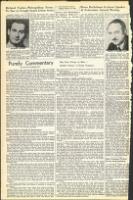
Richard Tucker, Metropolitan Tenor,
To Star in Temple Israel Artists Series
Richard Tucker, one of the ton and Manderson Rds., begins
Metropolitan Opera's leading at 8:30 p.m. Tucker's program
tenors and certainly one of the will include operatic arias, can-
torial selections and Israeli mel-
odies.
Now 36, Tucker made h i s
opera debut in 1945 when he be-
came the sensation of the Me-
tropolitan season. Since that
time, he has made numerous
appearances in this country and
abroad.
He has never forgotten his
Jewish heritage, which has
placed him among the all-time
cantorial greats in this coun-
try's congregational life. Each
high holiday finds him conduct-
ing services in a synagogue
somewhere in the country. .
' Born and educated in Brook-
lyn, his first public appearance
was at six as a choir boy. As
RICHARD TUCKER
critics throughout the world
have
recorded, he has come a
most versatile artists of all time,
long
way
since that time.
will appear on March 22, as the
Tickets for the concert are
second performer in the Temple available
at the Temple Israel
Israel Artists Series.
office, Grinnell's and Metro Mu-
The concert, to be held in the
Temple Israel auditorium, Mer- sic Shop.
Purely Commentary
2 — THE JEWISH NEWS
Friday, March 13, 1953
Moses Beckelman Is Guest Speaker
At Federation Annual Meeting
Lerner and Beckelman
An eye witness report of re- the JDC as second in command
To Address Midwest's cent
developments in Europe, of the vast JDC European pro-
UJA Parley on Sunday North Africa and the Near East gram in 1946, Beckelman be-.-
More than 300 American Jew-
ish leaders from 16 central
states will hear an authoritative
analysis of the recent upsurge
of anti-Semitic tensions in Iron
Curtain countries when M a x
Lerner, noted political observer,
and Moses W. Beckelman, direc-
tor general of the Joint Distri-
bution Committee, address • the
midwest leadership Conference
of the United Jewish Appeal.
Sunday, at Palmer House, Chi-
cago. Several Detroit Allied
Jewish Campaign leaders will
attend the conference.'
Gathering at a time of in-
creasing fears for the 2,500,000
Jews in Soviet-dominated landS,
the conferees will devote them-
selves to marshalling the spirit
of Midwest Jewry behind the
United Jewish Appeal's 1953
campaign to meet urgent needs
totaling $144,524,250. • • •
`The First Wings to
-
.
as t hey affect tens of thousands
of Jews will be brought to the
annual meeting of the Jewish
Federation by Moses W. Beckel-
Man, director general for over-
seas operations of the Joint
Distribution Committee, 8 p.m.
next Wednesday, at the Wood-
Ward Jewish Center. The an-
nual meetings of the Fresh Air
Society and the Jewish Voca-
tional Service will be held com-
currently with that of Federa-
tion.
Beckelman first foined the
JDC staff in 1939 and directed
JDC programs in the Baltic
States. He became assistant di-
rector of the International Gov-
ernmental Committee on refu-
gees in 1945, and assistant to
Sir Herbert Emerson, director of
IGCR, visited Europe, Africa and
MOSES W. BECKE'AIAN
China while supervising or es-
tablishing IGCR assistance pro - came director general in 1951
with supervision over JDC's re-
grams in those areas.
Joining Paris headquarters of lief, construction and resettle-
ment activities in 20 countries
abroad.
In addition to the election
Man' —
Jewish Letters: A Great Treasury
By PHILIP SLOMOVITZ
Franz Kobler, who was born in Bohemia in 1882 and studied
under Thomas G. Massaryk, gained fame for his discovery of the
Proclamation to the Jewish Nation issued by Napoleon Bonaparte
in 1799. He is the author of several very scholarly Jewish history
books. His latest work, "A Treasury of Jewish Letters," (published
in two volumes simultaneously by the Jewish Publication Society
and Farrar, Straus and Young) will be given a place alongside
the finest and most imperishable Jewish classics.
"The letter gave the first wings to man," Kobler states in his
informative preface. He adds weight to his thesis by quoting, as
the opening guide to his work, the words of the famous rabbi of
Venice, Leone da Modena:. "Remember me by your letters, as is
the custom among the Children of Israel, so that, when they are
separated, writing brings them near again." Thus, we are _linked
again to many generations by Franz Kobler's accumulation of so
many thrillingly inspiring documents.
We learn to realize, under the influence of Kobler's collection,
that Adolph Deissman was right when he said that "letters are ex-
periences"; that Thomas Jefferson was correct when he said that
"the letters of a person form the only and genuine journal of
his life." The Kobler volumes, in their enlightening fascination,
are valuable not only as studies of the characters of the people
who wrote the letters incorporated in them, but also the eras in
which they were written. „"The book is primarily designed for the
general reader who will find himself introduced by it to the most
reliable and most intimate sources of Jewish history and tradi-
tion." This is an undeniable quality of "A Treasury of Jewish
Letters."
"Letters from the Famous and the Humble" is the sub-title - to
Kobler's collection. This is an added recommendation to the nearly
700 pages of text, which begins with King Hezekiah's invitation to
the Children of Israel to a Solemn Passover at Jerusalem—dated
Jerusalem, the end of 8th centnry B.C.E. — and ends with the
section "How the Jews of the Diaspora Fought Maria Theresa"
and with the Samuel Wertheimer Letter to Wolf Wertheimer,
dated Vienna. end of 1748. We shall look forward impatiently to
Kobler's forthcoming collection of letters, quoting Jewish person-
alties who lived in the last two centuries.
History in the Raw: Struggle for Emancipation
These letters are history in the raw. They tell the story of
Jewry's struggles, our ancestors' aspirations for cultural attain-
ment, the search for truth, the battle for emancipation.
The concluding letter is brief and it reads: It places on record
the end of a fight for the right of Jews to live in Prague, and in
it Samuel Wertheimer wrote to his father, Wolf, who"was a leading
factor in a major libertarian effort:
"I have to notify that the Rabbi of Tergum wrote last Friday,
to my master and teacher, the Rabbi, may his light shine, that
Mr. Wurmbrand has written from Vienna to his son-in-law,'
the imperial count of Tergum as follows: that the Empress and
Queen, may her might increase, has bestowed grace upon the
Jews of Prague so that all Jews may return to Prague and have
all their liberties again."
In itself, the letter may sound vague. But Franz Kobler does
more than quote letters: he gives the history of the period refer-
red to by the correspondents and he describes the importance of
the writers of the letters and their place in history. In the
instance of the fight against Maria Theresa and the regaining of
their liberties by Prague Jewry, there is appended this important
historical note:
"Thus the curtain falls on one of the most exciting acts in
the great drama which has been termed 'the end of the Jewish
Middle Ages.' That the attempt to banish Jews from a capital
in Central Europe in the middle of the eighteenth century had
failed, that it was even frustrated through the combined efforts
of Jews and non-Jews, was symptomatic of the metamorphosis
which was coming over both the non-Jewish and Jewish world
. . . New types of Jews were in the making . . . They were about
to remodel the old Jewish world, and they wrote letters of a kind
very different from those in which the life and thoughts,' the
faith and feelings of the Jews since the days of Solomon's
Temple until the dawn of . the Emancipation era have been
recorded."
The readers recognize very early, in the reading of the letters
and the explanatory notes, that Kobler is justified in stating, in
his preface:
"Through these' letters Jews visited their distant brethren,
fathers taught their sons, sages instructed their pupils; legal
decisions were requested and given: It was through letters that
the persecuted people raised their voices, and that they received
consolation and help. In fact, all aspects of Jewish life were
encompassed by this correspondence conducted over a great
part of the globe through the ages. In them (the letters) per-
haps even more than in its literature, Israel has left the true
record of its soul."
The publication of these letters adds to the glory of the
Jewish Publication Society. It is another great cultural gift to
Jewry and the literary world.
Humor and Pathos, Yiddish and Hebrew Letters
In the 46-page introduction, which follows his enlightening
preface, Kobler describes briefly the quality of letters of the ages
he has covered in his book, the humor and the pathos, the Yid-
dish and Hebrew letters, the messages written by women, the
ripe fruits to be found in the letters of Maimonides and Spinoza.
History has seldom been recorded as interestingly as in
"A Treasury of Jewish Letters." Here, for example, is a quotation
from Kobler's introduction to the •letter of King Agrippa I, one
of the most inspiring characters in Jewish history, written in
40 C. E. to Caligula in defense of the sanctity of the Temple:
"In the year 40 C. E. the Jews of Palestine passed through a
grave crisis. The newly enthroned emperor Q Rome, the megal-
omaniac Caligula : decreed that statues of niimself should be
placed in all temples within the Roman Empire—which included
Judaea—and there receive divine honors. His command was
obeyed everywhere save in Jerusalem. Here the Jews made
energetic representations to the Roman procurator of Syria,
Petronius, pointing out that their Law categorically forbade
them to allow images to be placed in, the Sanctuary, and de-
claring their determination to perish rather than surfer such
a desecration .. .
"The national disaster was averted by ... Agrippa, the son
of Aristobulus, a grandson of the Idumean tyrant, Herod the
Great, by his Hasmonean wife Mariamne . . . Agrippa happened
to be in Rome when the alarming news of the Jewish opposition
against Caligula's order reached the capital. He at once tried to
persuade the Emperior to withdraw the fateful command. His
exciting but fruitless conversation with the raging Caligula
ended with his complete breakdown. He was carried back to
his lodgings in a state of unconsciousness. When he had been
brought back to himself . . . he realised that one choice was
left to him: to take the risk of possible martyrdom. With this
prospect before him, he addressed the following remarkable
letter to the Emperor."
And the letter itself, reads in part:
"... In all men, 0 Emperor, a love of their country is innate,
and an eager fondness for their national customs and laws.
And concerning these matters there is no need that I should
give- you information, since you have a heartfelt love for your
own country, and a deeply-seated respect for your national
customs.
". . . I am, as you know, 'a Jew: and Jerusalem is my
country, -in which there is erected the holy temple of the most
high God . . . You have given me the greatest and most glorious
inheritance . among mankind, the rank and power of a king.
Do not, after you have raised me up to the most brilliant light
cast me doWn from my eminence lo the most profound darkness.
I am willing to descend from this splendid position in which you
have placed me; I do not deprecate a return to the condition
in which I was a short time ago: I give up everything; I look
upon everything as of less importance than the one paint of pre-
serving the ancient customs and laws of my nation unaltered;
for if they are violated, what could I say either to my fellow
countrymen or to any other men?
Such is the limitless quality of this great work. The reader
of this review must not expect even the mention of the heroes
included in these two volumes—every correspondent is a hero,
whether he was Spinoza or Maimonides, or Nahmanides, or Sab-
batai Zevi, or the Geonim,. or Menasseh ben Israel, or Marranos,
or apprehensive humble Jews: Suffice it to say that any one who
deprives himself of the privilege and pleasure of reading these
letters and of possessing these books is imperishing himself.
There is temptation to make reference to "one of the earliest
extant Jewish love-letters," written by Salamone Candia, from
Ferrara, about 1590, to his bride, whom he told, "without thee
I am nothing but a painted man." , We quote Salamone, as an
example of the humble who are linked with the famed in Kobler's
great work :
"I would welcome many tortures, did I but know thou
wouldst heal them with an ounce of thy good .will, honored
spouse of mine. If my faculties' do not merit all this, my great
love assuredly doth; if my little understanding cloth not merit
it, my firm affection cloth. To_conclude, I huMbly kiss that snowy
of nine members-at-large to
the board of governors of the
Federation, the program of the
annual meeting will include
the annual business meeting
the financial report, review of
the past year's activities and,
for the third successive year,
the presentation of the Fred
M. Butzel award for disting-
uished communal service.
Nominees to the board of gov-
ernors of Federation are Irving
W. Blumberg, Jacob Citrin, Mrs.
Joseph H. Ehrlich, James I. Ell-
mann, Samuel H. Rubiner, Sid-
ney M. Shevitz, Rabbi Joshua S.
Sperka, Mrs. Leonard H. Weiner
and Max J. Zivian.
The nominating committee is compos-
ed of Rabbi Leon Fram, Mrs. Harry L.
Jackson, Myron A. Keys, Hyman Saf-
ran and Judge Theodore Levin, chair-
man.
Constituting the nominations committee
of JVS are David M. Welling, chairman;
Mrs. Joseph B. Gaylord, John P. Heaven-
D. Robinson and Erwin' S.
rich,
Simon (ex-officio).
Nominees for re-election to the board
of trustees of JVS for a three-year term
ending 1956 are Jerome J. Frank,. Max .7.
Gerstman, Erwin S. Simon and Leon G.
Winkelman. Nominees for election for
3 year terms ending 1956 are Harvey H.
Goldman, Samuel S. Greenberg, Hoke
Levin and Herbert D. Robinson. For elec-
tion to fill an unexpired term of two
years ending 1955, Nathan Shevitz.
The nominating committee of the
Fresh Air Society is composed of Mrs.
I. Irving Bittker, chairma.4; Mrs. Emil T.
Stern and Mrs. Gerald D. Spero.
Nominees for re-election to the board
of FAS for a three-year term are Milton
Doner, Adolph Goetz,. Mrs. Harry L.
Jones, Mrs. Hoke Levin and Mrs. Samuel
H. Rubiner. Nominees for election for a
three-year term are Lewis B. Daniels and
Nathan Silverman.
The committee to select the
recipient of the Fred M. Butzel
Award consists of the presidents
of Federation member agencies,
the presidents of Detroit Serv-
ice Group, Women's Division,
and recipients of the award in
previous years. Julian H. Krolik
was awarded the honor in 1951,
and Henry Wineman was pre-
sented the award in 1952.
In selecting. 4he recipient of
the award, the committee con-
siders, among other factors, the
length of service of the indi-
vidual to the Jewish community,
service to the total Jewish com-
munity as well as to its con-
stituant parts, service as a rep-
resentative of the Jewish com-
munity in the organized general
community and character and
integrity in communal affairs.
State Senators Protest
Soviet Anti-Semitism
A resolution calling for the
national government "to lead
the protest of the free world
against barbarism engaged in by
the Soviet Union and its satel-
lites" has been introduced on
the floor of the Michigan State
Senate by Republican Senators
Carlton H. Morris and Creighton
A. Coleman, and Lt. Gov. Clar-)
ence Reid.
Pointing out that Jews have
been selected by the Commun-
ists in Russian-dominated coun-
tries "as the butt of a vicious
unrestrained and coldly calcu-
lated attack," the resolutio7
states that the present Sovie
hand, which ( (did it desire). could make me happy with a single
move is but the latest mans
letter. Nay, I do not kiss it, fearing. to melt it with my sighs."
And in Kobler's book, in this gnat work • of art, the reader is festation "of .0 n-s crupulou
made happy byyhundreds of letters, each 'a • gem„ each an incident adaptation of anti-Semitism a
a tool of political expediencyj'
in history and in life. It is indeed a treasury.
- •\[