

Sinai Lists Medical
ospital's esign Described;
New Plans for North End Clinic
.
When Sinai Hospital is dedi ,L,
eated this week, members of the
Jewish community will congrat
ulate themselves upon . having
achieved a magnificent institu-
tion, and members of the gen-
eral community will be gratified
at the addition of a modern,
well-equipped hospital to the
health resources of the city.
The hospital site, bordered.by
Outer Drive,. Whitcomb, Lauder
and McNichols Roads, covers 34
acres and its purchase, as well
•as the construction of the build-
ing, was' made possible by the
efforts and contributions of
thousands of peOple. Funds for
the building came from three
principal sources—a special cam-
. paign sponsored by the Jewish
Welfare Federation In 1944, the
Greater Detroit Hospital Fund
and the Allied Jewish Campaign.
To Serve 211 Patients
The size of the tract made
possible the design of the hospi-
tal as a "pavilion-type," rather
than the vertical, multiple story
type. Albert Kahn Associated
Architects and Engineers, ' de-.
signers of the building, said that
the horizontal plan was selected
because it takes best advantage
of the land, reduces the number
of elevators, and expensive ele-
ments in construction, and be-
cause it allows for segregation
of related functions within the
four wings making up the pres-
ent iflan. •
Sinai is a general hospital and
will have 211 patients, with a)
features embodying the most re-
cent accepted techniques in hos-
pital care, both in nursing and
adrninistration.
Provide for Expansion
To insure the _Possibility' of
future expansion without un-
necessary additional costs, cen-
tral services, such as the boiler
room and kitchens, were de-
signed as to size and location so
that they will be as adeqUate for
another 100 beds.
In the same way, the. archi-
tects point out, the radiology,
diagnostic and therapy depart-
ments are located' on the first
floor of the center wing, where
they may easily be utilized if an
outpatient clinic is some day
constructed. At the present time,
plans call for the operation of
North End Clinic, also a member
agency of the Jewish Welfare
Federation, as the out-patient
clinic of the hospital; at its own
building, 936' Holbrook. Members
of the -hospital staff will staff
the Clinic.
The Kosher Kitchen
Included is a gallery in one of
the three delivery rooms for in-
struction and for viewing oper-
ations. A necropsy department
has been provided on the ground
floor of one of the wings, and
the present building will also
•
Maurice S. Reizen, William S. Reveno,
Harold A. Robinson, James It. Rogin,
Abraham S. Rogoff, Jack Rom, Harold
M. Rosen, Herbert Rosenbaum, Alvin B.
Rosenbloom, L. Hudson Rosenthal, Felix
F. Rosenwach, Saul Roipenzweig, William
A. Rosow, Hyman Ross, Harold B. Rqth-
bart, Emil D. Rothman, Leon Rottenberg.
Saul Sakwa, David J. Sandweiss, Harry
C. Sidtzstein, Schayel R. Scheinberg,
Arthur E. .Schiller, Norman Schkloven,
Nathan Schlafer, Carlisle F. Schroeder,
Louis A. Schwartz, Oscar D. Schwartz,
Laurence F. Segar, Reuben I. Shapiro,
Warren E. Shelden, Peter G. Shifrin,
Benjamin Shlain, Herschel A. Shulman,
include a museum with 'speci-
mens and slides for training
purposes.
•
The kosher kitchen, divided
into dairy and meat units, will
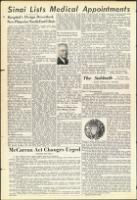
provide meals in conformity with Dr. Eusterman Given
Jewish tradition. There will also Appointment at Sinai
be a central kitchen and diet
kitchen. From all three; trays will
Dr. George B. Eusterman has
go to the patients' floors by been named chief of medicine
means of conveyor belts, insur- and director of education at
ing rapid arrival of the food for
Sinai Hospital.
delivery to the patients.
Since 1938, he
The 34-acre site permits at-
has been senior
tractive arrangement of the
cons ultant in
grounds and space for parking
medicine at the
140 cars,. It is ample, the archi-
Mayo Clinic, is
tects say, to provide for all fore-
Fa native of
seeable medical needs of the
Lewiston, Minn.
community.
He received the
degree of M.D.
The Medical Staff
from the Uni-
Sinai Hospital's board of trus-
versity of MM-
tees announces the following
nesota in 1908,
appointments to the Medical
and 'the same
staff: -
year joined the
Sidney L. Adelson, Sidney Adler, Louis
staff of the
Alper, Elliott B. Alpern, Raphael. Altman,
Howard B. Appeiman, Harry E. August, Dr. Eusterman Mayo Clinic as
Ira • Avrin, Arnold 'R. Axelrod, Morris E.
Bachman, Harry Balberor, Benjainin assistant in one of the sections
Barenholtz„ Morton Barnett, Moe Bau- in surgery, becoming' an asso-
mer, Abraham Becker, -Morris C. Beck-
Witt; Sydney E. Beigler, Max R. Beitman, ciate in 1912 and head of • a
Harry ' B. Bennett, Davis Benson, Theo- section in medicine in 1919.
dore I. Bargman, Allen Berlin, Robert
In addition to his work at the
H. Berman, Bernard Bernbaum, Samuel
S.' Bernstein, Frank B. Bickness, Leonard Mayo Clinic; Dr. Eusterman has
Birndorf, Floyd J. Bjork, Herbert J.'
Bloom, Maurice Bonin, Isadore ,Botvinek, been profesSor of medicine,
Benjamin Brand, Lionel Braun, Sylvan A. Mayo -Furidation, at his alma
Broadman, Nathan Brooks, Daniel Budson,
mater. During the " first World
John Butler.
Kenneth N. Campbell, Meyer 0. Cantor, War he was . a Captain in the
Lawrence A.' Cantow, Herman J. Carson,
Fred E. Caumartin, Henry -A. Chapnick, Medical Reserve Corps of the
Sidney • Charnas, Herman M. Chesluk, United States. Army,
and at
Laurence Qhroueh, -Herbert H. Cohen,
Lewis Cohen, Daniel E.Cohn, Paul J. present holds the rank of Ma-
Connolly, Leo J. Cron, Maurice Croll, jor, Medical ReSerVe Corps of
Joseph H. Curhan, Mark. Dale, Owen J. the Army (retired).
Deuby, William L. Deutsch, Reed 0.
Dingman, Benjamin W. ' Dovitz, George
He is the author of about 150
O. 'Downes, Victor Droock, Arthur Eck-
hous, Irving. I. Edgar, George B. Euster- miblished medical articles, a
man, Irving D. Fagin, Aaron A.- Farbman, book on the stomach and
David Feld, Martin Z. Feldstein, Meryl
M. Fenton, Joseph L. Fink, Morris B. denurn in collaboration with
Finkelstein. Leonard Fox, Morris Fox, Dr. D. C. BalfOur, the article
Alex S. Friedlander, Sidney Friedlander.
Laslo Galdonyi, H. Harvey Gass, Ed- on disorders of the alimentary
ward M. Gates, Harold W. Gehring, system in the Encyclopedia
Harold I. Ginsberg, Charles Gitlin, Walter
S. Glazer, Abe A. Goldman, Aubrey Britannica; and 'is an editor of
0Oldman, Perry Goldman, Abe S. Gold- the Year BOok of Medicine.
ointments.
Henry . Siegel, Jacob A. Sill, Emil Simon,
Robert A. Sobel, Raymond A. Sokolov,
Abraham B. Solomon, Milton L. Sorock,
Gerald• D.. Spero, Benjamin B. Stamen,
Edward Stein, Eugene Steinberger, Fred-
erick B. Steiner, Milton J. Steinhardt;
Louis D. Stern, Daniel M. Steifel Karl
Stillwater, Harry Stocker, - Lawrence L.
Stocker, H. Saul Sugar, Marcus Sugar-
man.
- Meyer Teitelbaum, Hayman , A. Vogel,
Max J. Wainger, Irving A. Warren, Lewis
C. Wassermann, Morris A. Wayne, A.
Allen Weisberg, Hairy Weisberg, Jacob
Weisberg, William W. Weisberg, Bernard
- Weston, Joseph L. Whelan, Morton J.
Wiener, Irvin A. Winner, Lawrence C.
Winnick, Morris Witus, Herschel' S. Zack-
'heim.
-
stein, Herbert L. Goodman, Samuel B.
Goss, Abraham H. Grant, Lewis, Green,
John N. Grekin, Julius J. Greenberg,
Sol C.- Grossman, Symour Gudes, Ben-
jamin R. Gutow, Meyer. A. Gutterman,
Benj H. Haidostian, Albert C. Hamburger;
Ely W. - Harelik, Louis .M. Harley, I.
Jerome Hauser, Maurice J. Hauser, Manes
Hecht, Loins E. Heideman, Jack . H.
Hertzler,- Edward J. Hill, Gerald Hill,
Sidney J.. Ifilleriberg, Akiba J. Himmel-
hoch, Alexander H. Hirschfeld, John B.
Horowitz, Barney B. Israel.
Louis Jaffe, Benjamin Juliar, Herbert I.
Kallet, Herman Kanter, Saul Karch, Jack
M. Kaufman, Louis L. Kazdan, Joesph
H. Kerzman, George Kinsley, Sander .P.
Klein, Shmarya Kleinman, David Kliger,
Joseph 0. • Kopel, Dennis D. •Koran,
Charles B. 'Lakoff, Mort?n Lazar, Rudolf
Leiser, Simon'E. 'Lerman, David M. Levin,
Herbert G. Levin, Michael M. Levin,
Samuel J. Levin, Sydney S. Levine,• Ed-
ward Levitt, Nathan. Levitt, David B.
LeVy, Sal M. Lewis, Leonard S. Linkner,
Ezra Lipkin, Louis S. Lipschutz, Adolf
W. Lowe, Jack N. Mandiberg, Jerome
Mark, Joseph M. Markel, Ben Marks,
Morris H. Marks Peter A. Martin,, Thomas
Marwil, Harry E. - Meisner, Hyman S.
Mellen, Harry Z. Mellins, Ruben Meyer,
Maurice P. Meyers, Sidney S. Meyers, Sol
G. Meyers, Morris J. Mintz, Coleman
Mopper, Selma Moss, John D. Mossman.
Samuel J. Nichamin, Katheryn O'Con-
nor, Joseph M. Oppenheim, Leo Orecklin,
Girardin O'Sullivan, Benjamin R. Parker,
Jack Pearlman, Leslie Pensler, Philip S.
Peven, Chester Phillipson, .Max J. Pier-
son, . Hermann Pinkus, Harold Pliskow,
Harold M. Podolsky, John J. Pollack,
Irving P6sner, Samuel G. Reisman,
March of Dimes Gets
Into Motion Today
"You Can Help, Too!"
Under . this slogan the 1953
March of Dimes will get under
way in . Wayne County and
throughout the United, States on
Jan. 2.
We look to every citizen to
support this hu manit a.r i a n
work," said William R. Bernard,
Wayne County campaign chair-
man. "Little did 'we 'know last
year that 1952 would record the
worst polio epidemic of all time.
Here in Wayne County, since last
Jan. 1, 1,102 new cases 'of polio-
myelitis 'have been recorded.
Two out of every 'three were
severly paralyzed or needed an
iron lung—it• was a record-
smashing year both in the num-
ber of cases and severity as
McCarran Act Changes Uiged
Continued from Page 1
1. The national origins quota system should be abolished.
2. There should be a unified quota system, which• would allocate. visas 'without regard to
national origin, race, creed, or color.
3. The maximum annual quota immigration should be one-sixth of one percent of the
poptilation of the United States, as determined by the most recent census. Under the 1950
census, quota immigration would be open to 251;162 immigrants annually, instead of the 154,-
•
657 now authorized.
(
4. All immigration. and . naturalization functions - now in the Departinent of State and
the Department of Justice should be consolidated into a new agency, to be headed 'by a corn--
mission on immigration and naturalization whose members should be appointed by the Presi-
dent and confirmed, by the Senate.
5. Maximum annual quota of visas should be distributed as determined by proposed
commission on immigration and naturalization on the basis of the following categories: Right
of asylum, reunion of families, needs in United •States, special needs . of free world and gen-
eral immizration.
6. For next three years,- within the ma,ximurn annual quota, there should be a Statu,
tory priority implementing the right of •asylum for the admission annually of 100,000 refugees,
expellees, escapees and remaining displaced persons.
7. The alloCation of visas within . ma,ximum annual quota should be determined once
every three years by proposed commission on immigration and naturalization, subject to re-
view 'by the President andCongress.
ns should be exercised under the commission's supervision and
8. Enforceent
Enforcement 'functio
contrel by an administrator. Quasi-judicial functions should be exercised under commission's
superinsion by statutory board of immigration and visa appeals.
9. Same officials shoUld not be permitted to exercise both enforcement and judicial
functions. AlienS should be accorded fair hearings and • procedure in exclusion and deporta-
tion. Cases. .:-.greufi. -ificKi 3 sk..1.., ;1) 1 1 bVt;Stiittlit
ages Of 18 and 50 and must pas::
a physical examination.
The courses will be, given , at
the Red Cross and at Sinai Hos-
pital. Anyone, interested in
unteering is invited to call-
BRoadway 3-3000,- ExtenSion 338,.
10 a.m. to' 4 p.m., -Monday.
through Friday. There is no fee;
for the courses. .•
Future of North End Clinic
With the dedication of Sinai'
Hospital, a new era is abOut to
begin' in the operation of North
End Clinic, Detroit's only out-,
patient clinic now. administered
separately frorn any hospital.
Although the plan will prob-
ably not be carried out until _
July, the agreement between the
Sinai Hos-
Board of Truatees.
pital . and the Board
oard of the
Clinic calls for the merger of
the two agencies, with the clinic
becoming the outpatient depart-
ment of the hospital.
After the ha-pital takes res-
ponsibility for operatiorf of the
clinic„ all medical , services will
be perfomed by members of the
hospital staff. The clinic offers
medical, diagnostic, and' dental
services to all unable to afford
private care, and its staff. is
open to, all qualified physi•
cians, regardless of race or creed.
Women's Guild Seeks Volunteers
As Sinai Hospital approaches
its day ,of dedication, the Wom-
en's Guild of the hospital has
issued xa call for volunteers --
Grey Ladies and Nurses' Aides—
to help bring the hospital's per-
sonnel to full force in time for
its opening.
Mrs. Hyman C. Broder, guild
president, has announced that a
training course for Grey _Ladies
will begin Jan. 26, and will idst
for two weeks. Grey Ladies per-
form auxiliary services for hos-
pital patients, such as readin,g
aloud, writing letters. Applicants
for this course ,rinist be between
the ages of 21 and 5Q, and must,
be able to pass a physical exam-
ination.
Nurses Aides will be trained
in a six-week course beginning
Feb. 16. Volunteers in this capa-
city will perform vitally-needed
services, assisting the nurses. 16 THE JEWISH NEWS
Friday,, January 2, 1953
Applicants must be between the
.
—
The Sitb bat h
Its Meaning
for Modern Man
By DR. ABRAHAM J. HESCHEL
Copyright' 1951 by Abraham J. Heschel. Published by Farrar, Straus & Young,
Inc., New York, in cooperation with the United Synagogue of - America. Repro-
duced by. American Jewish Press, News and Feature Service of the American
Association of English-Jewish Newspapers in conjunction with the National Sab-
bath Observance Effort as a public service of the United Synagogue of America.
Port V (Conclusion) ,
EPILOGUE TO SANCTIFY TIME
Pagans project their consciousness of God into a visible image
or associate Him with a phenomenon in nature, with a thing of
space.- In the Ten Commandments, .phe Creator of the universe
identifies Himself by an event in history, by an event in time,
the liberation of the people from Egypt, and proclalins: "Thou
shalt not Make unto 'thee any graven image or any likeness of
any thing that 'is in heaven above, or that is in the earth; or that
is in the water under the earth."
"Every important cult-center of, Egypt asserted its priinacy
by the dogma that it was the site of creation." In contrast, the
book of Genesis speaks of the days rather than Of the. site of cre-
ation. In the myths there 'is no reference to the time of creation,
whereas the Bible speaks of the creation of space in Wile.
Time is man's greatest challenge. We all take part in a pro-
cession through its realm which never comes to an end but are
unable to gain a foothold in it. Its reality is apart and away from
us. Space is exposed to our will;
we may shape and change the
things in space as we please.
Time, however, is beyond: our
reach, beyond our power.. It is
both near and far, intrinsic to
all experience and transcending
all, experience. It belongs exclu-
sively to God.
Time is the process of creation,
and things of space are results
of creation. When looking at
space we see, the products of
creation; when intuiting time we
hear the process of creation.
Things of space exhibit a deceptive independence. They show off
a veneer of limited permanence. Things created conceal the Cre-
atOr. It is the dimension of time wherein man meets God, wherein
man becomes aware that every instant is an act of creation,
Beginning, opening up new roads for ultimate realizations. Time
is the presence of God in the world of space, and it: is within time
that we are able to sense the unity of all beings.
A world without time would be a world without God, a world
existing .in and by itself, without renewal; without a Creator. A
world without time would be a world detached from God, a thing
in itself, reality withciut realization. A world in time is a' world
going on, through God; realization • of an infinite design; not a
thing in itself but a thing for God:
To witness the perpetual marvel of the world's coming into
being is to sense the presence of the Giver in the given, to realize
that the source of time is eternity, that the secret of being is the
eternal within time.
We cannot solve the problem of time through the conquest of
space, through either pyramids or frame. We can only solVe -the
problem of time through sanctification of time. To men alone
time is elusive; to men with God time is eternity in disguise.
Creation is the language of God, Time is His song, and things
of space the cosonants in the song. To sanctify time is tOsing the
vowels in unison with Hirii. ,
- This is the task of men: to conquer space and sanctify time.
We must conquer space in 'Order to sanctify time. All Ncieek
long we 'are called upon to sanctify life through employing things
of space the consonants in the song. To sanctify time is to sing the
that is in the heart of time. Even when the soul is seared, even
when no prayer can come out of our tightened throats, the clean,
silent rest of the Sabbath leads us to a realm of. endless peace,
or to the beginning of an awareness of what eternity :means.
There are few ideas in the world -of thought which contain so
much'spiritual power as the idea of the Sabbath. Ecms hence, when
of many. of our cherished theories only shreds will remain, that
cosmic tapestry will continue' to shine.
Muutr. utters a day.
.